
COMMENTS ON THE ART MARKET
And just like that… it’s April.
March flew by. And while I’m not exactly loving how quickly time seems to move these days, I’ll let it slide since it’s brought us right to the front steps of spring.
We have a lot to look forward to over the next couple of months…
First up, we’ll be heading to the Pennsylvania Antiques Show, a new event held at the Valley Forge Casino Resort (formerly the Philadelphia Show at the Philadelphia Museum), taking place April 23–26. We are especially excited to be bringing a strong selection of Pennsylvania-connected artists, including Daniel Ridgway Knight, Jane Piper, Martha Walter, and more.
My alma mater, the University of Rhode Island (Go Rhody!), has given me the opportunity to serve as the juror for the opening of its new arts school. The 2026 Juried Student Art Exhibit showcases outstanding work by URI students across a wide range of media, including painting, photography, sculpture, digital work, and film.
The exhibition will be on view April 6–30 in Lippitt Hall, with a reception and awards ceremony on April 22 from 4–7 PM. It’s an honor to be invited back in this capacity and to help spotlight the next generation of artists.
Over the past month, we were also pleased to place a number of exceptional works into new collections. We extend our congratulations and thanks to both the artists and collectors involved. Contemporary works by Gail Descouers, Stuart Dunkel, Timothy W. Jahn, Carrie Goller, Lucia Heffernan, and James Neil Hollingsworth all found new homes, along with notable historical examples by Antoine Blanchard and Édouard Léon Cortès. It is always rewarding to see these works resonate so strongly and continue their journeys in new collections.
One final note I want to share is that, as we continue to expand the inventory in our historical gallery, we remain active in the private market.
If you are considering parting with a work that may align with our program, we would be happy to take a look. You can send images and details to [email protected] — every submission will be personally reviewed and handled with care.
And to those who are celebrating, we wish you a very happy Passover and a joyful Easter.
-Alyssa
UPCOMING GALLERY EXHIBITION
ARC SELECT 2026: We Walk This Road Alone
In May, we’ll be hosting our next ARC Select Exhibition, one of our favorite programs each year. In partnership with the Art Renewal Center, we invite a select group of artists from their International ARC Salon to exhibit with us, offering both emerging and established contemporary realists a platform within the gallery.
This year’s exhibition, We Walk This Road Alone, explores the many sides of solitude—quiet, reflective, restorative, and at times, transformative. In a world that rarely slows down, these works offer a moment to pause and consider the value of time spent alone—not as isolation, but as something necessary and deeply human.
The exhibition will feature works by Adam Bauder, Bertrand Martin, Chauncey Homer, Lisa Falkenstern, Mark Harrison, Nanci France-Vaz, Paula Holtzclaw, and Sebastian Mesa.
Join us for the opening reception on May 15th from 4–8 PM, with an extended viewing on May 16th from 12–5 PM. The exhibition will remain on view through June 19th, 2026.
THE ECONOMIC CANVAS
I honestly don’t even know where to start… when I wrote last month’s market review, it was Saturday morning, February 28th – the morning after our initial attacks on Iran. I feel like we’ve been inundated with a swirling news cycle for weeks; to put it mildly, it’s overwhelming. What is clear, though, is that the markets are not responding positively to anything that is going on… volatility has surged alongside oil prices, and the path forward to resolving the current geopolitical tensions is unclear.
For too long now, markets have resisted anything that resembles a “correction” even as we have been wading through less-than-positive news for months. But March handed us a reality check… the Dow tumbled more than 5%, the Nasdaq slipped by 4.8%, and the S&P landed between the two with a 5.1% decline. Sure, it wasn’t a crash, but we still have a long road ahead given the way things are looking these days.
I usually follow that up with currency fluctuations but the prevailing market narrative is surrounding oil futures. Within days of military action, Crude surged well over $100… things seemed to level off by the end of the month in the $90-100 range, but in a tightening physical market with supply concerns, that number continues to creep up (as I’m writing this today, April 2nd, Crude again jumped another 10%). Since the start of March, it’s up nearly 70%! It’s worth noting here that higher energy prices increase the probability of sustained inflationary pressures, which we have already been fighting… this can mean elevated interest rates and tighter financial conditions, which are speed bumps for market growth.
Currency fluctuations amplified the stress… the US Dollar strengthened relative to both the Pound and Euro, as well as the Yen; each by between 2-3%. A firmer US Dollar can effectively tighten global liquidity, which adds another drag on the markets as they deal with pressure from oil prices. That said, strangely, gold futures moved in ways that were counterintuitive… perhaps the market had already priced in some of these elevated geo-political tensions. Usually, as instability grows, gold prices go up… but gold was already at a lofty level, and it fell by more than 11% in March.
Crypto was a mixed bag, so it’s hard to say exactly what drove one versus the others – perhaps it’s no more complicated than selective risk taking or speculation. Bitcoin finished roughly flat, with a slight gain of less than 2% - pretty unremarkable for the crypto-arena. Ethereum had a decent showing as it gained about 9% on the month, while Litecoin turned in a nearly even 0.8% loss.
According to some analysis, the mix of rising inflationary pressures alongside weakening growth can be an early warning of stagflation – that would be very bad, to say it plainly. Looking ahead, the real question is whether oil prices rebound or if they persist at elevated levels, and how central banks respond to inflation risks. Specifically, much of this will depend on how the ongoing conflict with Iran shakes out. Anyone’s guess is as good as mine at this point.
-Lance
HISTORICAL ARTIST SPOTLIGHT
James Edward Buttersworth
Few artists captured the drama and elegance of 19th- century sailing quite like James Edward Buttersworth, one of the most celebrated marine painters working in America during the second half of the century. Born in England in 1817, Buttersworth was the son and student of noted British marine painter Thomas Buttersworth, from whom he inherited both a deep understanding of naval architecture and a remarkable ability to convey movement on the water.
By the time Buttersworth began his career, England’s great age of naval warfare had largely passed. Marine painters increasingly turned their attention from battles to commercial shipping and competitive yachting, subjects that would define Buttersworth’s work for the rest of his life. Seeking broader opportunities, he emigrated to the United States in 1847. Shortly after arriving, he was introduced to publisher Nathaniel Currier, who commissioned him to create works for the firm Currier & Ives—an association that helped establish his reputation among American collectors.
Settling in West Hoboken, New Jersey, with a studio in Brooklyn, Buttersworth quickly became one of the leading interpreters of America’s growing sailing culture. The mid-19th century saw the rise of organized yacht racing and the formation of elite clubs such as the New York Yacht Club. These regattas provided dramatic subject matter: sleek racing yachts cutting through choppy waters, dramatic skies overhead, and spectators watching from accompanying vessels.
Long Island’s coastline, particularly the waters off Southampton, became one of Buttersworth’s favorite settings. In works such as Yachts Racing off Southampton, Long Island, he captures the excitement of competitive sailing with extraordinary technical accuracy. His paintings are prized for their precise rendering of rigging, hull design, and sail configuration, reflecting a painter who clearly understood the mechanics of the vessels he depicted. At the same time, his compositions convey speed and atmosphere — the billowing sails, shifting light, and rolling Atlantic waters all contributing to the sense of a race unfolding before the viewer.
The featured work, Yachts Racing off Southampton, Long Island, painted in oil on panel and measuring 7 × 15 inches (15 × 23 inches framed), exemplifies Buttersworth’s ability to combine intimacy of scale with expansive maritime drama. The elongated format mirrors the sea’s horizontal sweep and allows the racing vessels to stretch across the composition, their sails filled with wind as they compete along the Long Island shoreline. The painting is signed and inscribed on the reverse, and notably comes from the John Stobart Collection, linking it to another renowned painter of maritime history.
Today, Buttersworth is recognized as one of the most important marine painters working in America during the 19th century. His works are held in numerous institutional collections, including the U.S. Naval Academy Museum, the Newark Museum, the Museum of the City of New York, the Virginia Museum of Fine Arts, and the Peabody Essex Museum in Salem. Through paintings like Yachts Racing off Southampton, he preserved the energy and elegance of an era when sail still ruled the sea—and when the waters of Long Island served as a stage for some of the most exciting races of the age.
CONTEMPORARY ARTIST SPOTLIGHT
Leo Mancini-Hresko
For many painters, the path to becoming an artist unfolds gradually. For Leo Mancini-Hresko, it began with a curiosity about how the world could be translated into paint, an interest that eventually carried him across the Atlantic and into the tradition of classical European painting.
Born in Boston in 1981, Mancini-Hresko began his formal training at the Art Institute of Boston at Lesley University in 1999. While studying there, he traveled to Florence, Italy, for a semester abroad, a trip that would ultimately shape the trajectory of his career. During that time, he discovered the Florence Academy of Art, a school dedicated to the rigorous traditions of drawing and painting from life. He enrolled in 2001 and remained there for the next decade as both student and teacher.
At the academy, students immerse themselves in the methods of theOld Masters, working from plaster casts, studying anatomy, and painting directly from observation. Mancini-Hresko thrived in this environment. After graduating in 2005, he was invited to remain on the faculty, eventually becoming director of the school’s drawing program for sculptors while also teaching plein-air painting and artist materials.
Living in Florence for more than a decade allowed him to absorb the city’s artistic heritage while developing a deep respect for traditional craft. The experience left a lasting mark on his work. His paintings retain the discipline of classical training, but they are far from academic exercises. They are vibrant explorations of light, atmosphere, and the tactile qualities of paint itself.
In 2011, after years of teaching and working in Italy, Mancini-Hresko returned to Massachusetts and established a studio in a historic mill building in Waltham. From there, he continues to paint, travel, and teach, while exhibiting internationally in the United States, Europe, and beyond.
What distinguishes Mancini-Hresko’s work is his commitment to what he calls “observational painting.” Whether painting landscapes en plein air or carefully constructed still lifes in the studio, his focus is on translating a moment of experience into paint. The process itself, including brushwork, layering, and the contrast between rough and smooth surfaces, becomes an essential part of the finished work.
As the artist explains:
“A beautiful image must be considered in composition, color, drawing and execution. However, a painting should be painted. You must see the process, the brushstrokes, the glazes and impastos. No two inches of any picture should be treated the same.”
That philosophy is evident throughout his work. His landscapes capture fleeting light across coastlines, marshes, and villages, while his still lifes reveal an equally sensitive approach to color and texture. In both, the viewer can sense the painter’s presence through the deliberate placement of each mark and the subtle balance between structure and spontaneity.
Today, Mancini-Hresko’s paintings can be found in private collections around the world, and his reputation continues to grow among collectors who value both technical mastery and the enduring appeal of representational painting.
For collectors, his work offers a compelling combination. He is a painter deeply grounded in classical technique yet unmistakably contemporary in his approach to light, surface, and atmosphere.
As interest in traditional realism continues to expand, Mancini-Hresko’s paintings stand as thoughtful reminders of what first drew many of us to painting. They capture the ability to pause a fleeting moment and transform it into something lasting.
THE ART MARKET
At Auction
Sotheby’s London Modern & Contemporary Evening Sale
On Wednesday, March 4th, Sotheby’s kicked off a series of modern art sales at their location in London with their Modern & Contemporary Art evening auction. The evening featured fifty-three lots, mainly showcasing late nineteenth- and twentieth-century European and North American painting and sculpture.
Of course, the expected star of the show was Francis Bacon’s 1972 self-portrait. This was one of nine self-portraits Bacon created that year, and marks the early years of the artist’s morose, introspective turn following the death of his partner George Dyer. According to Martin Harrison, the editor of Bacon’s catalogue raisonné, this self-portrait shows a strong influence from the pastels of Edgar Degas, as seen in the blue and pink shades accenting the artist’s face. But despite these brighter colors, the composition hints at Bacon’s fixation with death and decay. Sotheby’s specialists write that the self-portrait gives us “a face in the act of becoming undone, yet held, paradoxically by an intelligence of paint so controlled that the very brutality becomes a kind of order.”
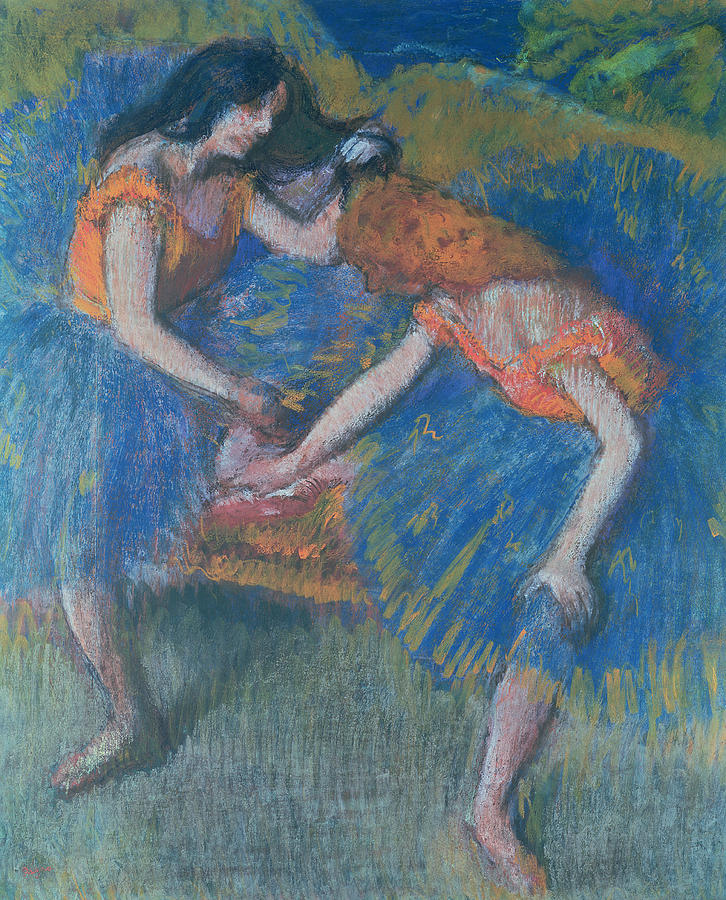
The painting has had only two owners since the artist gave it away in 1983. The collector who consigned it to Sotheby’s had previously bought it at that same location in 1994, where it sold for £364.5K w/p. With the market for Bacon’s work becoming far more robust in the last thirty years, it wasn’t terribly surprising that Sotheby’s specialists gave the Bacon self-portrait an estimate range of £8 million to £12 million. Bidders on Wednesday fought over the painting, driving the final hammer price beyond the high estimate, landing at £13.5 million (or £16.04 million / $21.4 million w/p).
Along with the Bacon self-portrait, Concetto spaziale by Lucio Fontana was the only other work in the sale with a high estimate above £10 million. Created in 1960, the work is an example of Fontana’s experimentations with altering the canvas itself as a form of artistic expression. A canvas painted a single color disrupted by slashes is probably the most recognizable way Fontana chose to mess with the support. However, here, he has created a series of holes highlighted by oil paint applied in a thick impasto. While the linear slash was a much more recent development in Fontana’s work, punching holes in the canvas was something he had been doing since 1948. Both the slash and the holes, however, are part of the same experimentation with artistic media. As Fontana said, “I have not attempted to decorate a surface, but on the contrary; I have tried to break its dimensional limitations.” Concetto spaziale, however, fell just short of its £8.5 million low estimate, selling for £8.1 million (or £9.8 million / $13.1 million w/p).

And finally, it wouldn’t quite be a modern art sale without a major Impressionist. Claude Monet created Maison de jardinier in 1884 during a trip to Bordighera, a small town on the Mediterranean coast in Liguria in northern Italy. He had planned to stay for three weeks, but ended up staying for three months. In a letter to his wife, Alice, Monet said he found it very difficult to capture the lush, varied vegetation surrounding the town, including wildflowers, citrus trees, and palms. The painting offered at Sotheby’s features houses among a grove of orange and lemon trees. The painting’s first owner was Monet’s friend and artistic contemporary John Singer Sargent, who wrote to Monet when he first acquired it, receiving it in exchange for an Alexandre Falguière painting. The painting last crossed the block in 2007, where it sold at Sotheby’s for £4.05 million w/p. It fared somewhat better this time around, selling slightly above the low estimate at £6.7 million (or £8.22 million / $10.9 million w/p).
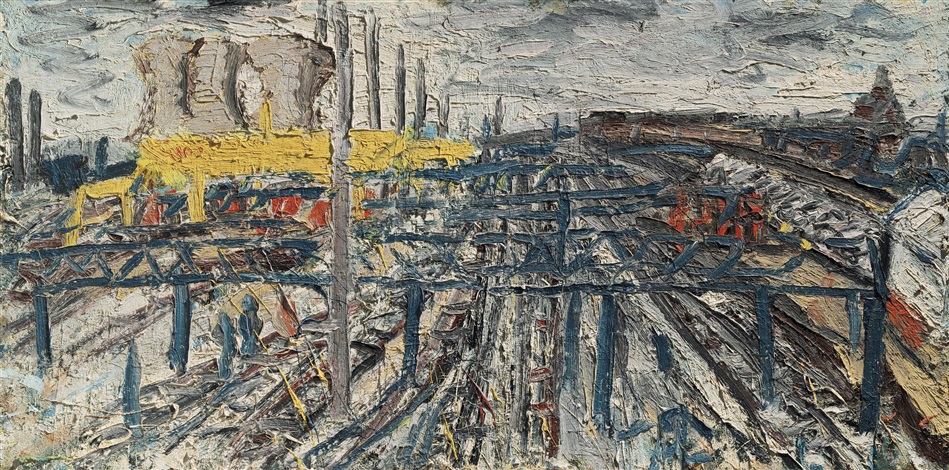
While a good portion of Wednesday’s lots sold above their estimates, only one lot was a true surprise. Children’s Swimming pool, 11 o’clock Saturday morning, August by the post-war British artist Leon Kossoff is considered one of the artist’s most iconic works. It was created in 1969 as part of a series Kossoff executed between 1969 and 1972. The subject is a public swimming pool in the northwest London neighborhood of Willesden. With a high estimate of £800K, the Kossoff achieved more than five times what Sotheby’s specialists expected. With a hammer price of £4.2 million (or £5.2 million / $6.9 million w/p), Children’s Swimming pool set the new auction record for the artist, blowing away the previous titleholder, Willesden Junction – Autumn Afternoon, which sold at Christie’s in 2018 for £1.38 million w/p.
In some regards, the evening sale did rather well. With eighteen of the fifty-three available lots selling within their estimates, Sotheby’s specialists walked away with a 34% accuracy rate. With another twenty-two lots (42%) selling below and eleven lots (21%) above, the sale overall achieved a 96% sell-through rate. Against a total pre-sale minimum estimate of £97.15 million, the available lots brought in £102.5 million, or £130.9 million / $174.9 million w/p.
Christie’s London Modern British & Irish Art
On Wednesday, March 18th, Christie’s London hosted their modern British & Irish Art evening sale, featuring twenty-five lots ranging from landscapes by Lowry to sculptures by Moore.
The undisputed star of the sale, however, was the Frank Auerbach painting Christmas Tree at Mornington Crescent. Though born in Germany, Auerbach was primarily a London painter, with this painting being a prime example of how he used the city as a subject. Mornington Crescent is a street in Camden Town, just around the corner from Albert Street, where Auerbach had his studio. Though the painting uses the earth tones typical of Auerbach’s work, it also creates a patchwork of blues, greens, and purples to represent the neighborhood, dotted with Georgian buildings, 1930s factories, and other structures from various eras. Auerbach finished the painting in 2005 and sold it through Marlborough Fine Art. Christie’s experts assigned the painting an estimate range of £1.5 million to £2 million. The hammer came down just barely within an estimate at £1.6 million (or £2 million / $2.67 million w/p).
Next up was the large bronze sculpture Back to Venice by Lynn Chadwick. Created in 1988 and measuring over nine feet tall, Chadwick created the sculpture for the British Pavilion at the Venice Biennale. Chadwick initially exhibited at the biennale in 1952, where the jarring, angular designs of not only Chadwick but also of other post-war British sculptors like Reg Butler and Eduardo Paolozzi led art critic Herbert Read to name these artists “the Geometry of Fear”. Though the eight artists featured in the pavilion worked in widely different styles, Read recognized that these artists created work that appeared battered and unpolished, expressing the anxieties and fears of young people in a post-war world. Thirty-six years later, Chadwick was invited back to Venice to create something for the gardens just outside the British Pavilion. Christie’s specialists refer to Back to Venice as “one of Chadwick‘s most recognizable and resolved achievements.” The sculpture has been in the same collection since 1998 and has not been exhibited since 2004. Christie’s specialists predicted it would sell for between £1 million and £1.5 million. The final bid landed nicely in between, at £1.3 million (or £1.64 million / $2.18 million w/p).
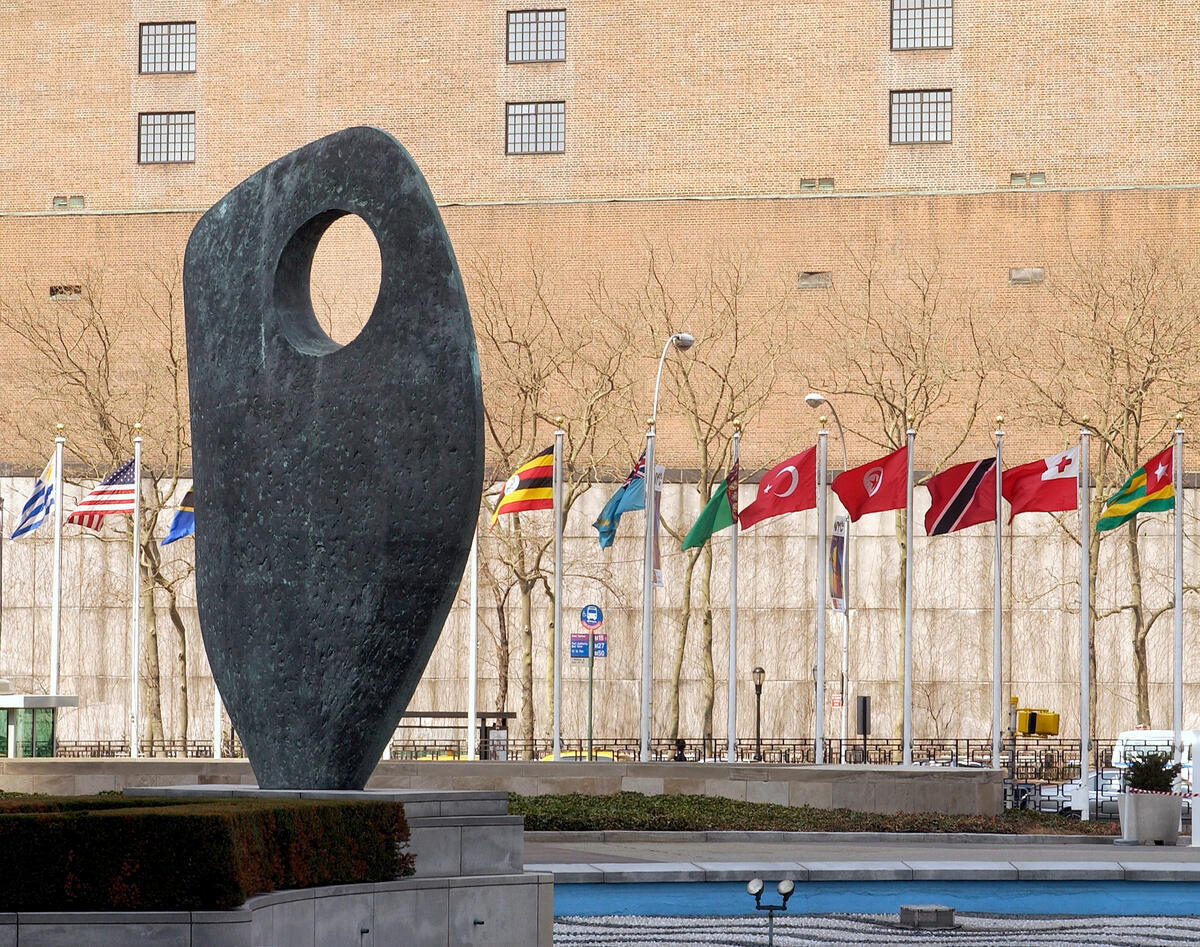
And in third place was an elegant sculpture by Dame Barbara Hepworth. Hepworth created Curved Form in 1960. The previous year, she had been the subject of several exhibitions, most notably in New York and at the São Paulo Biennial. Following this, she decided to turn away from bronze and more towards hand-carved wood sculpture. The example offered at Christie’s is made from a piece of walnut over eighteen inches high, with some sides treated with liming to alter the color. The grain of the wood becomes just as much part of the artwork as the shape. The form of the sculpture, along with the “delicately shaped concave divot”, makes the work very similar to some of the later versions of her Single Form sculpture series, one of which sits outside the United Nations headquarters in New York. Against a low estimate of £750K, Hepworth’s Curved Form achieved a final hammer price of £800K or (or £1.02 million / $1.35 million w/p).
Overall, the evening sale did rather well, with thirteen of the twenty-five available lots selling within their estimates, giving Christie’s specialists a 52% accuracy rate. With nine lots selling below estimate (36%), two selling above estimate (8%), and only one lot going unsold the entire night, the auction achieved a 96% sell-through rate. Against a total low estimate of £8.42 million, the evening sale reached a total hammer price of £9.2 million, or about £11.64 million with fees added ($15.52 million).
Christie’s Paris Veil-Picard Collection
On Wednesday, March 25th, Christie’s Paris offered a collection of Old Master works from the Veil-Picard family. The Veil-Picard family is a prominent French Jewish family. They started as bankers but moved into business in the late nineteenth century when they bought the absinthe producer Pernod. Much of the family art collection was assembled by Arthur Georges Veil-Picard, who preferred eighteenth-century French art. Among the thirty available lots at Christie’s on Wednesday were works by some of the biggest names in French portraiture, Rococo, and Baroque art, such as Antoine Watteau and Élisabeth Vigée Le Brun.
The expected star of the sale, the only lot with a minimum estimate over €1 million, was the Jean-Honoré Fragonard painting L’Heureuse Famille, or The Happy Family. Veil-Picard acquired the work around 1906 and remained with the family until the family’s art collection was confiscated during the Nazi occupation of northern France. The present work, also known as Young Couple Contemplating a Sleeping Child, The Return Home, and The Reconciliation, dates to the 1770s, with two other versions in private collections. The artist began to paint other similar scenes with maternal themes around this time. Christie’s specialists indicate that the painting may be based on a popular story called “Miss Sarah”, first published in a book by the Marquis de Saint-Lambert in 1765. The story goes that a traveler stops by a farmhouse and enjoys the hospitality of the farmer, his wife, and several children. After spending some time with them, it is revealed that the wife is actually an English aristocrat who fell in love with the farmer and lives as his wife. However, because of social expectations, she feels that she cannot marry him. The tale seems almost like a satire on the absurdity of social norms, feeling obligated to violate some yet hold others sacred. The Fragonard was given an estimate range of €1.5 million to €2.5 million, with the hammer coming down on the higher side at €2.3 million (or €2.86 million / $3.32 million w/p). This one painting accounted for 30% of the sale’s total.
Next up was a pair of works by Hubert Robert, an early French Romantic painter. The paintings were commissioned by their subject, Marie-Thérèse Geoffrin, the host of one of the great Paris salons in the eighteenth century. Her house on the rue Saint-Honoré became one of the most esteemed gathering places for philosophers, writers, and artists, including Montesquieu, Rousseau, Voltaire, Diderot, Rameau, and Bouchardon. In one painting, we see her in her chambers with an artist presenting a portrait. It is not certain whether the painting depicts someone else or whether this artist was commissioned to create a portrait of Madame Geoffrin as her younger self. We also do not know if Robert meant to represent himself as the artist in the painting. In the other painting, the subject takes her breakfast as a serving man stands behind her. The label at the bottom of the frame explains that the servant is reading to her aloud while she eats. Arthur Veil-Picard acquired the pair in 1922, and after the Nazis confiscated the family’s collection, it was transferred to the lieu before being placed in the infamous salt mines in Altaussee, Austria. This mine and several others were uncovered by the Allied Monuments, Fine Arts, and Archives program, popularly known as the Monuments Men. The Robert paintings are some of the last works Madame Geoffrin commissioned, the artist finishing them in 1771, several years before her death. The pair were expected to do very well, with Christie’s anticipating they would sell for at least €800K. The final bidsurpassed both the amount and the €1.2 million high estimate, landing at €1.95 million (or €2.44 million / $2.83 million w/p).
Rounding things out with another work by Fragonard, The Little Coquette. Much of the artist’s popular work fits nicely within the realm of Rococo painting, featuring great ornamentation, soft colors, and a somewhat overbearing sensuality. However, this work is a rather small portrait, measuring only 12 ¾ x 9 1⁄3 inches. It’s an intimate look at a young girl, done in an incredibly painterly way. Christie’s specialists refer to the loose brushwork as an example of the “pictorial energy, so characteristic of Fragonard”. The work was given an estimate range of €400K to €600K, given the rarity of its style and its excellent provenance. The portrait seemed more popular than expected, with bidders driving the final price beyond its high estimate to €800K (or €1 million / $1.18 million w/p).
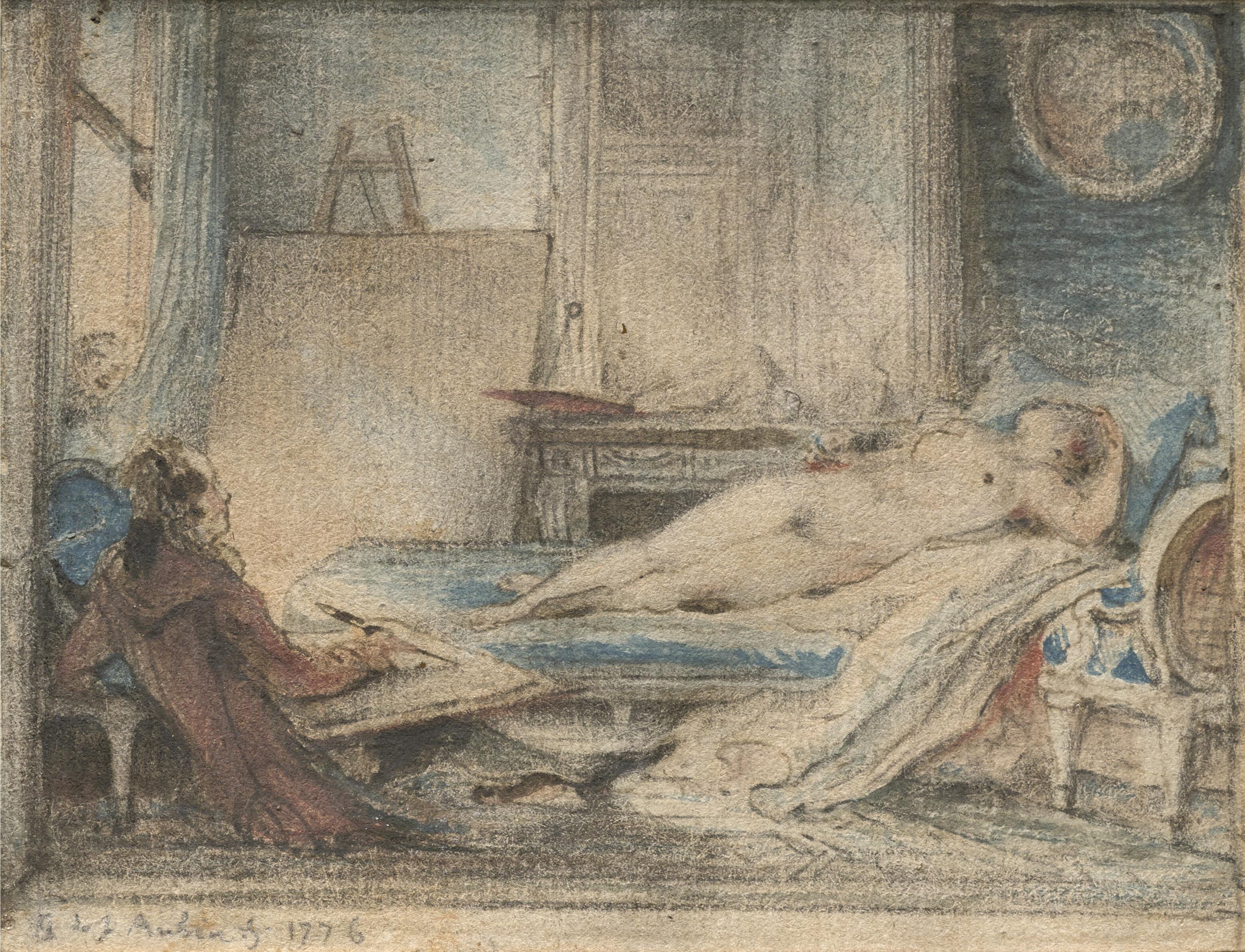
For a relatively small sale, there were many surprises. Five lots, 16.6% of the works available, sold for more than double their high estimates. One of them being a small 1776 pencil and chalk drawing by Gabriel de Saint-Aubin, which was expected to sell for no more than €200K yet shot up to €490K (or €622.3K / $721K w/p). Additionally, there were two paintings by the nineteenth-century Italian artist Giovanni Boldini, one of which was expected to sell for between €50K and €80K, but sold for €180K (or €228.6K / $264.8K w/p).
.jpg?mode=max)
Of the thirty available lots, ten sold within their estimates, giving Christie’s specialists a 33% accuracy rate. Three lots (10%) sold below estimate, and thirteen lots (43%) sold above estimate. With four lots going unsold, the sale achieved an 87% sell-through rate. Before the auction, Christie’s placed the total minimum estimate at €4.8 million. With the number of lots selling above their estimates, some exponentially so, the sale not only did very well, but it exceeded its €7.4 million high estimate. The total hammer ended up at €7.5 million, or €9.4 million w/p.
Beyond the Frame
Exhibitions, discoveries, and cultural commentary
Lost Rembrandt Receives Attribution
A painting initially dismissed as a copy has officially been confirmed as an original by the Dutch Golden Age master Rembrandt van Rijn.
Vision of Zechariah in the Temple shows a story from the New Testament, specifically the first chapter of the Gospel according to Luke. The painting’s main figure is the priest Zechariah, who, while performing his duties in the temple, receives a vision from the Archangel Gabriel. The angel announces that despite his and his wife’s advanced age, they will have a son who will “make ready for the Lord a people prepared.” Zechariah’s son became John the Baptist, who, as the angel described, became a forerunner to Jesus.
In the painting, we see Zachariah in his priestly garments poring over a text. The painting captures the moment he is disturbed from his duties by a golden glow emanating from the upper right corner. Rembrandt’s choice to keep the angel out of view is not only an opportunity for the artist to play with light, but it also shows off his mastery of drama even as a young artist.
In 1969, Vision of Zechariah in the Temple was examined by Rembrandt scholar Horst Gerson. He dismissed the painting as a creation of Rembrandt’s workshop, a copy of an original work thought to be lost. Some theorized it may have been created by one of Rembrandt’s contemporaries, such as Jan Lievens or Salomon Koninck. The painting has been in the same private collection since 1961, and has gone unexamined for many decades. However, this changed two years ago, when scholars associated with the Rijksmuseum’s research project Operation Night Watch were permitted access to the painting.
Jonathan Bikker, the Rijksmuseum’s curator of seventeenth-century Dutch paintings, claims that Gerson’s dismissal of the painting stems from his not viewing the work in person, relying instead on low-resolution images. A more thorough analysis of the work reveals that the paint matches the pigments used by Rembrandt in his early career. That data, along with an analysis of the signature and the wooden panel, has allowed researchers to determine that Rembrandt likely painted the work in 1633, when the artist was 27 years old. The subject is also consistent with the artist’s early work, when he frequently used biblical subjects to hone his storytelling skills.
The owners have decided to loan the painting to the Rijksmuseum for a long-term display, offering visitors a rare opportunity to view this newly authenticated Rembrandt starting Wednesday, March 4th.
Supreme Court Ends AI Art Legal Battle
The United States Supreme Court has refused to hear a computer scientist’s legal case, meaning that an artificial intelligence program he created cannot be credited as the author of a copyrighted artwork.
Several years ago, I wrote about Stephen Thaler and his legal battle to register a copyright for an AI-generated image. When I first heard of the case in August 2023, the district court for the District of Columbia held that an image created by an AI is not copyrightable. Thaler initially sued the US Copyright Office after it refused to grant a copyright for the image A Recent Entrance to Paradise. The image had been created by DABUS (Device for the Autonomous Bootstrapping of Unified Sentience), an AI system of Thaler’s own creation. The system is also sometimes known as the Creativity Machine. Thaler argues that not only can a computer program hold a copyright, but as the computer’s creator, he should be able to receive credit as well.
Judge Beryl Howell wrote that the Copyright Law of 1976 applies to any original work of any medium “now known or later developed”. However, human authorship remains one of the unchangeable characteristics of a copyrightable work. Howell further wrote, “Copyright has never stretched so far, however, as to protect works generated by new forms of technology operating absent any guiding human hand”. The court of appeals affirmed Howell’s decision last year.
Thaler first petitioned for the Supreme Court to hear his case in October 2025. In response, John Sauer, the Trump administration’s solicitor general, submitted a brief in opposition, urging the court to refuse to hear the case and uphold the validity of the lower courts’ decisions. Sauer wrote that while the Copyright Act does not explicitly define the word “author”, it is heavily implied that the word exclusively refers to humans and not machines, computers, or an AI. For example, the law states that a copyright “endures for a term consisting of the life of the author and 70 years after the author’s death.” It also specifies that upon the death of the copyright holder, the copyright will be transferred to the person’s widow, widower, or surviving children or grandchildren. To transfer a copyright, the copyright holder must sign an instrument of conveyance. According to Sauer, because a computer program lacks a measurable lifespan, next of kin, or the ability to sign a legal document, it must be inferred that copyrights can only be held by humans.
The Supreme Court has refused to grant certiorari, meaning that the court will not hear Thaler’s case and that his case has exhausted all remedies available in the legal system. Thaler’slawyers commented, saying that the court’s siding with the copyright office has “irreversibly and negatively impacted AI development and use in the creative industry during critically important years.”
Madrid Cultural Center Loses Its Name
A Madrid house immortalized by a famous photograph by Robert Capa was set to be turned into a museum. However, after some changes were made, Capa’s estate now refuses to allow the project to use the photographer’s name, face, or works.
Calle Peironcely 10 is a small single-story house in the Puente de Vallecas neighborhood of Madrid. It’s a rather unremarkable building, had it not been for Robert Capa. In 1936, Capa arrived in Spain shortly after General Francisco Franco invaded the country from Morocco. He did so to overthrow the democratically elected Republican government, launching a three-year-long civil war that would become the first fight against fascism in Europe. Understanding this, Nazi Germany and Fascist Italy provided aid and material support to Franco, most notoriously using Spain as a testing ground for Germany’s air force, the Luftwaffe. The Nazis would experiment with bombing tactics against Spanish cities on Franco’s behalf, which led to the Nazis’ development of blitzkrieg warfare. Most infamously, German bombers attacked the city of Guernica, resulting in the deaths of several hundred civilians. This war crime became memorialized in the Pablo Picasso painting named after the town. But Guernica was far from the only place that suffered from fascist bombing campaigns.
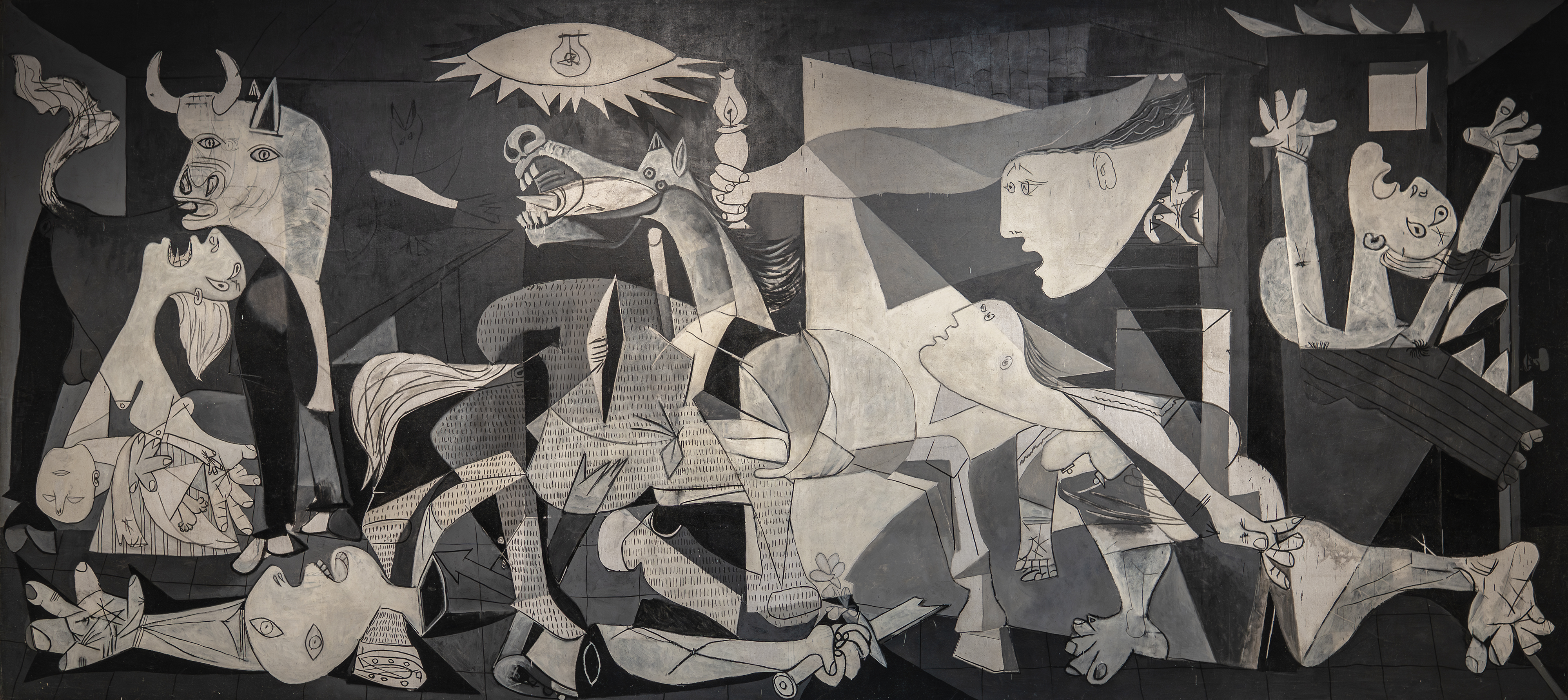
For most of the Spanish Civil War, the capital city of Madrid was under siege by Franco’s forces, during which German airplanes heavily bombed many of the city’s residential areas. Capa was in Madrid during these bombings, during which he took many photographs to document the conflict. Just one month before, he had taken probably his most famous photograph, The Falling Soldier. While in Madrid, Capa took another of his better-known photographs, later titled Children in Madrid. A group of children plays on the sidewalk in front of a house that’s been peppered with shrapnel from the German bombs. It is a brief look, depending on your interpretation, at the persistence or destruction of childhood in wartime. Capa’s work, including Children in Madrid, would be published in newspapers like The New York Times, bringing news of the conflict and its impact to a global audience. The image became a symbol of Spanish resilience as well as a testament to the destruction wrought by the fascists. Its power was such that Franco’s government went to great lengths to clamp down on the photo’s distribution.
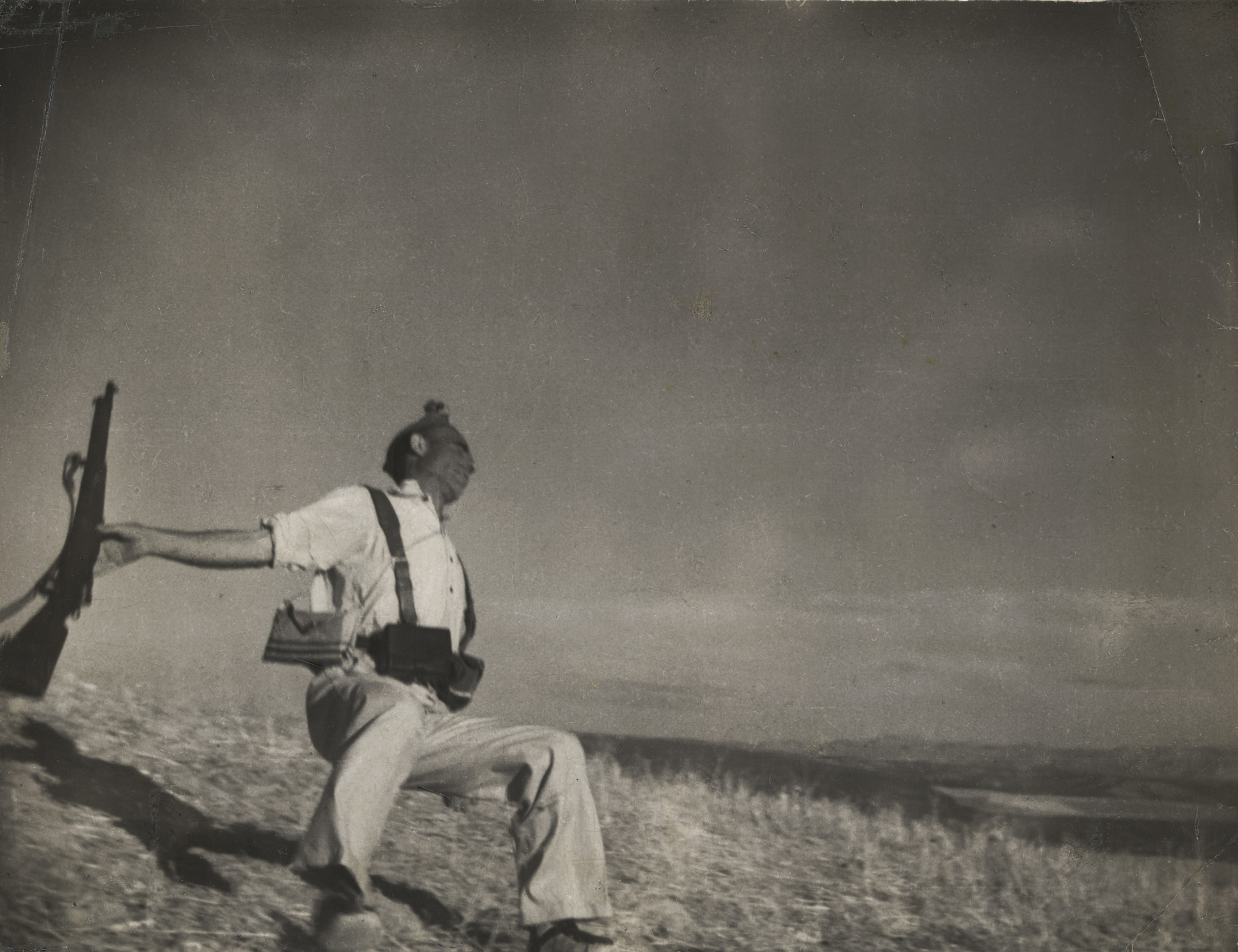

After Franco claimed victory in 1939, Peironcely 10 was repaired and converted into apartments. Initially, the building was intended for demolition. But after it was identified in 2010 as the building in Capa’s photo, the community stepped in to save it, recognizing it as an iconic part of the city and the country’s historical memory. In 2018, Madrid’s city council adopted an initiative to convert the building into the Centro Robert Capa, dedicated to educating the public about the Siege of Madrid and Robert Capa’s role in covering the Spanish Civil War. Construction and renovation have been ongoing since 2021. However, recently, there has been talk of changing the project’s purpose. Starting in 2024, Madrid’s local government has instead tried to convert the building into more of a multi-use cultural center. Their specific language was that it would become “a center for cultural experimentation, especially for children and young people at risk of social exclusion, offering them tools to develop their creativity and use culture as a vehicle for inclusion, learning, and opportunities”.
This move sparked opposition from the original SalvaPeironcely10 organization and the Federation of Madrid Neighborhood Associations. José María Uría, one of the original project’s organizers, commented on the municipality’s decision: “They’ve done this without talking to anyone and we’re all very surprised to see them acting like this […]. They were very keen on it before and then there’s been this 180-degree turn, which also obviously points towards a kind of opacity when it comes to the question of the city’s [historical] memory.” To their credit, Peironcely 10 is not just an empty building waiting for whoever is most ready to occupy it. The building has been preserved because of Robert Capa’s photograph; therefore, its future use should be tied to his work.
Despite these protests, the local government seems committed to changing the center’s purpose. But now the project has encountered a complication. The International Center of Photography, the organization that manages the Robert Capa Foundation, has said it will rescind its permission to use Capa’s name and works in the project if the building’s purpose is changed from what was originally agreed. Additionally, the Capa Haus, a memorial and exhibition space in Leipzig, has raised objections to the municipality’s changes to the building’s future use.
SalvaPeironcely10 has made offers of compromise to help the planned cultural center find an alternative location. However, Madrid’s city council has not commented on whether more changes will be made.
Restoration Complete on London’s Rubens Ceiling
After two years of restoration work, one of the largest works ever made by Peter Paul Rubens will be unveiled and made available for public viewing.
Located in Central London, Banqueting House is the only surviving complete section of the Palace of Whitehall. Though the palace had been used as the official royal residence since the time of King Henry VIII, Banqueting House was added much later on the orders of King James I in 1619. As the name would suggest, Banqueting House was mainly used by the monarch for entertaining. When construction was complete, James’s son and successor, Charles I, commissioned the interior decorations. Most notably, the king commissioned Peter Paul Rubens to paint the ceiling of the main banqueting hall.
While the ceiling has nine sections, six are decorated with cherubs and allegorical figures. However, most of the attention is drawn to the three large sections running down the center of the ceiling. The Union of the Crowns of England and Scotland shows Minerva taking the separate crowns of England and Scotland, tying them together as King James looks on from his throne. Above, a pair of cherubs descend to give the king the new coat of arms for his new realm. In 1603, Queen Elizabeth I died without having had any children. The throne of England, therefore, went to James, her first cousin twice removed, who had reigned as king of Scotland since he was 13 months old. Although England and Scotland would be ruled by the same monarch starting with James, they were technically still independent countries. This would not be changed until the two kingdoms were legally joined as one in 1707.

On the other side of the banqueting hall is the second of the three paintings, The Wise Rule of James I. The king is shown on his throne as a laurel crown is placed on his head. Before him, Minerva, representing wisdom, is shown attacking Mars, representing war. Appropriately, on the left, female allegorical figures representing peace and abundance are shown embracing one another.

In the very center of the ceiling, in a large oval, Rubens created The Apotheosis of James I. The king is guided by a figure bearing thunderbolts and scales, representing divine justice. He ascends into Heaven on the back of an eagle, upwards towards Victory and Britannia holding a laurel crown. It is one of the most succinct representations of the divine right of kings and the monarch’s connection to God. This was something James believed strongly and instilled in his son, Charles. It was likely this belief, that the king was answerable only to God, that led to Charles’s opposition to Parliament’s power and the subsequent English Civil War. Ironically, when Charles lost the war to parliamentary forces and was found guilty of treason, he was led underneath the Rubens paintings and beheaded right outside Banqueting House in January 1649.
The paintings were among the largest Rubens ever painted. They were so large, in fact, that the canvases could not fit into his studio. Instead, he and his assistants and students had to work in the Antwerp commodity exchange and in the refectory of a nearby Carmelite monastery. The canvases were rolled up and shipped to England, where they were laid onto panels and installed in the ceiling in 1636.
Historic Royal Palaces, an independent charity that oversees and maintains Britain’s unoccupied Royal residences, started renovations on Banqueting House in May 2024. With the renovations complete, the building is now more accessible and sustainable. In addition to any repairs and cleaning to the Rubens ceiling, restoration workers installed air-source heat pumps on the roof to better control temperature and humidity within the building. The building’s windows were also coated with a film to filter out most infrared radiation, reducing the damage that direct sunlight would cause to the paintings.
Banqueting House will reopen for previews starting on March 20th, with a full public reopening scheduled for August 1st.
Italy Buys Caravaggio Portrait
The Italian government has purchased an early Caravaggio portrait that previously attracted blockbuster crowds in Rome.
From March to July 2025, Portrait of Maffeo Barberini by Michelangelo da Caravaggio was on display for the first time since it was positively attributed to the artist over sixty years ago. The portrait was the centerpiece of an exhibition at the subject’s former residence, Rome’s Palazzo Barberini, which is now home to the Gallerie Nazionali di Arte Antica. The painting became such an attraction partly because of its rarity as a Caravaggio portrait. Of the sixty-five Caravaggio paintings still surviving, only three are portraits. The artist was primarily known for religious scenes, becoming one of the great painters of the Counter-Reformation, the Catholic Church’s efforts to combat what it saw as the rising Protestant heresy.
While much of the Counterreformation took the form of ecumenical councils and wars of religion, art was often used by the Church to influence laypeople. Church figures patronized the great artists of the time to create religious scenes that would resonate with the common people of the sixteenth and seventeenth centuries. This resulted in the theatricality and intensity of Baroque art. However, Caravaggio created the Barberini portrait only a few years after first arriving in Rome. He was in the early stages of success, making his mark by combining his skill for realist painting with the drama and tenebrism for which he later became famous.
Likewise, Maffeo Barberini was in the early stages of a successful career in the Church. When Caravaggio painted his portrait, he had earned a law degree in Pisa and was only a few years away from being named the pope’s ambassador to France. In due time, he would be named a cardinal and later ascend to the papacy in 1623 as Urban VIII. He was a patron of the arts, commissioning and purchasing works by Gianlorenzo Bernini, Nicolas Poussin, and Claude Lorrain. However, he also used his leadership of the Church to empower and enrich his family, giving his brother and two nephews the rank of cardinal. Barberini also pushed for the astronomer Galileo to be tried for heresy.
The Palazzo Barberini’s Caravaggio 2025 exhibition was the largest survey of the artist’s work since the Metropolitan Museum of Art’s The Age of Caravaggio in 1985. The Barberini show featured twenty-four of the Baroque master’s paintings, and was considered a blockbuster success. After three months, it had attracted 400,000 visitors, prompting organizers to extend the show by two weeks. The exhibition also included Ecce Homo and The Martyrdom of Saint Ursula, one of the artist’s final paintings. After the exhibition’s success, the Italian government has decided to purchase the painting for €30 million, or about $34.7 million. It is one of the largest sums ever paid by the state for a work of art. The purchase is part of the Italian culture ministry’s broader plan to prevent works of importance from lingering in private collections. According to culture minister Alessandro Giuli, this policy will both strengthen Italy’s sense of cultural heritage and ensure that great works of art are more readily available to scholars.


Scholar Claims New Michelangelo Painting Discovered
A segment of the art-historical community may find itself divided into camps after one man has attributed a painting to the Renaissance master Michelangelo.
While the frescoes of the Sistine Chapel are some of Michelangelo’s best-known works, he first and foremost considered himself a sculptor. While he received his artistic training in the workshop of the painter Domenico Ghirlandaio, Michelangelo famously disliked painting. This is why so few of Michelangelo’s paintings exist. Apart from frescoes he did at the Vatican, only two paintings are confirmed to have been created by the master: The Entombment at London’s National Gallery and the Doni Tondo at the Uffizi, both created while the artist was in his late twenties and early thirties. Another two paintings, the Manchester Madonna and The Torment of Saint Anthony, are often attributed to Michelangelo, but there is no scholarly consensus on their authorship. One art historian, however, now claims he has found another painting potentially by Michelangelo, which would be an incredible discovery.


The Belgian scholar Michel Draguet, a professor at the Université Libre de Bruxelles and former director of the Royal Museums of Fine Arts, has now asserted the authenticity of a painting he calls the Pietà Spirituali. A pietà is a work of religious art showing the Virgin Mary cradling the lifeless body of Jesus following his crucifixion. The most famous version of a pietà is a sculpture that Michelangelo created when he was around 24 years old.
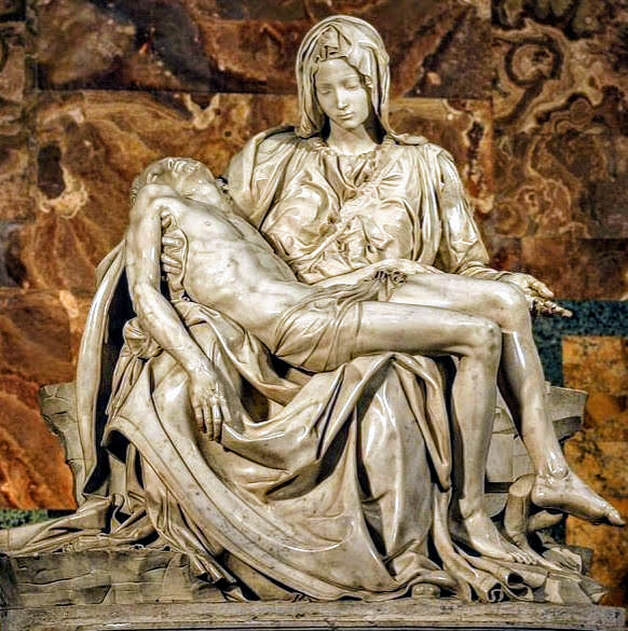
Pietà Spirituali originally appeared at the Genoa auction house Wannenes in 2020. Despite the modest high estimate of €3,000, it eventually sold for €87,600 w/p. The auction house did not attribute the painting to any artist, only describing it as the work of a sixteenth- or seventeenth-century painter. The catalogue authors wrote that the painting appears to draw heavily on “Tuscan-Roman influences,” including the works of Andrea del Sarto, Pontormo, Francesco Salviati, and Michelangelo. They further wrote that the work also appears inspired by late Mannerist artists like Federico Zuccari and Jacopino del Conte.
In his report, Draguet wrote that several parts of the painting indicate Michelangelo’s technique. He claims that the figures bear anatomical similarities to several of Michelangelo’s graphic works, like Il Sogno and Bacchanal of Children. He also claims that at the bottom of the canvas is a symbol that resembles a monogram Michelangelo sometimes used in letters. Additional chemical tests performed at Belgium’s Royal Institute for Cultural Heritage confirmed that the materials used date to 1520 to 1580, which slightly overlaps with Michelangelo’s lifespan.


Draguet also points to documentary evidence of the painting’s existence in Viterbo in the 1540s. Letters refer to a pietà painting by Michelangelo owned by the English cardinal Reginald Pole. This is where Draguet came up with the painting’s title. The Spirituali were a Catholic movement in sixteenth-century Italy that sought to bridge some of the gaps between the Church and the protestant sects that had emerged in recent decades. Cardinal Pole was associated with the Spirituali, as was Michelangelo’s close friend, the poet Vittoria Colonna.
Some have criticized Draguet for perhaps jumping the gun a little. First of all, he is not a specialist in Renaissance art. His area of study, rather, is the work of nineteenth- and twentieth-century Belgian surrealists and symbolists, namely René Magritte and Fernand Khnopff. Others say that the presence of the monogram may be evidence contradicting the claim that Michelangelo created the painting. Michelangelo never signed any of his works, except for his pietà sculpture at the Vatican. In covering the story, the French newspaper Le Figaro spoke with a French art historian specializing in the Renaissance, who said the painting appears to be a genuine sixteenth-century work. Still, they have doubts about Draguet’s authorship claims. “I don’t believe in Michelangelo’s monograms. The majority of great Italian artists rarely signed their works. This signature is rather detrimental to the painting”. The British art historian and Renaissance specialist David Ekserdjian also commented that stylistically, the painting does not match anything that Michelangelo did. He also asked why, if this was a painting by Michelangelo, hadn’t anyone mentioned it until now? Ekserdjian and others have noted that Michelangelo was, among Renaissance artists, “incomparably, the most documented in terms of artistic biography”. Two of his contemporaries, Giorgio Vasari and Ascanio Condivi, wrote separate biographies on him. If Michelangelo had created this painting, surely one or both of them would have mentioned it.
Le Figaro also claimed that the paintings’ two owners may be trying to replicate the success of Salvator Mundi, a rediscovered painting purportedly by Leonardo that sold at Christie’s in 2017 for $450 million. Draguet, however, denied that this was the case as the owners have no plans to sell the work.
Frida and Diego’s Last Dream at MoMA
The Museum of Modern Art recently opened a small exhibit featuring the works of Frida Kahlo and Diego Rivera in collaboration with the Metropolitan Opera’s new production focusing on the two artists.
El último sueño de Frida y Diego (Frida and Diego’s Last Dream) is a new opera that will premiere at the Lincoln Center institution on May 14, 2026. Composer Gabriela Lena Frank and librettist Nilo Cruz have created something that seems befitting of the magical realism and surrealism of Kahlo’s work. In what the Metropolitan Opera calls “a reversal of the Orpheus and Euridice myth”, the production focuses on Frida Kahlo’s spirit taking advantage of Día de Muertos to visit Diego Rivera. Media exploring their relationship has always been popular. The two embodied striking dichotomies. In both appearance and temperament, they were profoundly different. Kahlo’s mother, Matilde Calderón, famously referred to them as “the elephant and the dove.” Their artistic styles diverged as well, with Rivera creating monumental public murals, while Kahlo focused on deeply intimate self-portraits. Yet both achieved the same goal, redefining the culture of post-revolutionary Mexico. Both also had a deep passion for traditional Mexican folk art and were champions of leftist politics.
The opera’s one-night reunion is said to be an artistic fulfilment of Rivera’s final wish. Before he died in 1957, he requested that his cremated remains be placed beside those of Frida Kahlo. Hers are located in an urn at the Casa Azul, the Kahlo family home, which is now a museum dedicated to the artist. However, Rivera remarried following Kahlo’s death in 1954. His fourth and final wife, Emma Hurtado, defied his wishes, allegedly for religious reasons. Instead, he was given a large, public funeral and buried at the Panteón de Dolores in Mexico City.
El último sueño de Frida y Diego originally premiered at the San Diego Opera in 2022. Productions were also staged in Los Angeles and San Francisco. A production in Chicago is planned for later this year. However, Frank began the project in 2007, when the Arizona Opera’s artistic director approached her with the idea of creating a work about Frida Kahlo. She soon found Cruz as a collaborator. Cruz, however, commented that he was “not interested in writing a biopic”, especially since “Frida’s work is so autobiographical to begin with.” The need for an alternative storytelling vehicle is what prompted the Day of the Dead elements. While Cruz took great inspiration from Kahlo’s 1949 painting The Love Embrace of the Universe, the Earth (Mexico), Myself, Diego, and Señor Xólotl, the MoMA exhibit focuses on the opera’s production design.
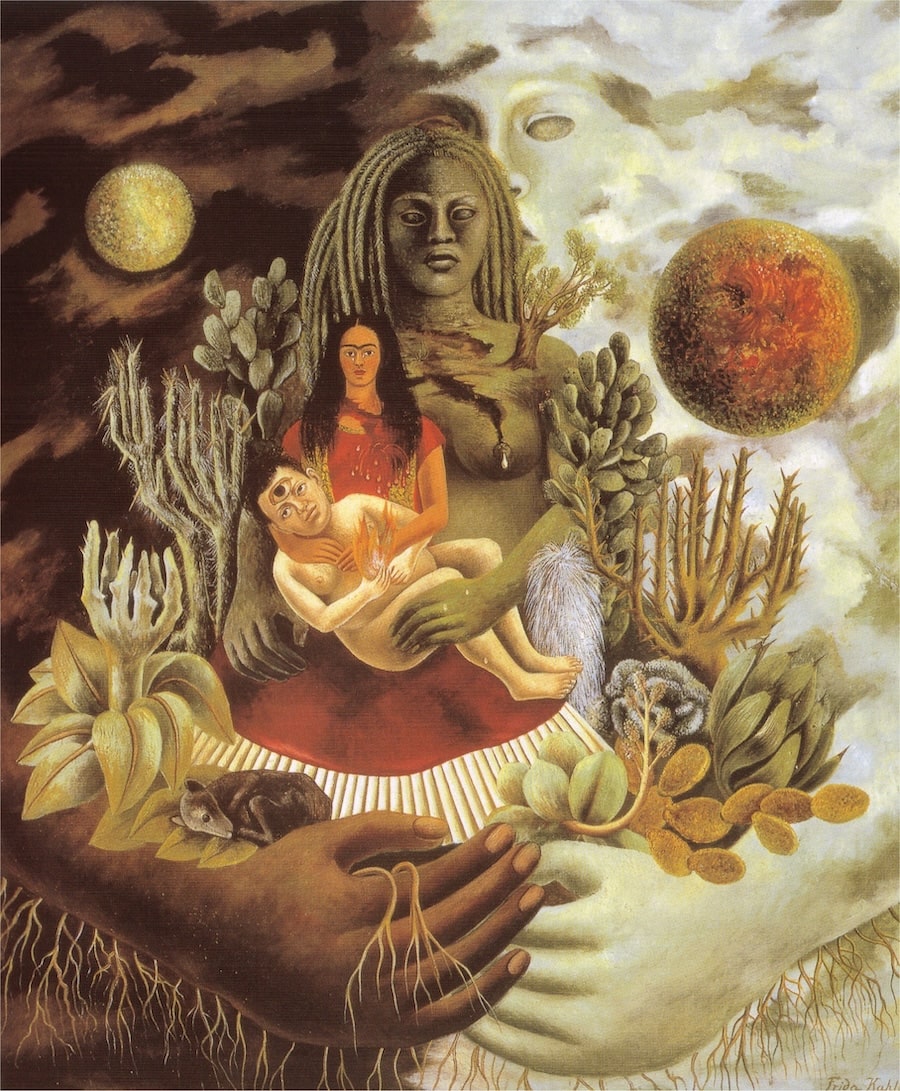
Since the museum show is not an attempt by curators to make an art-historical argument, none of the works on display were accompanied by articles or explanations. MoMA creators instead presented the works by the two artists and allowed visitors to draw their own conclusions. Several important Kahlo paintings are on display, including Self-Portrait with Cropped Hair and Self-Portrait on the Borderline between Mexico and the United States. Several large works by Rivera were also on display, including Líder Agrario Zapata and Flower Festival: Feast of Santa Anita. Several dozen paintings, drawings, lithographs, and other works by both artists give visitors a crash course in the styles, subjects, and themes that Kahlo and Rivera respectively preferred.
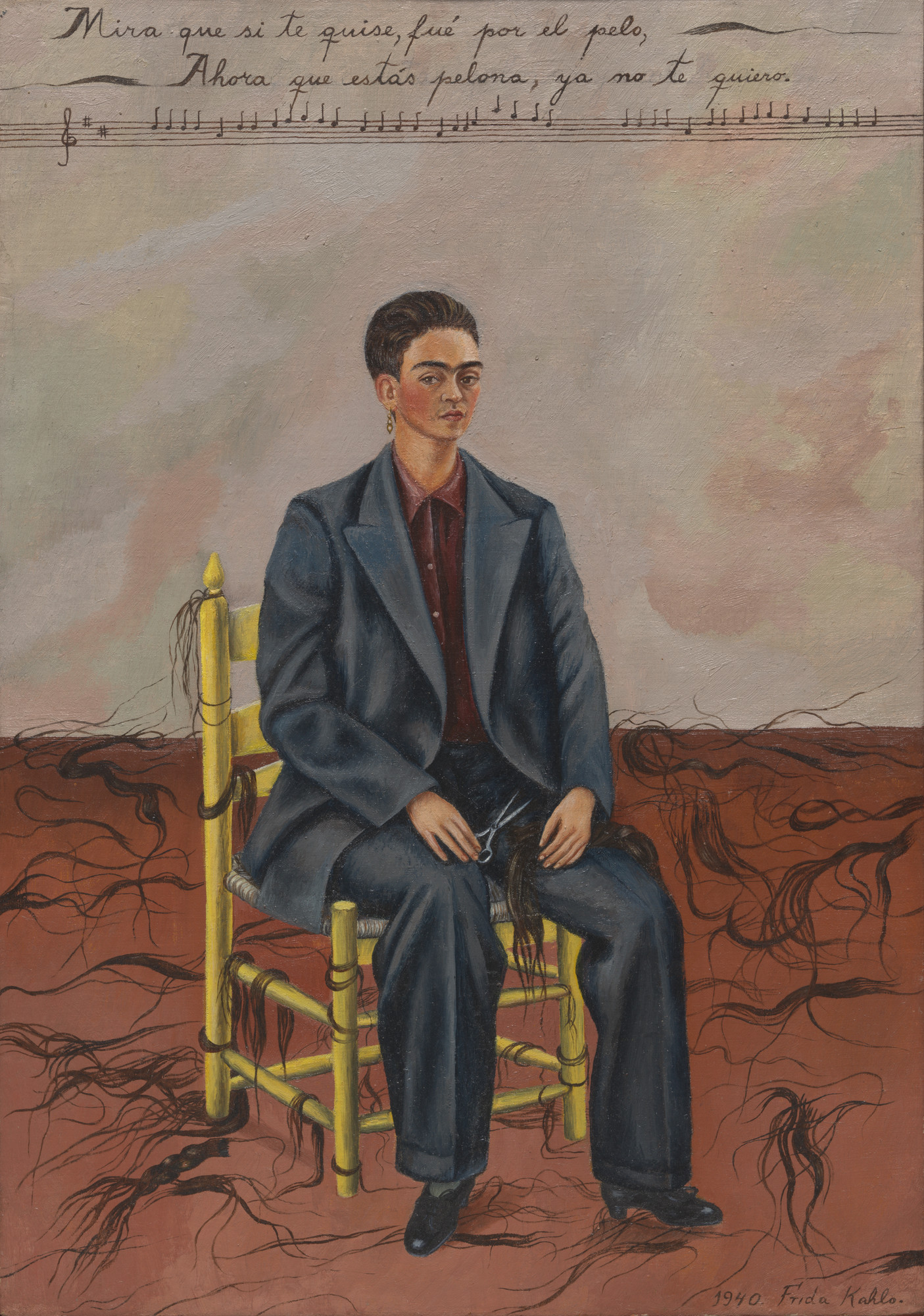
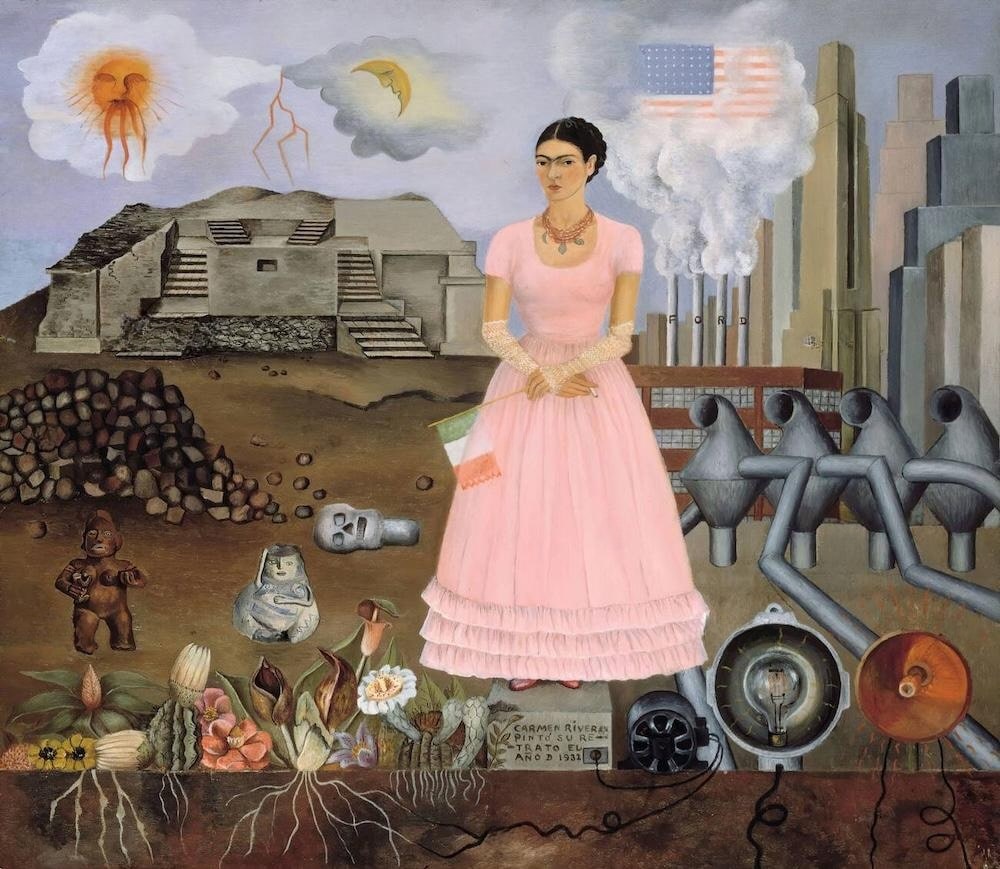
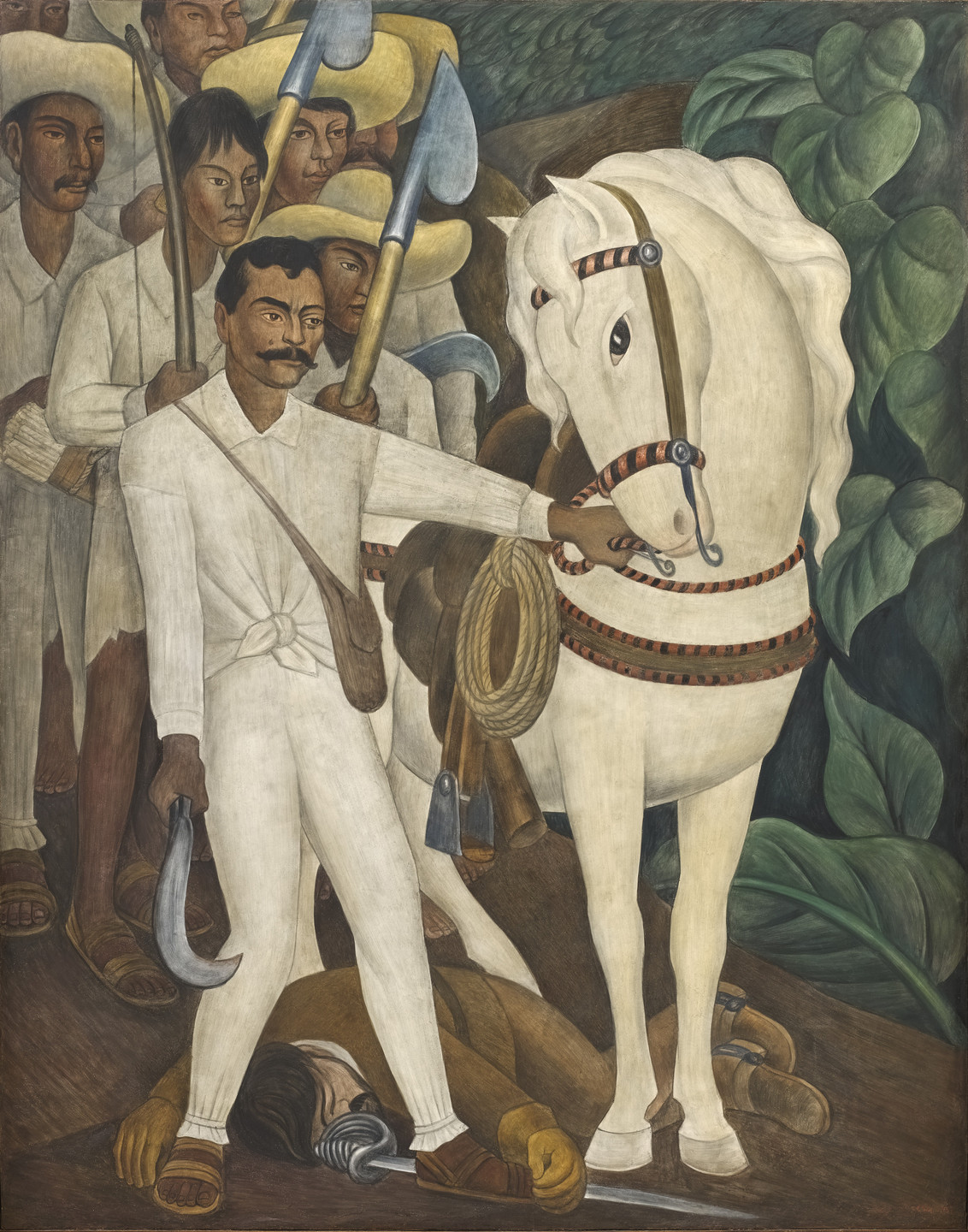
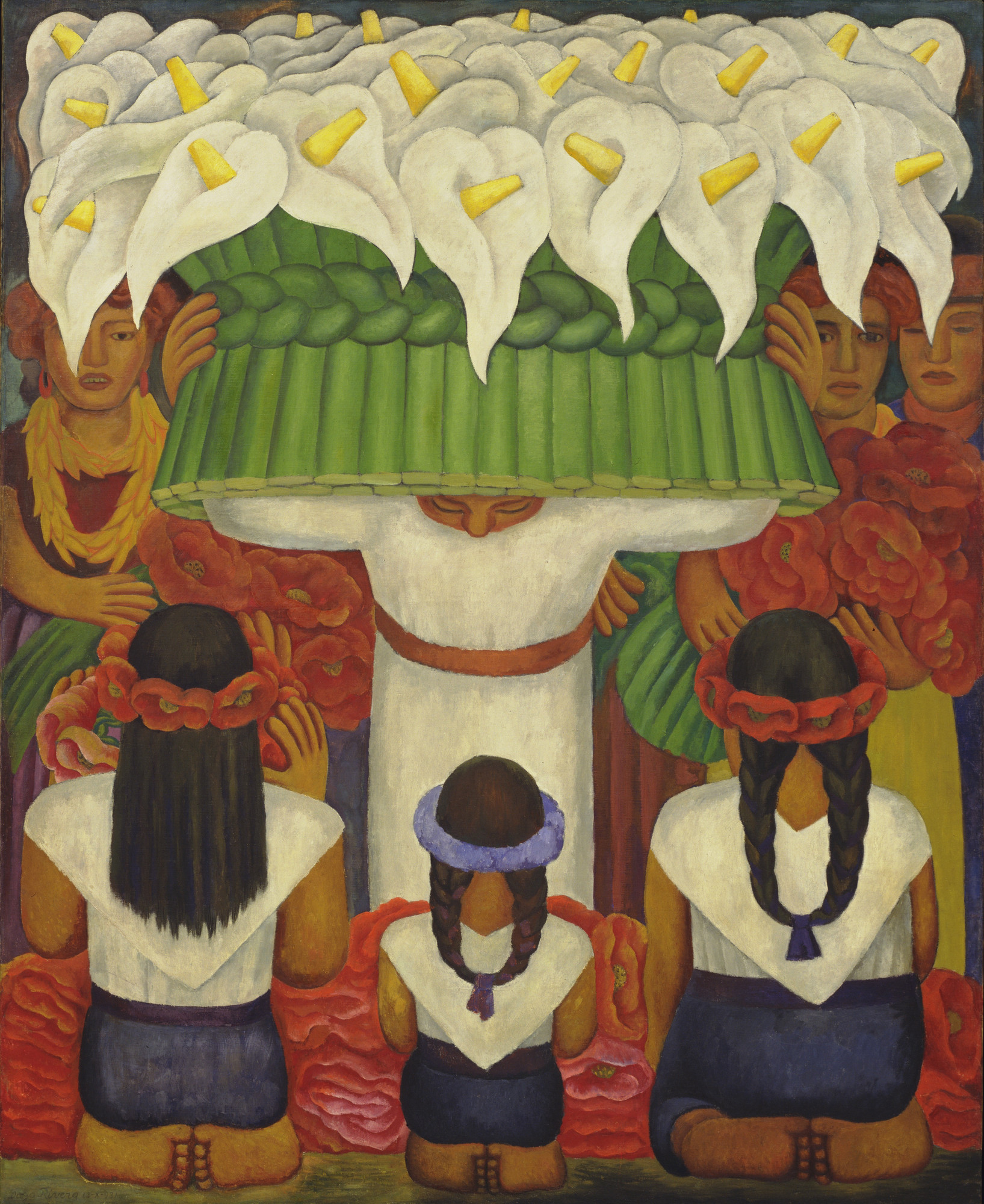
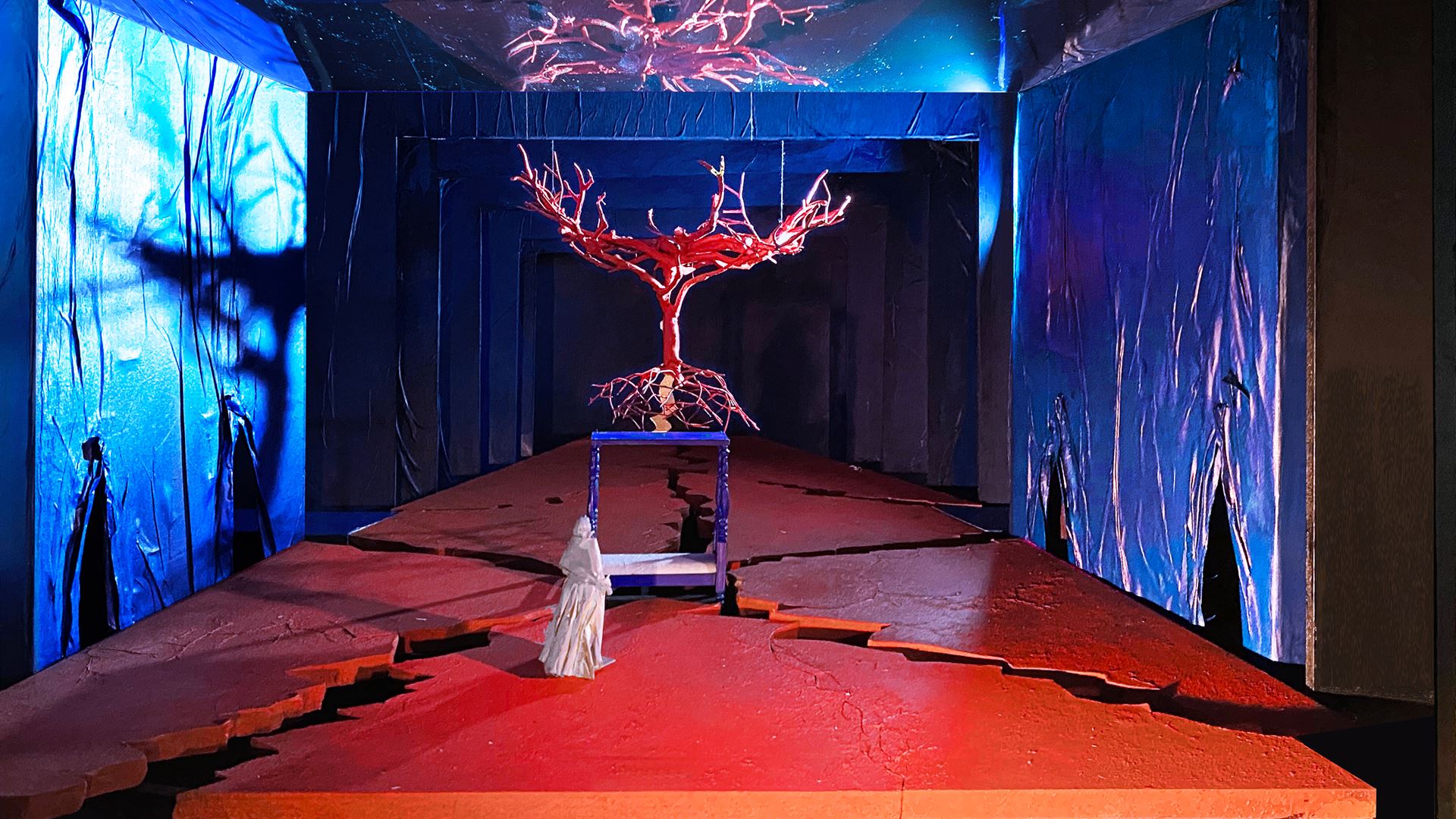
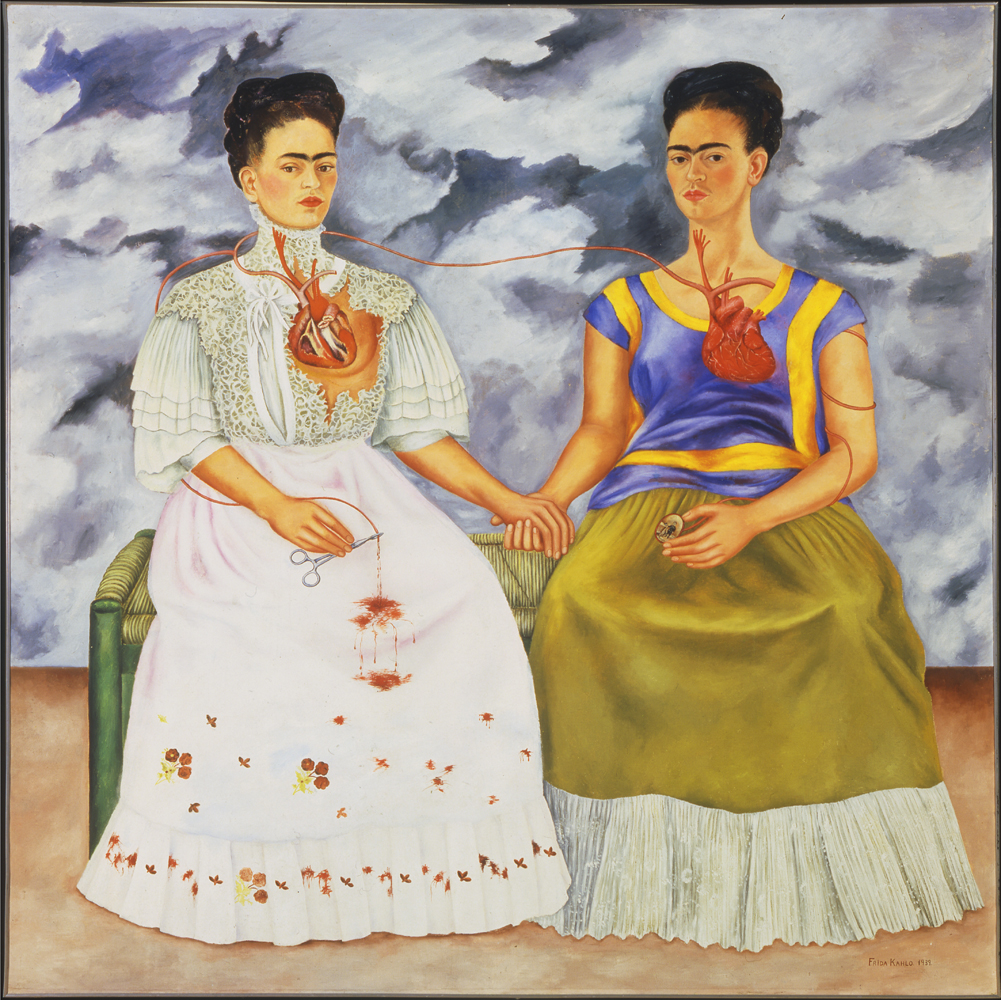
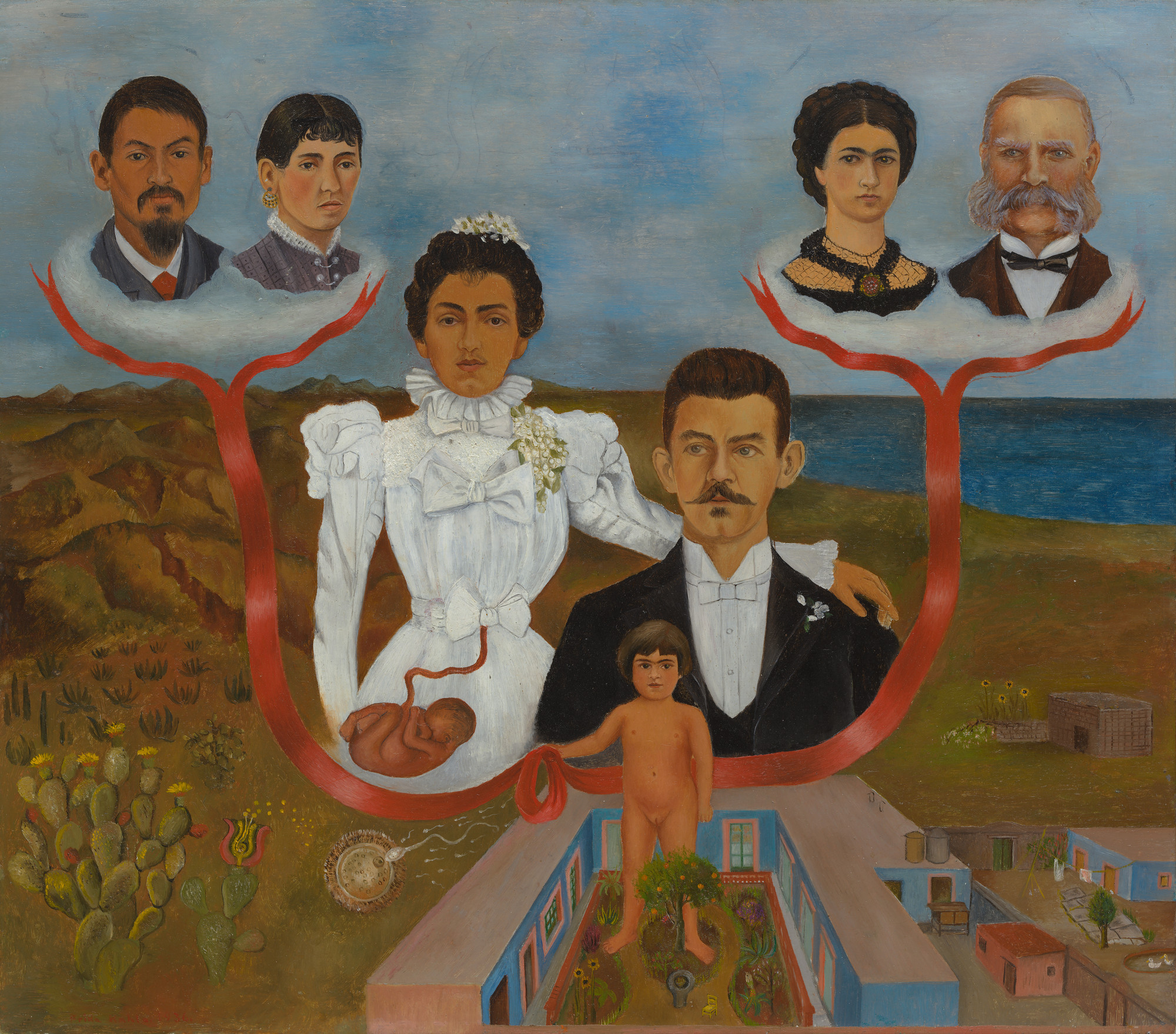
Most striking, however, was not necessarily an artwork in the exhibition, but something decorative. On one side of the single large room where the exhibition is taking place is a sort of sculpture resembling a gnarled, leafless tree, the bark tinted red. The trunk grows through a blue four-poster bed, something that Kahlo included in some of her work, most famously The Dream (The Bed), which set an auction record for a Latin American artist and a female artist when it was sold at Sotheby’s last November for $54.7 million w/p. Both the tree and the bed are important parts of the opera’s design, among the few large set pieces on stage. In an interview with MoMA, production designer Jon Bausor explained how it fits in with the themes of the larger story: “For me, the idea of cracks and fissures, tears and wounds was important, and the sense of what is revealed beneath the skin or surface. I’ve translated these themes into a materialism. There’s a tree of life and death; its arterial red branches are like a human heart or lung held up and underpinned by wooden scaffolding.” The iconography of hearts, arteries, and bloodlines was a common feature in Kahlo’s work, most famously in her 1939 painting The Two Fridas. This symbolism was also featured in one of the works on display at MoMA, My Grandparents, My Parents, and I.
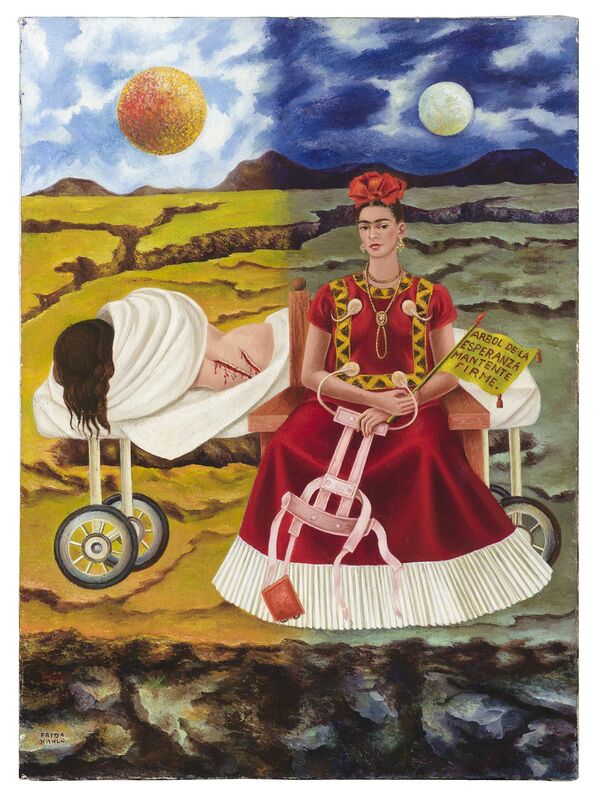
But the image of the tree may remind audiences of the first painting exhibition-goers see when they enter the space: Kahlo’s painting Árbol de esperanza, mantente firme, the title of which translates to Tree of Hope, Remain Strong. She created this work in 1946 following a trip to New York, where she underwent surgery for her chronic spinal pain. Though no tree is visible in the painting, the title, printed on a flag Kahlo holds, is more metaphorical. It could refer to Kahlo’s spine, or even her spirit. The fact that her life and work can inspire others to create great works of art just goes to show that while Frida Kahlo’s body often failed her, her spirit has remained strong even decades after her death.
Raphael’s Sublime Poetry at the Met
On Sunday, March 29th, New York’s Metropolitan Museum of Art opened the first-ever retrospective of the Renaissance master Raphael by an American museum.
The exhibition, titled Sublime Poetry, was a monumental undertaking that required collaboration with dozens of cultural institutions and private collectors. The museums that loaned works to the Met for the exhibition include the Louvre, the Uffizi, the Vatican Museums, the Galleria Borghese, the Palazzo Barberini, the Rijksmuseum, the Prado, the British Museum, the Ashmolean Museum, the Victoria & Albert Museum, London’s National Gallery, Boston’s Gardner Museum, the Getty Museum, the Morgan Library, and the royal collections of both Britain and Spain. Since the exhibition is a retrospective, the Met curators were not trying to make a specific art-historical argument. Rather, this was a comprehensive overview of Raphael’s life and work.
They begin, appropriately, at the beginning, with Raphael’s background in Urbino. The first galleries mainly feature work by Raphael’s predecessors, such as Fra Carnevale, Pietro Perugino (in whose workshop Raphael was apprenticed), and the artist’s own father, Giovanni Santi. Their inclusion underscores Raphael’s role as heir to a legacy of naturalism and detail. However, they also show how Raphael, even as a young artist, defied some of the painting conventions that his teachers still adhered to. This included having the figures’ size proportional to their importance. This was seen in several Perugino paintings, such as Saint Augustine and the Madonna della Consolazione. The titular figures are significantly larger than the others, eschewing realism in favor of stylization and symbolism.

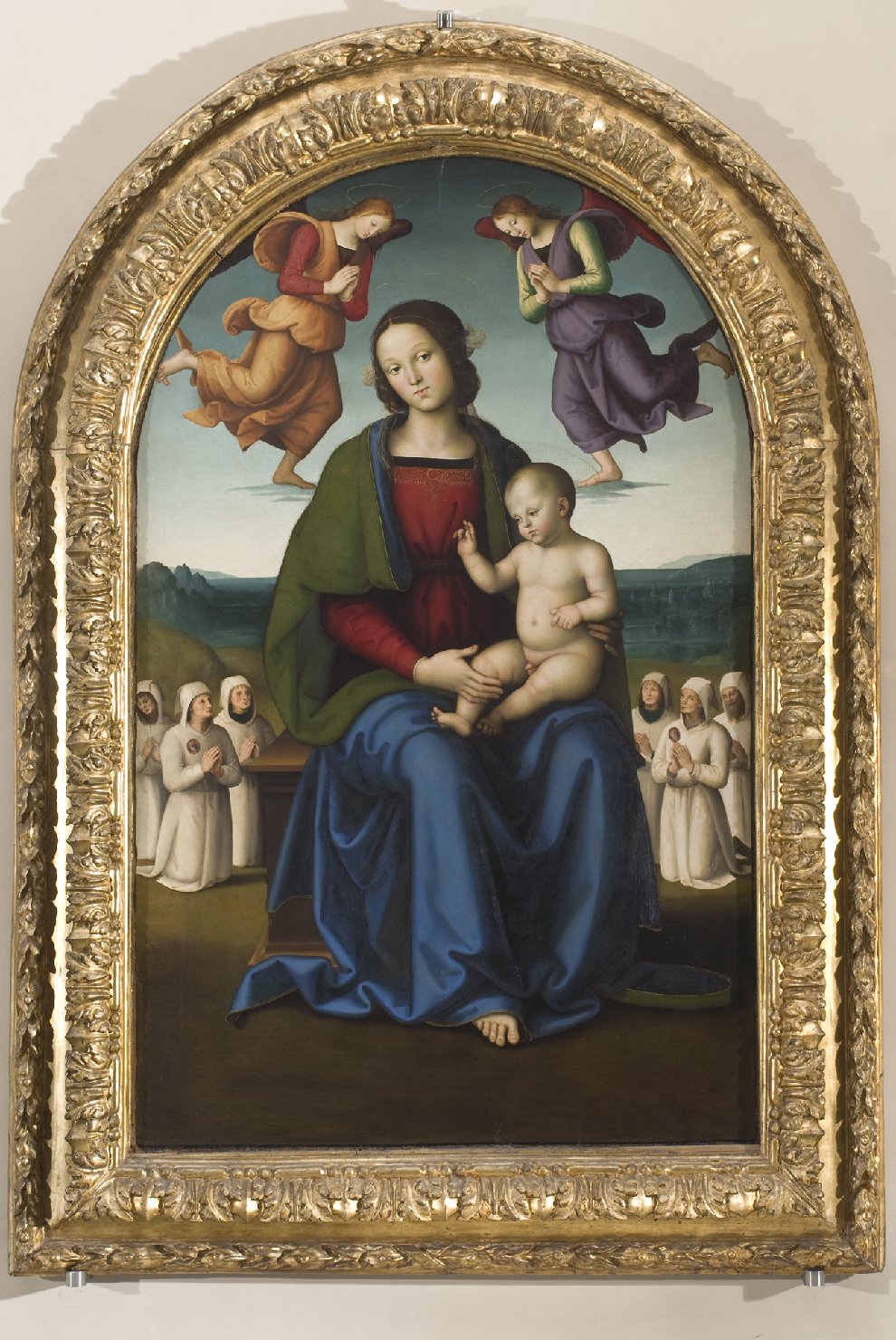
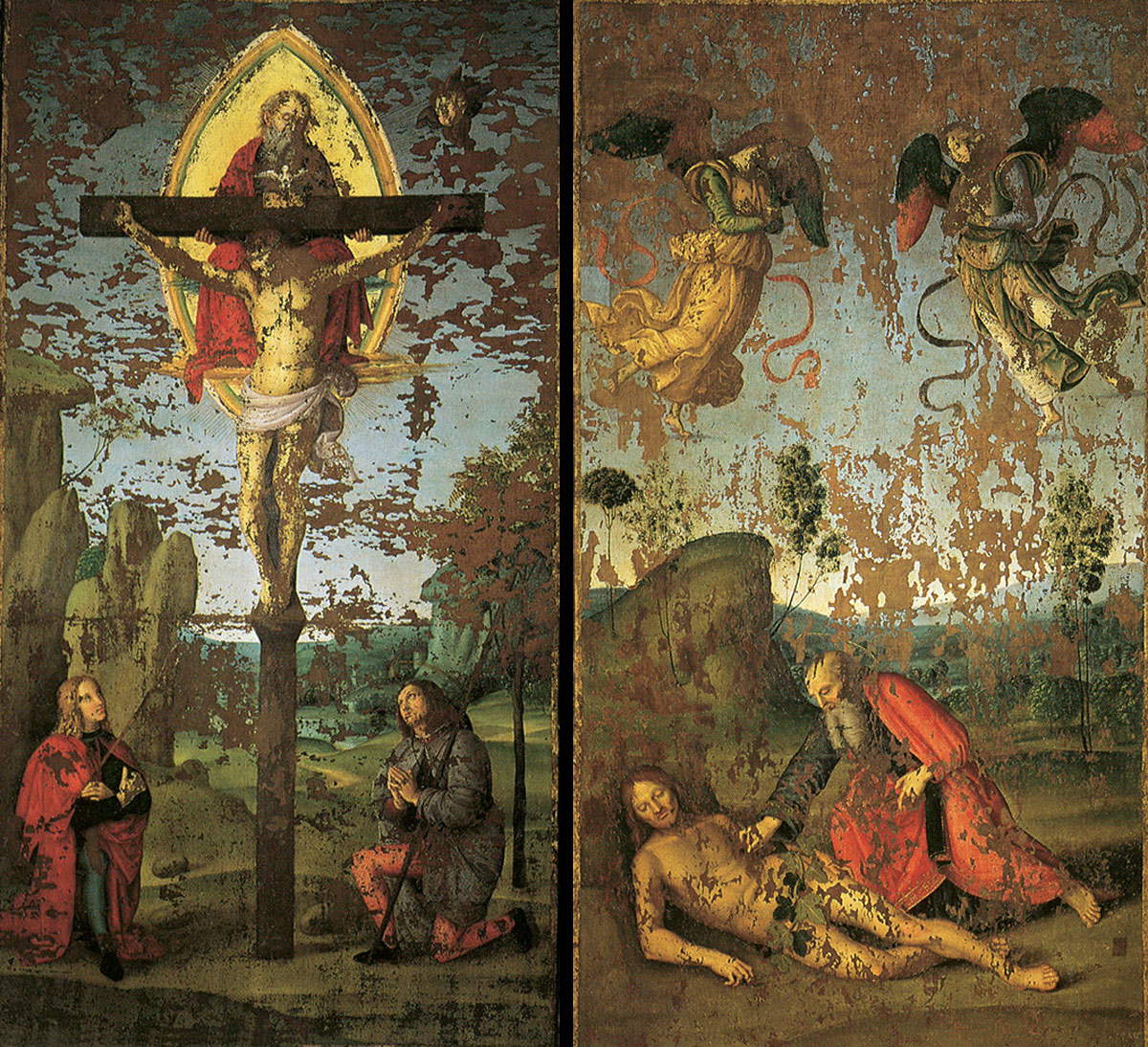
Raphael completely omits this practice and makes all human figures the same size, furthering his dedication to naturalism. Met curators managed to secure a loan from the Pinacoteca Comunale in Città di Castello, the town in Umbria where Raphael worked in his early career. The Processional Banner of the Confraternity of the Santissima Trinità is credited as the first work Raphael ever painted independently of his master, Perugino. The work is two paintings that used to be the recto and verso of the same piece, but are now separated and displayed side-by-side. One half shows the Crucifixion with Saints Sebastian and Roch, the other shows God taking one of Adam’s ribs to create Eve. The paintings are in poor condition, yet it is clear that, regardless of importance, all the figures are proportional to each other.
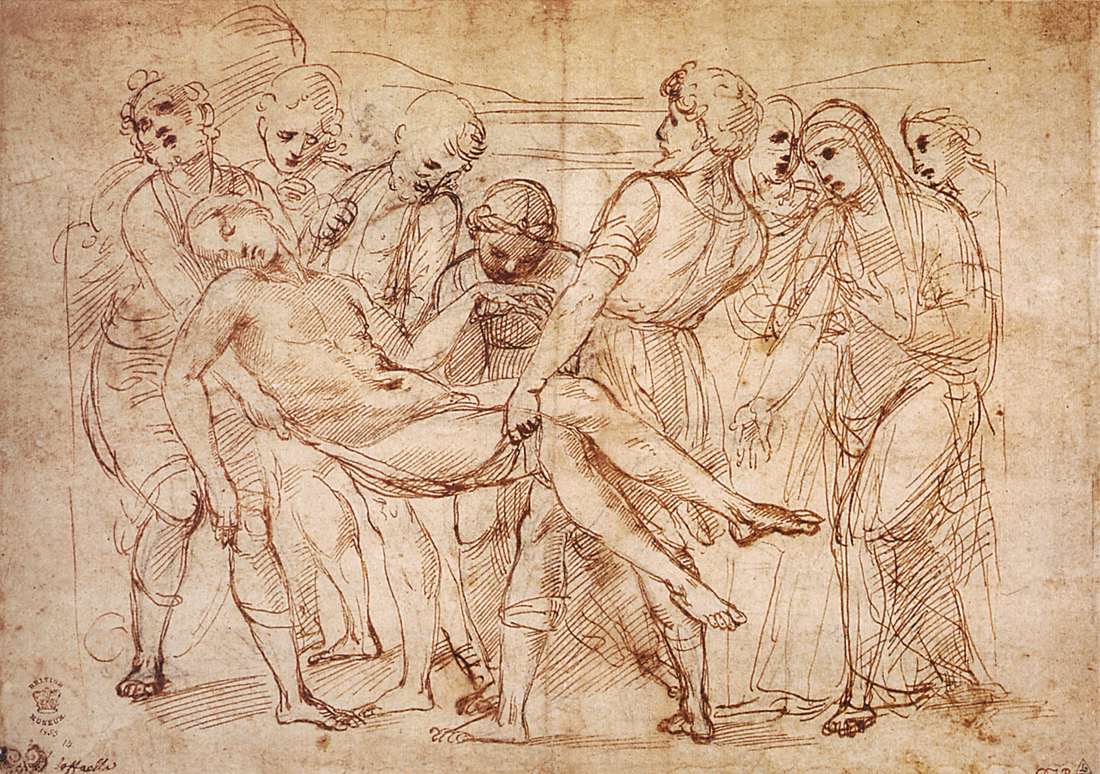
Later on, Sublime Poetry features work by the other Renaissance giants. For example, curators display sketches by Da Vinci and paintings made in the Leonardesque style to show the differences between Raphael and his contemporaries. Leonardo worked in a quick, almost impressionistic style in sketches and drawings, very different from Raphael’s smooth, precise draughtsmanship. But Raphael was also greatly influenced by Michelangelo, specifically his sculptural monumentality. Raphael and Michelangelo never had the best personal relationship, since they were both competing for commissions at the papal court. However, despite the tension, Raphael expressed great admiration for Michelangelo and his work in sculpture. Both artists were also greatly influenced by classical Greco-Roman sculpture, a second-century example of which was on display next to Raphael’s preparatory drawings for his 1507 painting The Deposition.
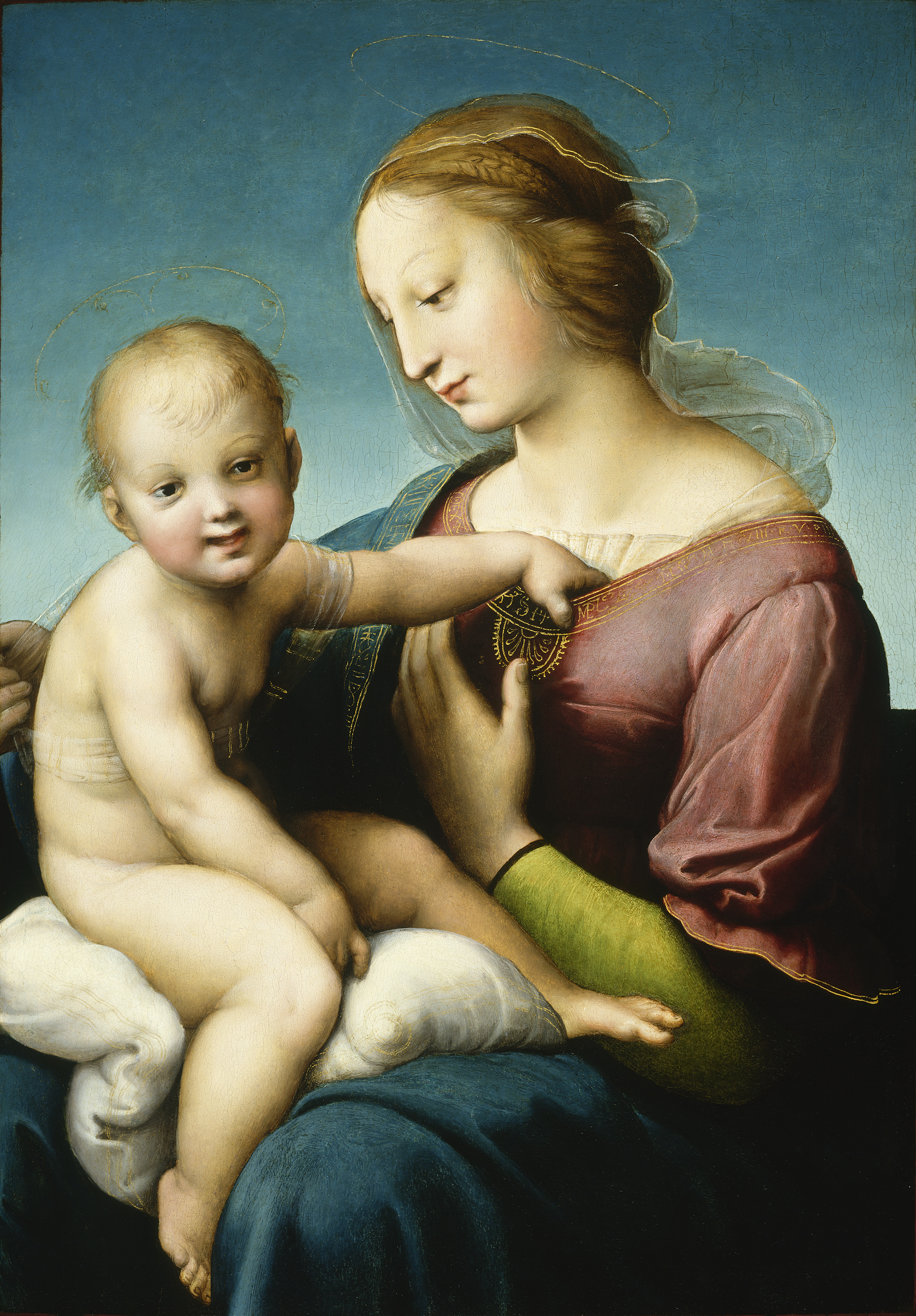
In the exhibition, great attention was given to one of Raphael’s most famous objects: the Madonna and Child. Exhibition curators provide several sources of inspiration for the artist, including the history of this subject, dating back to the Madonna Eleusa, an influential Byzantine icon also known as the Virgin of Tenderness. However, they also go into detail about the importance of affectionate motherhood in an era where relatively little scientific information was available about pregnancy. Raphael’s own mother died from childbirth-related complications in 1491. And yet Raphael often attempted to introduce not only realism but playfulness into his mother-and-child paintings. The Niccolini-Cowper Madonna, for example, features the Christ Child innocently tugging at his mother’s shirt. The Madonna of the Rose features the Baby Jesus and an infant John the Baptist fighting over a piece of ribbon or scroll containing a fragment of text. Similarly, the Esterhazy Madonna features infant John the Baptist examining a similar ribbon, with the Baby Jesus reaching out his hand to see it. Additionally, the Alba Madonna tondo features Jesus trying to take John’s small, reed cross. Rather than stoic, miniature adults, as was common in many Madonna paintings of the time, including those of his master, Perugino, Raphael shows children behaving like children. Similar to the figural proportionality, Raphael forgoes stylization in favor of strict realism. Having the infant Jesus behave less like a symbol and more like an actual child makes the subject more familiar and intimate, bringing the devout closer and creating a more impactful emotional response.

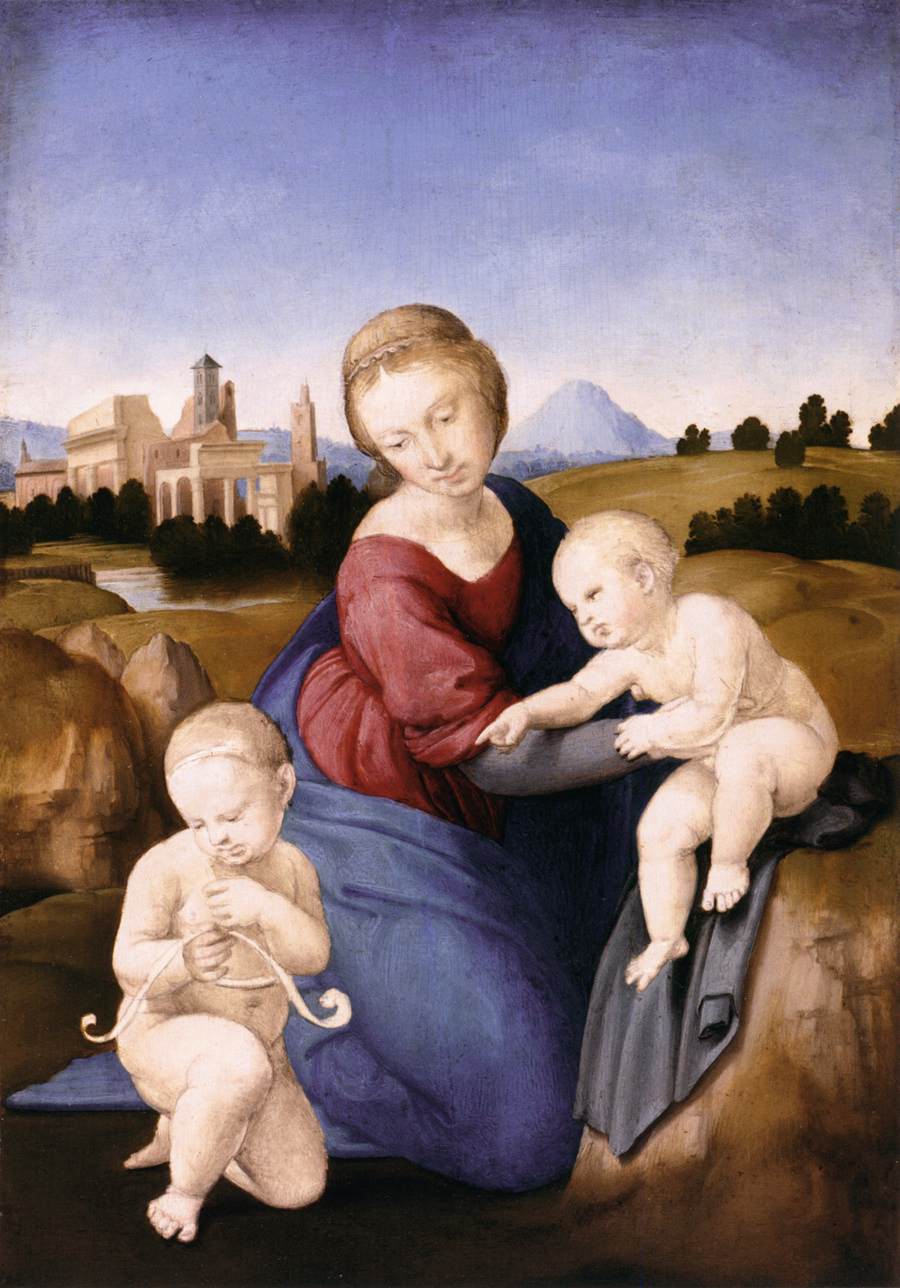


And of course, no Raphael exhibition would be complete without mention of the Vatican frescoes. The curators ease into this by providing some background on his move from Florence to Rome. Florence was a rather saturated market for great painters at the time. Raphael did receive commissions, mainly painting portraits for wealthy merchant families. However, he did decide to move to Rome, where he became a favorite of the papal court. Though he was young and relatively inexperienced at the time, his Urbino origins offered him a step up, given the duchy’s extensive connections to Roman power centers. Donato Bramante was also from Urbino and was Pope Julius II’s favorite architect. Bramante’s advocacy for the papacy’s patronage of Raphael rubbed others the wrong way, especially Michelangelo.
After passing through a room of Raphael’s preparatory sketches, visitors enter a small room where life-size versions of the Vatican frescoes are projected onto the walls. Of course, the School of Athens is the most famous example from these works, yet that segment of the wall alone does not convey the monumentality of the complete work. Even if one views these frescoes in person, their height on the walls of these chambers keeps anyone without scaffolding from examining these works in great detail. Seeing them life-size, one after another like a slideshow, makes it more apparent how Raphael possibly spread himself too thin, leading to his premature death at the age of thirty-seven.

Raphael’s influence brings to mind a noteworthy quote by the fantasy author Terry Pratchett. While commenting on the influence of Lord of the Rings author J.R.R. Tolkien, Pratchett likened his influence to Mount Fuji in Japanese art: “Sometimes it’s big and up close. Sometimes it’s a shape on the horizon. Sometimes it’s not there at all, which means that the artist either has made a deliberate decision against the mountain, which is interesting in itself, or is in fact standing on Mt. Fuji.” Raphael was known as the “prince of painters” for a reason. His strict naturalism set the example for centuries to come. And when a generation of modernists came along in the nineteenth century, what did some of them do? Some explicitly rejected Raphael and his place of pride among the European academies, calling themselves “pre-Raphaelite” to emphasize their preference for medieval and early Renaissance aesthetics. Yet their explicit rejection of Raphael does not weaken the Italian master’s impact, but rather reinforces it. And it was very interesting to walk directly from the exhibition into the nineteenth-century European paintings section. After a short time, I came face-to-face with William-Adolphe Bouguereau’s Breton Brother and Sister. And while I did see a pair of siblings in traditional northwestern French folk costume, the first thing I saw was a Madonna and Child, not dissimilar from those that I saw within Sublime Poetry.
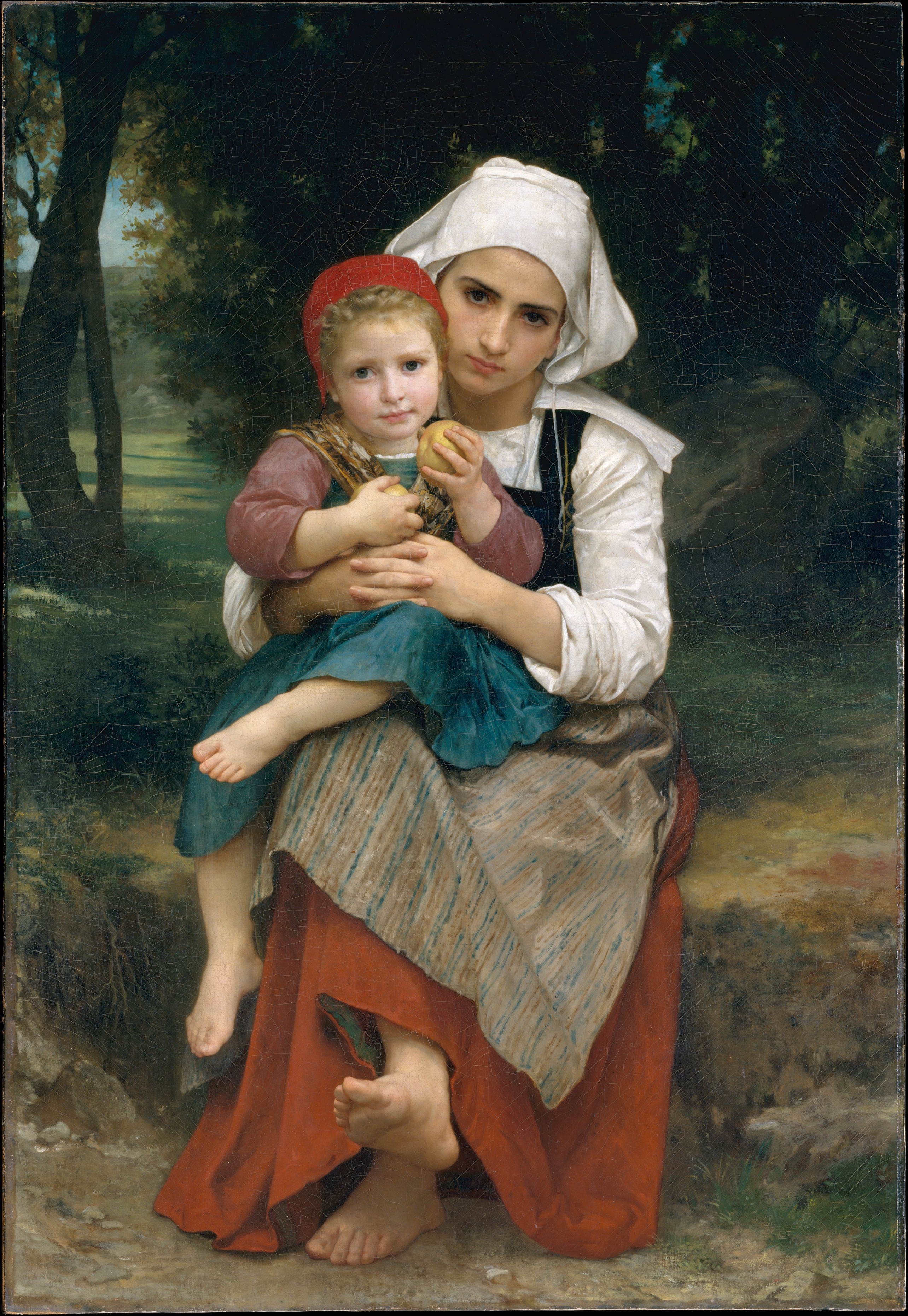
Raphael: Sublime Poetry will be on display at the Metropolitan Museum of Art through June 28th.
Thank you for following along with our Comments on the Art Market. Stay tuned for more art news, discoveries, and gallery highlights in next month’s newsletter.
The Rehs Family © Rehs Galleries, Inc., New York – April 2026