COMMENTS ON THE ART MARKET
Volume 303
|
WELCOME TO THE MARCH 2026 EDITION OF COMMENTS ON THE ART MARKET
|
|
|
THE PALM BEACH SHOW - A FAIR TO REMEMBER
The majority of February — as always — was spent “snow-birding” in Palm Beach for the Palm Beach Show. Professionally, it remains one of our strongest fairs. Personally, this year carried a little more weight.
For starters, it was my first time back in sunny Florida after back-to-back pregnancies and the newborn haze that kept me either too pregnant to fly or homebound by sleep schedules and diapers. The newfound freedom of toddlerhood was short-lived — but for the best reason. PB 2026 marked Teddy and Bennett’s first official “work-cation,” something I always looked forward to as a kid in the antiques business. A true full-circle moment... just with more carry-ons and crumbs.
I went down first to set up, and a few days later, the kids flew in with my husband. When I picked them up from the airport, Teddy looked out the window at the palm trees and said in complete awe, “Mom… Moana trees.” It wasn’t Hawaii or Disney, but Palm Beach would do.
Teddy embraced her role as junior art critic, wandering the aisles, trying on a few dazzling jewels (her piggy bank portfolio needs time to mature), and snapping photos of her favorite works with her unicorn digital camera. Bennett, lovingly known as “Benny the Bull,” lived up to his name — emphasis on bull in a china shop. A few close calls, zero casualties. I strategically relocated him poolside for most of the fair to preserve both the artwork and my blood pressure. Crisis averted. Insurance premiums unchanged.
Palm Beach also showed up for Howard in a way that meant more than I can properly express. His legendary “Kamikaze” was featured at the show bars, with three dollars from every cocktail sold donated to his ALS Memorial Foundation — one from the bar, matched by both the Palm Beach Show Group and the Convention Center. Howard always enjoyed starting happy hour. Thank you to everyone who ordered his drink and supported the cause.
The booth maintained a steady rhythm of energy throughout the week. Works by Timothy W. Jahn drew sustained attention, with several interiors finding new homes. Lucia Heffernan brought constant smiles, while works by Gail Descouers and Alexandra Klimas repeatedly sparked the same question: "Are these photographs?" To many people’s surprise, no, they are paintings -- and a few by each artist found new homes in Palm Beach as well.
On the historical side, two works by Eugène Boudin sparked thoughtful conversations. Oisème, Route de village was admired for its earthy palette and quiet charm, while Le quai de Camaret, Pêcheur attendant la marée captivated collectors with its narrative strength and distinguished provenance. Dietz Edzard’s Au Bois de Boulogne remained a magnet for attention, and maritime enthusiasts gravitated toward Yachts Racing off Southampton, Long Island, by James Edward Buttersworth, further enriched by its prior ownership by John Stobart.
Sandwiched between two major Northeastern snowstorms, it was a welcome shift to trade snow shovels for sunshine. Palm Beach reminded us why we do this work, not only for the sales, though we are grateful for them, but for the community and the memories.
(Welcoming local kid-friendly places to add to next year's itinerary!)
-Alyssa
|
|
|
Ugh, good morning… I’m up at 7AM on a Saturday writing about stocks – “good” mornings shouldn’t start before 10. February was not a great month for the markets, and to pile on, I’m waking up to news that we engaged in major offensive military operations last night while everyone was asleep… when will the fun stop?!
Markets are currently standing on some uneasy footing. Inflation data came in hotter than expected, there are persistent concerns around AI use and spending, we’re seeing major strain on private credit, no one can figure out what the heck is going on with the tariffs, and we just bombed Iran… but hey, we won the Gold Medal in Men’s and Women’s hockey – that’s gotta count for something, right?? For the month, the Dow eked out a slight 0.2% gain after withstanding a 1.1% slide on the final trading day of February – the index can hang its hat on 10 straight months of gains, but the positive news seems to end there. The S&P was down about 1% while the Nasdaq dropped more than 3% – its worst month in about a year. Fueling some of that downward pressure was January’s Producer Price Index, or PPI, which is a measure of wholesale inflation. The most recent report showed a 0.5% increase for the month, though economists expected that figure to be closer to 0.3%... and more concerning was core PPI, which excludes food and energy prices – that came in at 0.8%; more than double expectations. The other notable pain point was liquidity pressure in private credit… Blue Owl Capital, a major private lender, was forced to sell roughly $1.4 billion in assets to shore up liquidity; a move that confirms strain on its credit funds. More broadly, the KBW Bank Index – a key measure of US bank stock performance – experienced its steepest decline in nearly a year as fears about private credit spillover risks intensified. Oh, and where do I submit my tariff refund claim?
Currencies and commodities continue to be hot topics as well. Both the Pound and Euro weakened against the dollar… the Pound was also impacted by the collapse of UK mortgage provider Market Financial Solutions, which only stoked more widespread concerns. Crude is up more than 10% from the start of February – it was a seesaw month as prices swung back and forth, but with growing geopolitical tensions, futures continued to climb in the final week. Gold turned in a 14% gain after a sharp correction at the end of January… it’s back to testing its record high, now again trading above $5,200. Even better was silver, which turned in a 23% month, granted its late-January correction was more dramatic; it's still a bit off from the record high from last month, but it is trending in that direction. When crude climbs, gold rallies, and equities wobble at the same time, it’s usually not a “growth acceleration” signal, it’s a stress signal.
The crypto arena should be renamed the toilet bowl these days… or if you’re a toilet-half-full kinda person, it’s a buying opportunity! Bitcoin has shed nearly 30% in the past month and now sits in the 60K range – it’s been hovering there for weeks. Ethereum is even worse, down nearly 40%, while Litecoin has given up more than 25%. I can say with first-hand experience, it has been brutal watching crypto just fall off a cliff after a hot streak last year.
Overall, there has definitely been a noticeable shift from optimism to caution in the last few weeks. Perhaps it’s time to look in the mirror and realize the party has been going on a bit too long. With sticky inflation, a looming AI bubble, stress in private credit, and signs of a softening labor market, it’s probably the prudent thing to exert some caution… especially with the uncertainty of how this conflict with Iran will play out. It’s honestly difficult to stay on top of all these moving pieces – while February was far from a crash, it felt like the market waking up a bit. That doesn’t mean it’s time to panic, but 2026 may be less of a victory lap, and more of a year where underlying financials and policy decisions matter again.
-Lance
|
|
|
Historical Artist Spotlight: Hugues Claude Pissarro
Born on November 9, 1935, in Neuilly-sur-Seine, Hugues Claude Pissarro occupies a unique position in French art history—as both an heir to one of the most influential artistic dynasties of the 19th century and an independent painter who has forged a distinct, modern voice. As the grandson of Impressionist master Camille Pissarro and the son of painter Paul-Émile Pissarro, his early immersion in art was both inevitable and formative. Yet rather than working in the shadow of his lineage, Hugues Claude transformed that inheritance into a platform for personal exploration and stylistic breadth.
Trained initially by his father and later at the École Normale Supérieure des Beaux-Arts in Paris, Pissarro developed a disciplined academic foundation that underpins even his most lyrical works. Throughout his career, he has navigated fluently between Impressionism, Post-Impressionism, and more structured pictorial traditions, blending painterly freedom with compositional rigor. His canvases reveal a sophisticated command of color and an acute sensitivity to light, hallmarks of the Pissarro legacy, tempered by a contemporary clarity and architectural awareness.
In L’Arrêt de Bus de la Porte Saint-Martin, Hugues Claude Pissarro turns his attention to one of Paris’s most storied urban thresholds. The monumental arch of the Porte Saint-Martin anchors the composition, while the surrounding boulevards hum with activity – omnibuses, automobiles, and pedestrians animated by a soft, luminous atmosphere. Executed with a vibrant yet harmonious palette, the painting captures both the grandeur of Parisian architecture and the poetry of everyday life.
Cityscapes have long been central to his oeuvre, particularly scenes of Paris rendered with warmth, movement, and human presence. Rather than nostalgic reverie, these works offer a living portrait of the city as an evolving organism—where history, modernity, and daily life intersect.
Contemporary Artist Spotlight: Carrie Goller
Carrie Goller creates paintings that inhabit the quiet space between material and imagination. Known for her distinctive use of encaustic wax and oil paint, Goller builds compositions that feel suspended in time – intimate, atmospheric, and emotionally resonant. Her subjects, often birds, cats, and other creatures adorned with florals, exist in environments that feel more dreamlike than literal.
In many works, Goller begins with encaustic, layering pigmented wax to form luminous, textured grounds. These surfaces are softly dimensional and cloud-like, dissolving any fixed sense of horizon or place. Light activates the wax, revealing subtle movement and depth. Painted in oil atop these atmospheric foundations, her figures emerge with clarity and individuality. The dialogue between diffused wax and defined oil creates a delicate visual tension: her subjects feel both weightless and grounded.
Not all of Goller’s paintings incorporate encaustic. Some works are rendered entirely in oil, allowing her to explore a different kind of surface—smoother, more direct, yet equally nuanced in tone and emotion. Whether working in mixed media or solely in oil, her focus remains consistent: to create spaces where material enhances meaning and atmosphere supports narrative.
Across her practice, Goller balances softness with structure, mystery with presence. The result is a body of work that feels playful yet contemplative, inviting viewers into worlds shaped as much by feeling as by form.
FIRST LOOK
The Afternoon Room by Timothy W. Jahn
We are pleased to share a first look at The Afternoon Room, the newest painting in Timothy W. Jahn’s celebrated Interior Series — a work that depicts not a physical place, but a remembered feeling.
“This room exists nowhere but in emotion,” Timothy writes. “It was never a real place, only a real memory.”
Growing up, he and his mother would sit together for hours — no destination, no agenda — just her voice, steady and unhurried, carrying the warmth of family stories he never wanted to end. Those afternoons shaped his understanding that the most sacred spaces are not defined by architecture, but by presence. By someone choosing to stay.
In The Afternoon Room, leather chairs are positioned just close enough for conversation. Books stand quietly at attention. Light pours through a tall window — generous and soft, like a Sunday afternoon stretching long into evening. Crystal catches the glow. A half-finished cup of tea rests nearby. Every element is composed not for spectacle, but for belonging.
Jahn’s mastery lies in restraint. The room feels inhabited — as though someone has just stepped away, or is about to return. Time slows. Silence holds weight. Stories wait to be told.
At the heart of his Interior Series, each painting becomes a variation on the same emotional architecture. As Timothy reflects, every room he paints is ultimately the same room — the one where his mother’s voice still lives.
Available for private preview and will be released this month on our website.
THE ART MARKET
At Auction
|
|
|
Best Foot Forward: Michelangelo Sketch Sells for Record Price
A red chalk drawing of an arched right foot.Study for a foot of the Libyan Sibyl by Michelangelo
This week saw a series of Old Master sales in New York at Christie’s and Sotheby’s. While several great pieces crossed the block at both auction houses, it is without doubt that the highlight of the week turned out to be… a foot? Not just any foot, but an original chalk drawing by Michelangelo made as a preparatory drawing for the Sistine Chapel ceiling.
The red chalk drawing was part of Christie’s Old Master & British Drawings sale on the afternoon of Thursday, February 5th. It had only recently been rediscovered after being kept away in the same private collection, that of an aristocratic Swiss family, for over two centuries. Though just a foot, the sketch is actually a preparatory drawing Michelangelo made while working on the Sistine Chapel ceiling. Part of the ceiling features twelve figures on the spandrels, the triangular spaces between the chapel windows where the ceiling begins to arch upward. These figures are seven prophets of the Old Testament and five of the ancient Sybils, the classical Greco-Roman oracles associated with specific holy sites. The sibyls on the ceiling included the Cumaean Sibyl, the Delphic Sibyl, the Erythraean Sibyl, the Persian Sibyl, and, most importantly in this case, the Libyan Sibyl.
The drawing offered at Christie’s is a study for the Libyan Sibyl’s right foot, which, in the completed fresco, is shown arched as the figure turns in her seat, trying to reach a large codex behind her. While Michelangelo was obsessively fixated on mastering his ability to capture the human form, I understand why the foot may have been a point of focus for him. The foot is notoriously difficult to draw. Even great masters like Sandro Botticelli struggled to render his subjects’ feet, as seen in several of his paintings. So depicting the feet accurately, and in a somewhat unusual pose no less, was likely something Michelangelo cared about very much.
Michelangelo made hundreds of sketches and drawings during the four years he worked on the Sistine Chapel ceiling. However, most of these drawings are now considered lost. Those that survive now mainly belong in museum collections. Because so few works by the artist remain in private hands, the drawing’s rarity alone made this an incredibly exciting auction moment.
While Christie’s expected the drawing to sell for between $1.5 and $2 million, things went a little out of hand. There were several interested parties that afternoon, driving the final price ever higher. At one point, I left my desk and came back to find the current bid was quadruple the high estimate. And the bidding was not over yet. After what must have been over twenty-five minutes of bidding, auctioneer Georgina Hilton brought down the hammer at a mind-blowing $23.1 million (or $27.2 million w/p). It is now the most expensive work by Michelangelo ever sold at auction, and the third most valuable Old Masters work on paper ever sold at auction.
The sale as a whole, consisting of one hundred thirty-one lots, was only expected to bring in no more than $5.46 million. But even if the Michelangelo drawing only reached its high estimate of $2 million, the sale would have still done rather well. Some other highlights included the William Blake drawing The Grave: The Reunion of the Soul and the Body (which sold for $750K against an estimate range of $800K to $1.2 million) and an eighteenth-century ink drawing Study of four figures by Giovanni Battista Piranesi (which sold for $220K against a $120K high estimate).
Of the one hundred thirty-one lots, twenty-nine sold within their estimates, giving Christie’s a 22% accuracy rate. An additional thirty-seven lots (28%) sold below, while an impressive forty-three lots (33%) sold above. With twenty-two lots unsold, Christie’s achieved an 83% sell-through rate on Thursday afternoon. The entire sale brought in $25.7 million (or $30.5 million w/p), with the Michelangelo accounting for 89.9% of the total.
|
|
|
BEYOND THE FRAME
Exhibitions, discoveries, and cultural commentary
Met Opera Considers Selling Chagalls
New York’s Metropolitan Opera House may be forced to sell two of its most iconic possessions: a pair of murals by Marc Chagall.
The Metropolitan Opera has existed since 1883, but the current opera house first opened in September 1966. Though close to sixty years old, it remains the largest opera house in the world, as well as one of the most technologically advanced. However, the company took a significant financial hit during the Covid pandemic. Since then, it has been forced to take steps to remain financially solvent, including reducing the number of performances and drawing about $120 million from its endowment. The most immediate source of financial issues stems from director Peter Gelb’s plan to begin a five-year winter residency in Riyadh, Saudi Arabia, in exchange for $200 million from the Saudi government. With this money failing to come through on time, the opera is considering selling off one of its greatest assets.
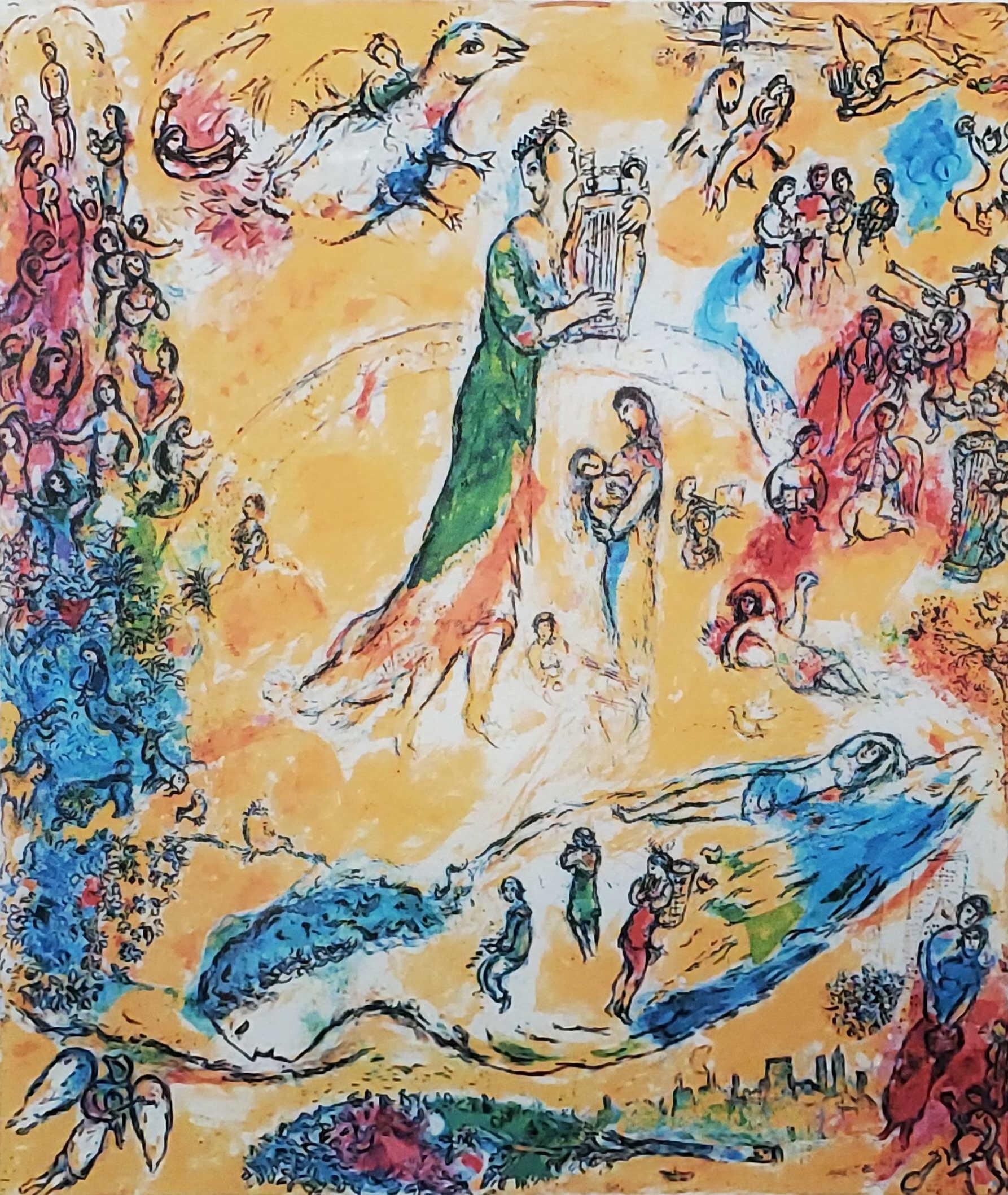
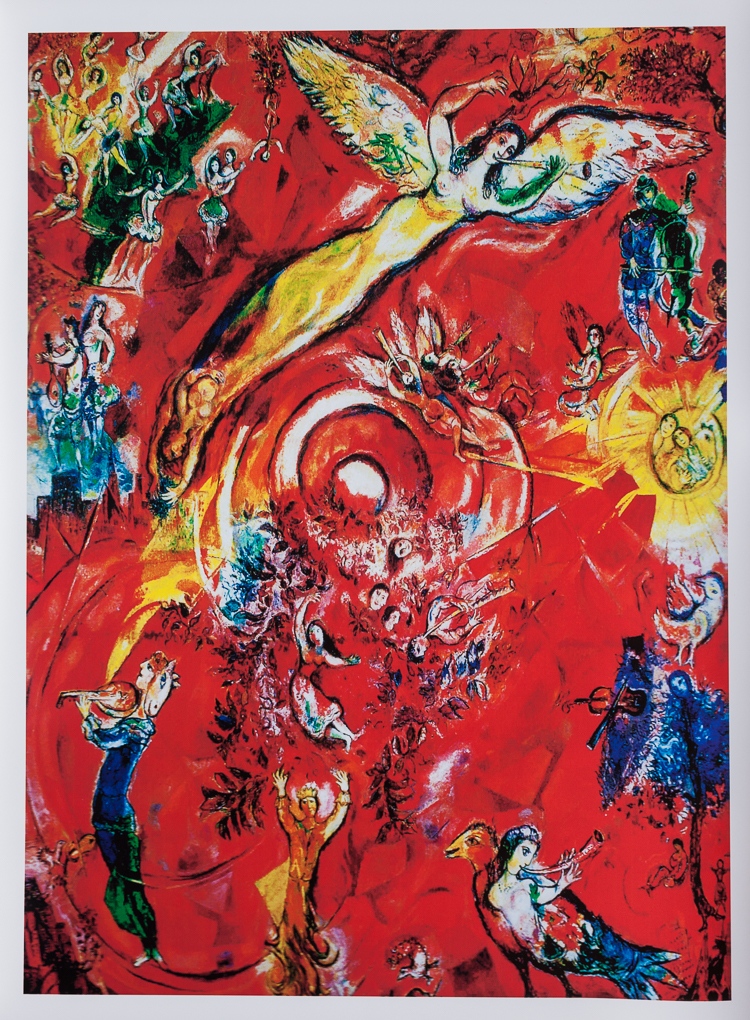
When the Metropolitan Opera House opened in 1966, it featured two massive murals, each measuring over 1,000 square feet, by the modernist master Marc Chagall. The Sources of Music and The Triumph of Music are not very visible from inside the lobby, though. The best view of them is from outside the opera house, through its enormous glass façade. The plan to sell the murals includes the condition that they remain in the opera house, with a plaque identifying the future owner on site. Specialists from Sotheby’s value the murals at $55 million.
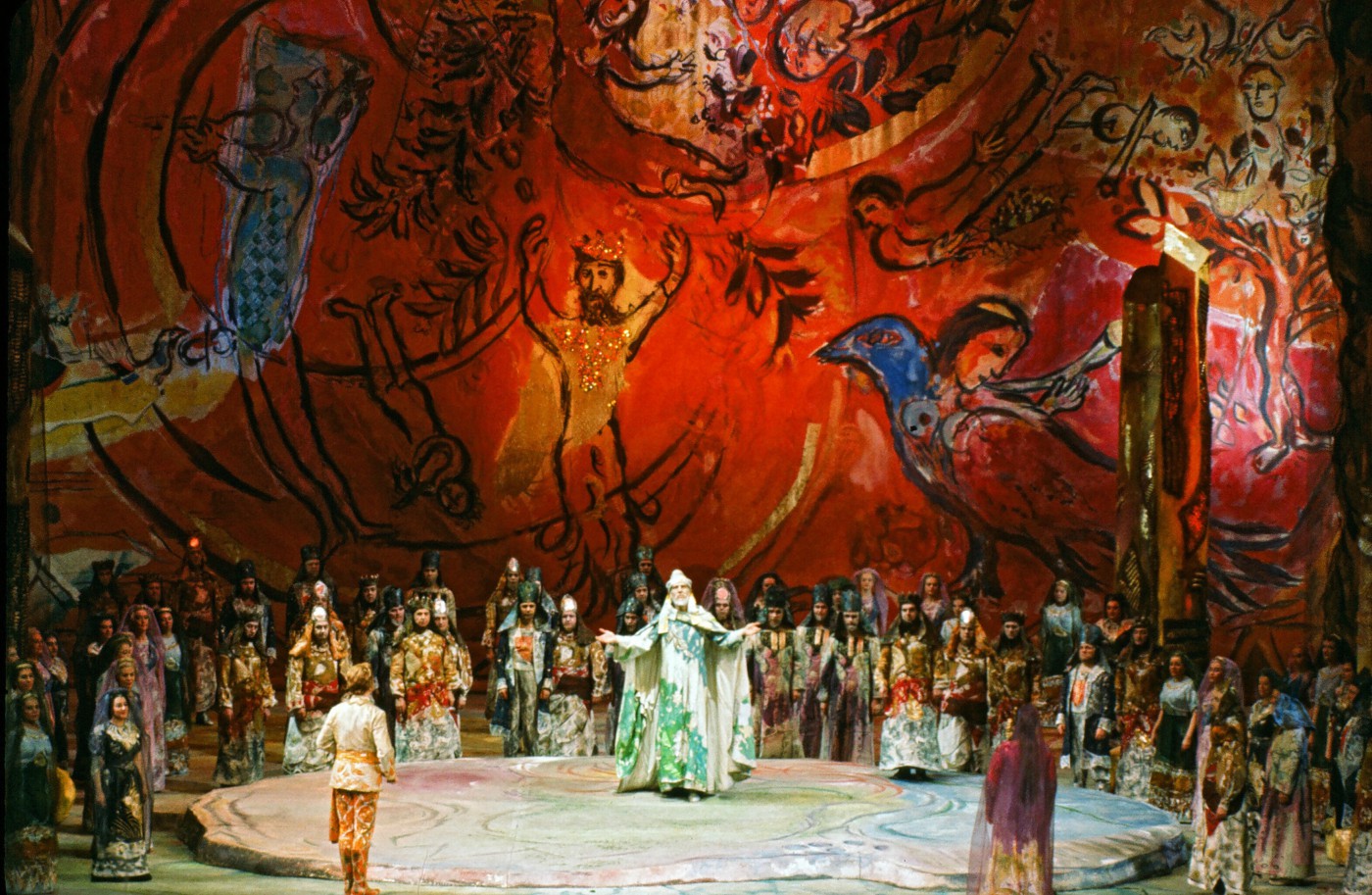
Opera house murals by Chagall are actually not unheard of outside New York. The artist was also commissioned to create murals for the Palais Garnier, the home of the Paris Opera, which was unveiled in 1964. Before creating the New York murals, the Metropolitan Opera had also commissioned Chagall to create designs for a new production of Mozart’s 1791 opera Die Zauberflöte. The Chagall production proved so popular that the Metropolitan Opera used it for the next fifteen years.
The Sources of Music is primarily bright yellow with blue accents, framing a crowned figure in the center holding a lyre, likely representing either King David or Orpheus. Surrounding this figure are angels playing violin, harp players, groups playing woodwinds and horns, many animals, and touches of modern urban life, such as skyscrapers. Many claim that Chagall added figures representing Mozart, Beethoven, Wagner, Verdi, and other composers. The features highlight the inspiration behind musical expression, both ancient and modern. It also draws on mythological and folkloric imagery, with humans, animals, and music itself emerging from nature. Its companion, The Triumph of Music, burns bright red, centered on an angel sounding their triumphal horn. Figures similar to those in The Sources of Music appear, but everything seems to be floating upwards, with music transcending the mundane and material world.
This would not be the first time the Chagall murals were used by the opera house to ensure its survival. During the 2008-9 financial crisis, the Metropolitan Opera used the murals as collateral for a $35 million loan from J.P. Morgan. The opera is also considering selling the theater’s naming rights. Should the opera find a buyer, the murals will likely become the most valuable Chagall work in the world.
|
|
|
Louvre Director Resigns
After five years on the job, Laurence des Cars has resigned as director of the Louvre.
Des Cars tendered her resignation to President Emmanuel Macron earlier this week. She had previously offered her resignation to the president in the immediate aftermath of the October 2025 crown jewels heist, but Macron refused to accept it.
Prior to her taking the helm of the world’s most-visited museum, des Cars previously served as director of the Musée d’Orsay and the Musée de l’Orangerie, both in Paris. She was appointed to the position in 2021, making her the first female director of the Louvre. Despite some successes, such as the Jacques-Louis David retrospective and the increased acquisition of modern and contemporary artworks, some predict that des Cars’s time as director will likely be characterized by institutional failures that expose the museum’s infrastructural and security issues.
As part of President Macron‘s cultural agenda, des Cars signed off on a major renovation project called the Nouvelle Renaissance. Notably, the plan included a new museum entrance by the River Seine and a 33,000-square-foot wing dedicated to the Mona Lisa, which would ease visitor traffic in the other galleries. The need for infrastructural improvements was driven home by several instances over the past year in which rainwater leaked into museum galleries, libraries, and archives. Museum staff have gone on strike several times during des Cars’s directorship, partially to call attention to the need for improvements.
And of course, one of the top art-world moments of 2025 was the October heist that saw the theft of some of France’s crown jewels, valued at €88 million. The investigation is ongoing, but several arrests have been made. The stolen jewels have not been recovered, but the crown of Empress Eugénie will soon be restored after being damaged in the incident.
The most recent scandal to rock the Louvre occurred only this month. Paris police have arrested nine people for allegedly conspiring to defraud the museum through several methods. These conspirators, mainly tour guides, were found to have reused tickets, split tour groups to avoid extra fees, and bribed museum employees. Using these methods for close to ten years, authorities allege that the suspects cost the Louvre €10 million. When questioned, some officials, like the museum’s administrator general, Kim Pham, said that some fraud is inevitable for a museum as large as the Louvre. However, the museum administration has stated it will revise its ticket validation policies to prevent this fraud from happening again.
In a statement, des Cars wrote that being director of the Louvre was “the honor of my professional life.” President Macron has since announced his candidate to replace des Cars, the director of the Palace of Versailles, Christophe Leribault.
|
|
|
Angel or Devil?: Fresco Restorer Inserts Face of Italian PM Meloni
An art conservator in Italy is coming under fire after an angel in a restored fresco now bears an uncanny resemblance to the country’s current far-right prime minister, Georgia Meloni.
San Lorenzo in Lucina is a Catholic basilica in the center of Rome. While a church has existed on the site since the fourth century CE, the current structure dates to the seventeenth century. It contains several notable works of art, including Guido Reni’s crucifixion altarpiece and a marble bust by Gian Lorenzo Bernini. Furthermore, the great French Baroque painter Nicolas Poussin is buried in one of the chapels. The last chapel on the right side of the church, closest to the altar, is sometimes called the Cappella Nataletti, named after the wealthy family that leased it in the nineteenth century. The chapel features a large seventeenth-century painted wooden crucifix and a Madonna & Child painting by Onofrio Avellino. The chapel also features a memorial to Umberto II, the last King of Italy.
In 1946, Italy held a referendum on whether to retain or abolish the monarchy. Umberto’s father, King Victor Emmanuel III, had abdicated to give the institution a better shot at survival. This was a prudent move, as his reign was tainted by his embrace of Benito Mussolini. But it was not enough. The electorate voted 54% in favor of a republic, abolishing the monarchy. Umberto spent the rest of his life in Portugal. The chapel’s memorial includes a marble bust of the king and surrounding frescoes. These include a pair of angels, one with a crown and the other with a scroll showing the outline of Italy. The angel with the scroll is the figure that resembled the current prime minister.
Meloni is the leader of the right-wing nationalist party Fratelli d’Italia (Brothers of Italy). She is the first female leader in Italy’s modern history, and her premiership has been described as the most right-wing government the country has had since the Second World War. Her party can be traced directly to Mussolini, descending from the Movimento Sociale Italiano, founded by former fascists after the Second World War. Meloni has habitually violated civil liberties, particularly of non-citizens, queer people, and the press. Her government has banned surrogacy, opposed the implementation of hate speech legislation, and has been seeking a constitutional ban on same-sex adoption. But most importantly, she has taken a hard-line stance on immigration, with her government rejecting two-thirds of asylum-seekers’ claims in 2024.
Conservation work began at San Lorenzo in Lucina in 2023 following water damage to some of the frescoes in the chapels. The basilica’s rector, Daniele Micheletti, commented, “We were surprised. We did not see the work until the scaffolding came down.” The diocese of Rome also issued a statement, saying that the alleged changes made to the angel were “an initiative of the decorator not communicated to the competent bodies”. The conservator, Bruno Valentinetti, initially insisted that he restored the angel in accordance with reference materials and that any resemblance to Meloni was unintentional. Many did not accept this assertion, especially when they saw a before-and-after photograph of the angel that shows numerous differences that are difficult to excuse or explain away. Meloni herself commented on the matter, posting an image of the restored painting on Instagram with the caption, “No, I definitely do not look like an angel.”
However, Valentinetti did later confess. After a few days, the Italian newspaper La Repubblica reported that Father Micheletti and Cardinal Baldassare Reina had spoken with Valentinetti and ordered him to cover the angel’s face. The restorer confessed, “Yes, it’s the Prime Minister’s face, but in a style similar to the previous painting.” Cardinal Reina is the Vatican’s vicar general, responsible for overseeing the administration of the Diocese of Rome on behalf of the Pope, its bishop. The diocese has instructed that the angel’s face be restored to its previous appearance.
While Meloni’s face is no longer visible, Valentinetti may get more than just bad publicity. He may have violated Article 169 of Italy’s Cultural Heritage Code. This section states that the penalty is “imprisonment from six months to one year and a fine from 775 to 38,734.50 euros” for anyone who “demolishes, removes, modifies, restores or carries out works of any kind” without authorization. The city of Rome’s Special Superintendency began archival research as part of an investigation to determine whether Valentinetti indeed violated this provision.
35 Long-Hidden Rembrandt Prints Rediscovered in the Netherlands
Earlier this month, a remarkable trove of Rembrandt van Rijn’s prints resurfaced in the Netherlands after nearly a century out of sight. A set of 35 rare etchings by the Dutch master, long forgotten in a family safe, has been brought back into public view and is now slated for exhibition.
The works were originally acquired in the early 20th century by the grandfather of collector Charlotte Meye. It wasn’t until the pandemic that Meyer decided to have the collection examined by specialists from the Rembrandt House Museum in Amsterdam. Experts were reportedly surprised by the exceptional condition and art historical significance of the prints once they were uncovered and assessed.
These rediscovered etchings include works spanning a broad range of Rembrandt’s graphic output — pieces less familiar to the general public than his iconic paintings but deeply central to his artistic legacy. After they were authenticated, plans were made for a dedicated exhibition at the Stedelijk Museum Zutphen titled “Rembrandt: From Dark to Light.” The show, opening on March 21 and running through June 14, 2026, will not only feature the 35 prints but also include additional works by Rembrandt’s predecessors, contemporaries, and followers drawn from Meyer’s wider collection and loans from nearby museums.
Capitol Calder to Be Restored
After over a decade, a monumental Alexander Calder sculpture on Capitol Hill will be restored.
The Hart Senate Office Building first opened in 1982. During construction in the 1970s, Alexander Calder was selected as part of a competition to create a sculpture for the building’s central atrium. The resulting work was Mountains & Clouds, the final scale model for which Calder presented in Washington the day before his death on November 11, 1976. Mountain & Clouds is, therefore, Calder’s final work, completed in November 1986.
The sculpture is made from aircraft aluminum painted black to contrast against the polished marble of the atrium’s interior. It is composed of two main parts: the mountains, made from four large metal plates forming five peaks; and the clouds, four pieces suspended overhead, similar to the artist’s earlier mobile sculptures. It is the only work Calder created made from both stationary and mobile components. However, while Calder’s other mobiles relied on airflow to move them, drafts and breezes in the Hart Building were limited. The cloud component moved thanks to small motors controlled by computers that generated random patterns. The entire work was 51 feet tall, with the clouds covering an area 75 feet wide.
Staffers in the Hart Building can walk around the sculpture up close and even walk through the arch in one of the mountains. The building’s atrium is also lined with walkways leading to the offices, meaning that viewers can, in a way, scale the mountains as they ascend from one floor to the next. However, the mountains and the clouds became separated at one point and have never been reunited.
In 2014, analysis revealed that the 4,300-pound cloud segment may have been structurally compromised, prompting its removal from the atrium. Since then, only the mountains have remained, with promises to restore the complete sculpture contingent on when funding becomes available. After over a decade, the money to finance this restoration has been secured through private donations solicited by the Calder Foundation. The Architect of the Capitol, the agency responsible for maintenance of the Capitol grounds, has stated that it will collaborate with the Calder Foundation to completely reconstruct the mobile portion for Mountains & Clouds in accordance with Calder’s original designs.
Mountains & Clouds is scheduled to be fully restored later this year.
|
|
|
Thank you for following along with our Comments on the Art Market. Stay tuned for more art news, discoveries, and gallery highlights in next month’s newsletter.
|
|
The Rehs Family
© Rehs Galleries, Inc., New York – March 2026
SUBSCRIBE
To subscribe to our monthly Comments On The Art Market newsletter,
click here.
ARCHIVES
September 2026 - Volume 309
August 1, 2026 - Volume 308
July 1, 2026 - Volume 307
June 1, 2026 - Volume 306
May 2, 2026 - Volume 305
April 4, 2026 - Volume 304
March 1, 2026 - Volume 303
- Volume 302
January 2026 - Volume 301
December 1, 2025 - Volume 300
November 1, 2025 - Volume 299
October 1, 2025 - Volume 298
September 1, 2025 - Volume 297
August 1, 2025 - Volume 296
7/1/2025 - Volume 295
June 1, 2025 - Volume 294
May 3, 2025 - Volume 293
April 1, 2025 - Volume 292
March 1, 2025 - Volume 291
February 1, 2025 - Volume 290
January 1, 2025 - Volume 289
December 1, 2024 - Volume 288
November 1, 2024 - Volume 287
October 1, 2024 - Volume 286
September 1, 2024 - Volume 285
August 1, 2024 - Volume 284
July 1, 2024 - Volume 283
June 1, 2024 - Volume 282
May 1, 2024 - Volume 281
April 1, 2024 - Volume 280
March 1, 2024 - Volume 279
February 1, 2024 - Volume 278
January 1, 2024 - Volume 277
December 1, 2023 - Volume 276
November 1, 2023 - Volume 275
October 1, 2023 - Volume 274
September 1, 2023 - Volume 273
August 1, 2023 - Volume 272
July 1, 2023 - Volume 271
June 1, 2023 - Volume 270
May 1, 2023 - Volume 269
April 1, 2023 - Volume 268
March 1, 2023 - Volume 267
February 1, 2023 - Volume 266
January 1, 2023 - Volume 265
December 1, 2022 - Volume 264
November 1, 2022 - Volume 263
October 1, 2022 - Volume 262
September 1, 2022 - Volume 261
August 1, 2022 - Volume 260
July 1, 2022 - Volume 259
June 1, 2022 - Volume 258
May 1, 2022 - Volume 257
April 1, 2022 - Volume 256
March 1, 2022 - Volume 255
February 1, 2022 - Volume 254
January 1, 2022 - Volume 253
December 1, 2021 - Volume 252
November 1, 2021 - Volume 251
October 1, 2021 - Volume 250
September 1, 2021 - Volume 249
August 1, 2021 - Volume 248
July 1, 2021 - Volume 247
June 1, 2021 - Volume 246
May 1, 2021 - Volume 245
April 1, 2021 - Volume 244
March 1, 2021 - Volume 243
February 1, 2021 - Volume 242
January 1, 2021 - Volume 241
December 1, 2020 - Volume 240
November 1, 2020 - Volume 239
October 1, 2020 - Volume 238
September 1, 2020 - Volume 237
August 1, 2020 - Volume 236
July 1, 2020 - Volume 235
June 1, 2020 - Volume 234
May 1, 2020 - Volume 233
April 1, 2020 - Volume 232
March 1, 2020 - Volume 231
February 1, 2020 - Volume 230
January 1, 2020 - Volume 229
December 1, 2019 - Volume 228
November 1, 2019 - Volume 227
October 1, 2019 - Volume 226
September 1, 2019 - Volume 225
August 1, 2019 - Volume 224
July 1, 2019 - Volume 223
June 1, 2019 - Volume 222
May 1, 2019 - Volume 221
April 1, 2019 - Volume 220
March 1, 2019 - Volume 219
February 1, 2019 - Volume 218
January 1, 2019 - Volume 217
December 1, 2018 - Volume 216
November 1 2018 - Volume 215
October 1, 2018 - Volume 214
September 1, 2018 - Volume 213
August 1, 2018 - Volume 212
July 1, 2018 - Volume 211
June 1, 2018 - Volume 210
May 1, 2018 - Volume 209
April 1, 2018 - Volume 208
March 1, 2018 - Volume 207
February 1, 2018 - Volume 206
January 1, 2018 - Volume 205
December 1, 2017 - Volume 204
November 1, 2017 - Volume 203
October 1, 2017 - Volume 202
September 1, 2017 - Volume 201
August 1, 2017 - Volume 200
July 1, 2017 - Volume 199
June 1, 2017 - Volume 198
May 1, 2017 - Volume 197
April 1, 2017 - Volume 196
March 1, 2017 - Volume 195
February 1, 2017 - Volume 194
January 1, 2017 - Volume 193
December 1, 2016 - Volume 192
November 1, 2016 - Volume 191
October 1, 2016 - Volume 190
September 1, 2016 - Volume 189
August 1, 2016 - Volume 188
July 1, 2016 - Volume 187
June 1, 2016 - Volume 186
May 1, 2016 - Volume 185
April 1, 2016 - Volume 184
March 4, 2016 - Volume 183
February 5, 2016 - Volume 182
January 1, 2016 - Volume 181
December 1, 2015 - Volume 180
November 2, 2015 - Volume 179
October 1, 2015 - Volume 178
September 1, 2015 - Volume 177
August 1, 2015 - Volume 176
July 1, 2015 - Volume 175
June 1, 2015 - Volume 174
May 1, 2015 - Volume 173
April 1, 2015 - Volume 172
March 1, 2015 - Volume 171
February 1, 2015 - Volume 170
January 1, 2015 - Volume 169
December 1, 2014 - Volume 168
November 1, 2014 - Volume 167
October 1, 2014 - Volume 166
September 1, 2014 - Volume 165
August 1, 2014 - Volume 164
July 1, 2014 - Volume 163
June 1, 2014 - Volume 162
May 1, 2014 - Volume 161
April 1, 2014 - Volume 160
March 1, 2014 - Volume 159
February 1, 2014 - Volume 158
January 1, 2014 - Volume 157
December 1, 2013 - Volume 156
November 1, 2013 - Volume 155
October 1, 2013 - Volume 154
September 1, 2013 - Volume 153
August 1, 2013 - Volume 152
July 1, 2013 - Volume 151
June 1, 2013 - Volume 150
May 2, 2013 - Volume 149
April 2013 - Volume 148
March 2013 - Volume 147
Feb 2013 - Volume 146
January 2013 - Volume 145
December 2012 - Volume 144
November 2012 - Volume 143
October 2012 - Volume 142
September 2012 - Volume 141
August 2012 - Volume 140
July 2012 - Volume 139
June 2012 - Volume 138
May 2012 - Volume 137
April 2012 - Volume 136
March 2012 - Volume 135
February 2012 - Volume 134
January 2012 - Volume 133
December 2011 - Volume 132
November 2011 - Volume 131
October 2011 - Volume 130
September 2011 - Volume 129
August 2011 - Volume 128
July 2011 - Volume 127
June 2011 - Volume 126
May 2011 - Volume 125
May 2011 - Volume 125A
April 2011 - Volume 124
March 2011 - Volume 123
February 2011 - Volume 122
January 2011 - Volume 121
December 2010 - Volume 120
November 2010 - Volume 119
October 2010 - Volume 118
September 2010 - Volume 117
August 2010 - Volume 116
July 2010 - Volume 115
June 2010 - Volume 114
May 2010 - Volume 113
April 2010 - Volume 112
March 2010 - Volume 111
February 2010 - Volume 110
January 2010 - Volume 109
December 2009 - Volume 108
November 2009 - Volume 107
October 2009 - Volume 106
September 2009 - Volume 105
August 2009 - Volume 104
July 2009 - Volume 103
June 2009 - Volume 102
May 2009 - Volume 101
April 2009 - Volume 100
March 2009 - Volume 99
February 2009 - Volume 98
January 2009 - Volume 97
December 2008 - Volume 96
November 2008 - Volume 95
October 2008 - Volume 94
September 2008 - Volume 93
August 2008 - Volume 92
July 2008 - Volume 91
June 2008 - Volume 90
May 2008 - Volume 89
April 2008 - Volume 88
March 2008 - Volume 87
February 2008 - Volume 86
January 2008 - Volume 85
December 2007 - Volume 84
November 2007 - Volume 83
October 2007 - Volume 82
September 2007 - Volume 81
August 2007 - Volume 80
July 2007 - Volume 79
June 2007 - Volume 78
May 2007 - Volume 77
April 2007 - Volume 76
March 2007 - Volume 75
February 2007 - Volume 74
January 2007 - Volume 73
December 2006 - Volume 72
November 2006 - Volume 71
October 2006 - Volume 70
September 2006 - Volume 69
August 2006 - Volume 68
July 2006 - Volume 67
June 2006 - Volume 66
May 2006 - Volume 65
April 2006 - Volume 64
March 2006 - Volume 63
February 2006 - Volume 62
January 2006 - Volume 61
December 2005 - Volume 60
November 2005 - Volume 59
October 2005 - Volume 58
September 2005 - Volume 57
August 2005 - Volume 56
July 2005 - Volume 55
June 2005 - Volume 54
May 2005 - Volume 53
April 2005 - Volume 52
March 2005 - Volume 51
February 2005 - Volume 50
January 2005 - Volume 49
December 2004 - Volume 48
November 2004 - Volume 47
October 2004 - Volume 46
September 2004 - Volume 45
August 2004 - Volume 44
July 2004 - Volume 43
June 2004 - Volume 42
May 2004 - Volume 41
April 2004 - Volume 40
March 2004 - Volume 39
February 2004 - Volume 38
January 2004 - Volume 37
December 1, 2003 - Volume 36
November 2003 - Volume 35
October 2003 - Volume 34
September 2003 - Volume 33
August 2003 - Volume 32
July 2003 - Volume 31
June 2003 - Volume 30
May 2003 - Volume 29
April 2003 - Volume 28
March 1, 2003 - Volume 27
February 1, 2003 - Volume 26
January 1, 2003 - Volume 25
December 1, 2002 - Volume 24
November 1, 2002 - Volume 23
October 1, 2002 (Updated: January 16, 2016) - Volume 22
September 1, 2002 (Edited 2015) - Volume 21
August 1, 2002 - Volume 20
July 1, 2002 - Volume 19
June 1, 2002 - Volume 18
May 1, 2002 (Edited 2008) - Volume 17
April 1, 2002 (Edited 2008) - Volume 16
March 1, 2002 (Edited 2008) - Volume 15
February 1, 2002 (Edited 2008) - Volume 14
January 1, 2002 (Edited 2008) - Volume 13
December 1, 2001 - Volume 12
November 1, 2001 (Edited 2008) - Volume 11
October 1, 2001 - Volume 10
September 1, 2001 (Edited 2008) - Volume 9
August 1, 2001 (Edited 2008) - Volume 8
July 1, 2001 (Edited 2008) - Volume 7
June 1, 2001 (Edited 2008) - Volume 6
May 1, 2001 (Edited 2008) - Volume 5
April 1, 2001 (Edited 2008) - Volume 4
March 1, 2001 (Edited 2008) - Volume 3
February 1, 2001 (Edited 2008) - Volume 2
January 1, 2001 (Edited 2008) - Volume 1