
COMMENTS ON THE ART MARKET
Current Exhibition – Sweet Treats
Now – September 26th
The gallery is brimming with eye-catching, mouth-watering works! From Kevin Champeny’s towering ice cream cone mosaic, crafted from 10,000 individual scoops, to Joel Carson Jones’ delicate trompe-l’œil painting of a shiny red lollipop taped to its panel, there’s something to satisfy every sweet tooth. Stop by anytime through September 26th to feast your eyes on this delectable exhibition.
____________________
Stocks & Crypto
Another month down and somehow summer is over… ugh, can’t we just get a few more weeks of warmth?! I know it’s not happening, but hopefully the markets won’t cool off with the weather – August, which is historically a down month for stocks, bucked the trend this time around.
When the markets closed on Friday, all three major US indexes secured another positive month… even with a notable retreat on the final day of trading, the Nasdaq finished off August with a 1.6% gain, which is its fifth straight month in the green. The S&P 500 and Dow, which turned in 1.4% and 2% gains this month, both continued pushing record highs… those indexes have been on a 4-month winning streak. All good, right? Maybe not.
As I always stress, “the stock market” is not synonymous with “the economy,” and things have been weird lately… the AI boom is starting to feel a bit bubbly, as insiders warn that the technology is nowhere near ready for widespread deployment. Aside from the shortcomings of AI itself, there are power issues, security issues, and social issues… while the tech is promising, it feels like the market has overextended itself in relation to companies that specialize in AI and AI tangent businesses. Separately, the most recent government data showed that inflation rose in July while US consumer sentiment declined to a three-month low… there is a reasonable concern that inflation will be a problem over the next year. Adding to the concern is as of yesterday, August 29th, the US ended the de minimis rule (an exemption from the Tariff Act of 1930), which allowed packages worth $800 or less to enter the country tariff-free… I know some of you think it may sound dramatic, but numerous countries have already suspended US consumers orders; from what I’m reading, that list is up to 30 countries, including Australia, France, Germany, Greece, India, Italy, Japan, South Korea, Spain, Taiwan, and obviously many others. There are a lot of moving parts here, so it’s worth paying attention to more than simply the +/- of the stock market to gauge the health of our economy.
Looking at currencies and commodities, performance was mixed… the US Dollar weakened against both the Pound and Euro by more than 2% in August. Crude saw a notable slide of more than 7%, while gold remained untouchable as it breached the $3,500 threshold – a fresh record high.
There was some serious volatility in the crypto world… Bitcoin surged to an all-time high of more than $120K, before retreating below $110K – it turned in a 4.5% loss this month. Ethereum didn’t see the same pullback, and recorded a 20% gain, while Litecoin followed Bitcoin’s pattern and ended roughly even for the month.
Looking ahead, I think many will be awaiting to see what moves the Fed makes next month – if they hold steady or if there is a rate cut… that’ll be an indicator of what to expect in the near future. Hope everyone has a nice Labor Day weekend and you all enjoy what is left of summer!
.
____________________
Tales From The Dark Side
Collector Sues Christie’s Over Tainted Provenance
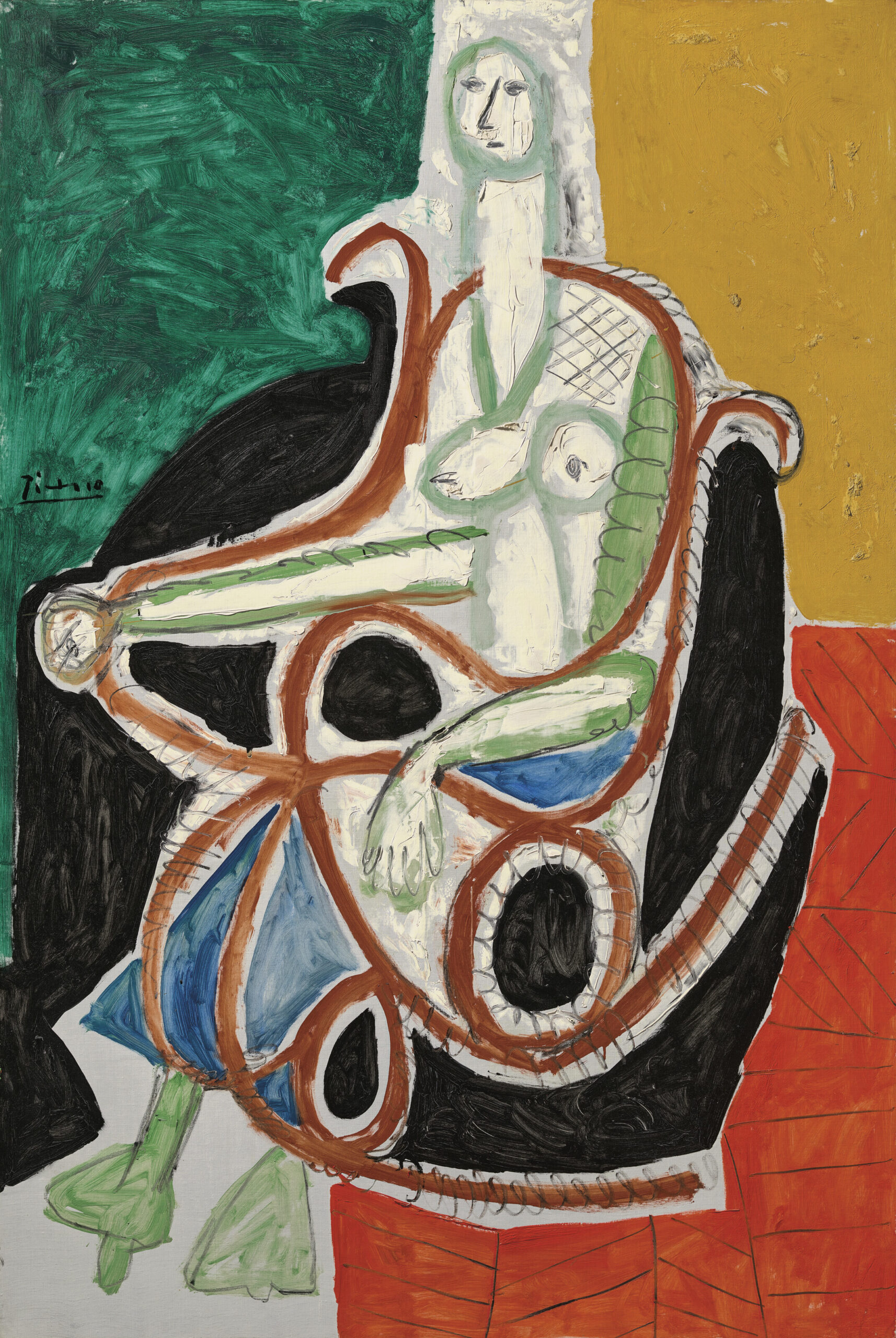
A collector is suing Christie’s for allegedly failing to disclose that a cocaine kingpin may have previously owned a Picasso painting they agreed to buy.
Sasan Ghandehari is the son of the Kazakh-born Iranian billionaire Hourieh Peramam, who made her money in real estate. Both Sasan and his wife, Yassmin, are involved in Peramam’s business and are known as prominent art collectors. Yassmin Ghandehari is a member of the Sotheby’s International Council, a co-founder of the British Fashion Council’s Fashion Trust, and a former council member for the University of the Arts London. The couple are regular donors to the Tate museums, and have amassed an impressive art collection, mainly focusing on modern and contemporary artists. They have previously been listed on the ArtNews Top 200 Collectors list. Sasan Ghandehari also occasionally serves as an intermediary to assist other collectors and large businesses in acquiring works of art for their own collections. He was working in this capacity when the Brewer Management Corporation (BMC) named him as their authorized representative in acquiring paintings from Christie’s. The company guaranteed it would purchase Pablo Picasso’s 1956 painting Femme dans un rocking-chair at a Christie’s sale in February 2023. However, Ghandehari and BMC have recently filed a lawsuit against Christie’s in the High Court of England & Wales’s Chancery Division, alleging that the auction house obfuscated the work’s provenance.
According to the painting’s webpage, the owners who consigned the work to the sale initially acquired it at Christie’s in 2007. It’s not uncommon for more recent owners to remain anonymous in the provenance sections of auction house websites. However, according to the suit, BMC would never have agreed to guarantee the Picasso if it had known the identity of the previous owner. They allege that this owner was José Mestre Fernández, one of the largest cocaine traffickers in Barcelona. Mestre operated the company TerCat, which was given the contract to oversee operations in Barcelona’s cargo port. In 2010, he was arrested and sentenced to nine years in prison after police confiscated 202 kilograms of cocaine from a cargo. The suit alleges that Christie’s had disclosed the previous owner’s identity. However, BMC claims that they never would have agreed to serve as the painting’s guarantor if they knew of Mestre’s criminal activity, since there’s a possibility that Mestre purchased the work with proceeds from his cocaine trafficking. The lawsuit demands that Christie’s cancel the contract and return the £4.8 million that BMC has already paid.
A spokesperson for Christie’s described the suit as “a straight-forward debt claim” which the auction house will “robustly defend […]. Christie’s owes duties of confidentiality to its clients, bidders and buyers but is confident that it has complied with all legal and regulatory obligations in relation to due diligence of the work and our consignor.”
____________________
The Art Market
As we approach the fall season, I would like to share a brief snapshot of where the art market stands, particularly in areas most relevant to our gallery and collectors like you.
19th & 20th Century European & American Art: Demand remains steady for top-quality works in these categories. Fresh-to-market landscapes, Impressionist scenes, and carefully preserved examples are commanding strong results, while middle-market pieces require sharper pricing. For collectors, this is a moment to upgrade quality — condition, provenance, and subject matter are more important than ever.
Contemporary Realism: In contrast to the softening of the ultra-contemporary segment, technically skilled realist painters are drawing increased attention. Our contemporary program continues to highlight artists whose works strike a balance between craftsmanship and narrative depth.
Opportunities:
- If you are considering selling, private sales through galleries and tightly curated auction placements are yielding the strongest outcomes.
- If you are building, now is an excellent time to focus on historically significant works with strong provenance and to invest in contemporary realists whose skill sets them apart from speculative trends.
As always, we are here to advise on both acquisitions and deaccessions, ensuring that your collection remains personally meaningful. Please don’t hesitate to reach out if you’d like to discuss specific opportunities or review available works in the gallery.
____________________
Deeper Thoughts
Confiscated 1MDB Art To Be Auctioned
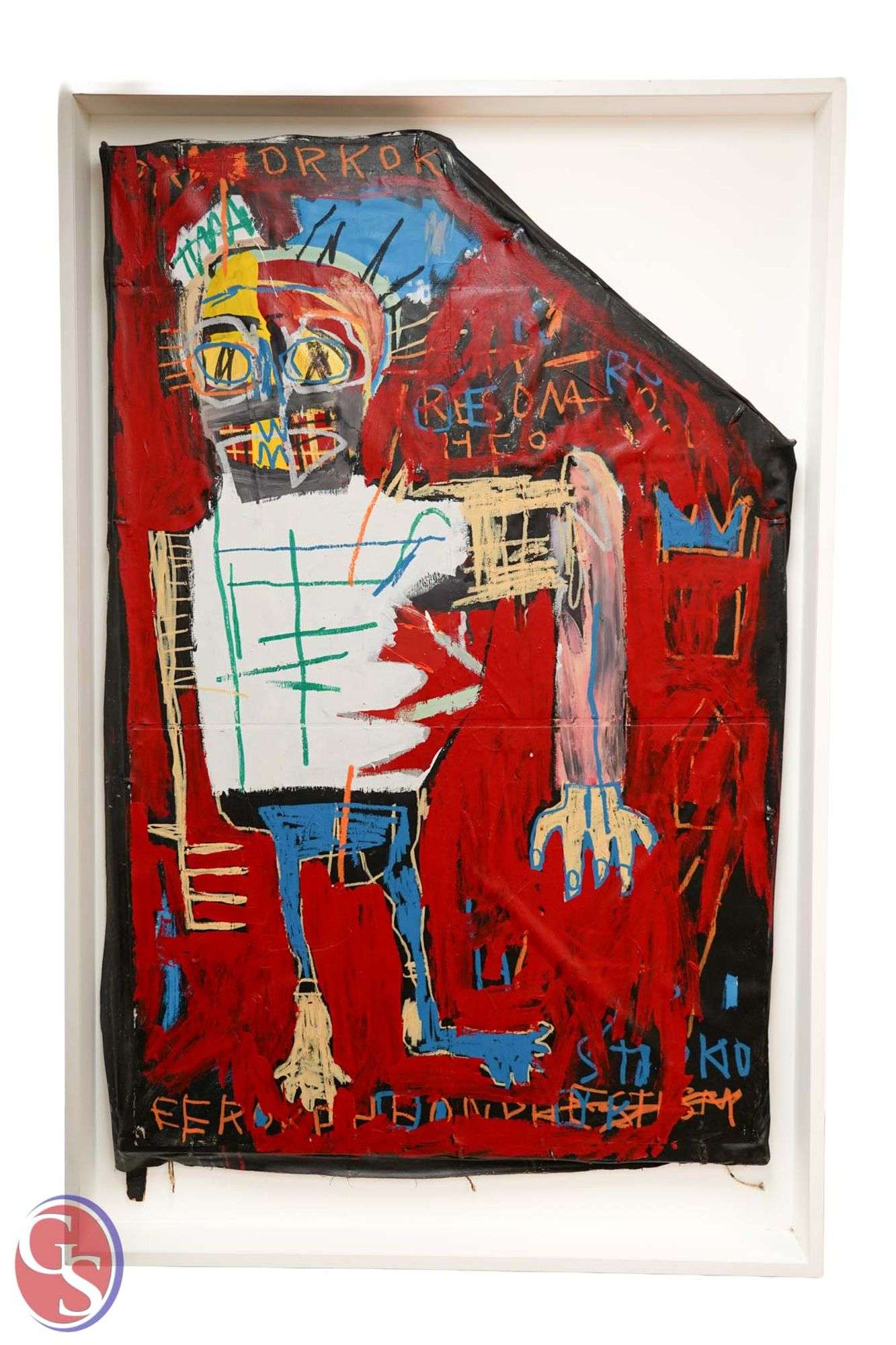
The United States Department of Justice will be auctioning off several works of art confiscated as a result of the 1MDB scandal.
Nearly a decade after the 1MDB scandal first broke, developments continue to emerge from one of the largest corruption cases in history. For those unfamiliar, the 1MDB scandal involved prominent Malaysian politicians and businesspeople, including former Prime Minister Najib Razak, who embezzled billions of dollars from the country’s sovereign wealth fund, 1Malaysia Development Berhad (1MDB). The fallout resulted in investigations in several countries, including Malaysia, the United States, Britain, Switzerland, Australia, and several others. The highest estimates, those given by Swiss investigators, place the amount of stolen money at $7 billion. Buying assets such as real estate and art was one of the most common ways to hide this money. And investigators are still in the process of confiscating these assets. The last time I wrote about this was a little over a year ago, when the Department of Justice confiscated a Picasso drawing previously owned by 1MDB’s former general counsel Jasmine Loo Ai Swan. And now, several seized works of art connected to the scandal will be auctioned off by the US Marshal Service through a small auction house in Texas.
The confiscated artworks include two pieces by Jean-Michel Basquiat, one by Pablo Picasso, and one by Diane Arbus. Bidding opened online on July 16th and is set to close on September 4th. Each lot has only received one or two bids in advance thus far, yet already these four pieces are set to make millions of dollars. The most valuable of the four 1MDB works is the Basquiat painting Red Man One, created in 1982 from acrylic paint and oilstick, along with paper and a variety of objects laid down on canvas in a collage. The work was previously sold at a contemporary evening sale at Sotheby’s in New York for $3.55 million w/p. So far, only one potential buyer has submitted a bid for $2,975,000. The other Basquiat, a 1982 crayon drawing called Self-Portrait, has received two bids, bringing the current price as of August 1st up to $852.5K. The Picasso is a 1939 oil painting called Tête de taureau et broc, which has received one bid of $850K. And finally, the Diane Arbus photograph, Child with a Toy Hand Grenade, dates to 1962. It’s received the most bids so far, bringing the current price to $4.4K, far below the auction average for her work. However, there’s still over a month to go before the lots close. The proceeds from the auction will be added to the nearly $1.5 billion the United States has returned to Malaysia.
Pearlman Foundation Donates Collection to American Museums
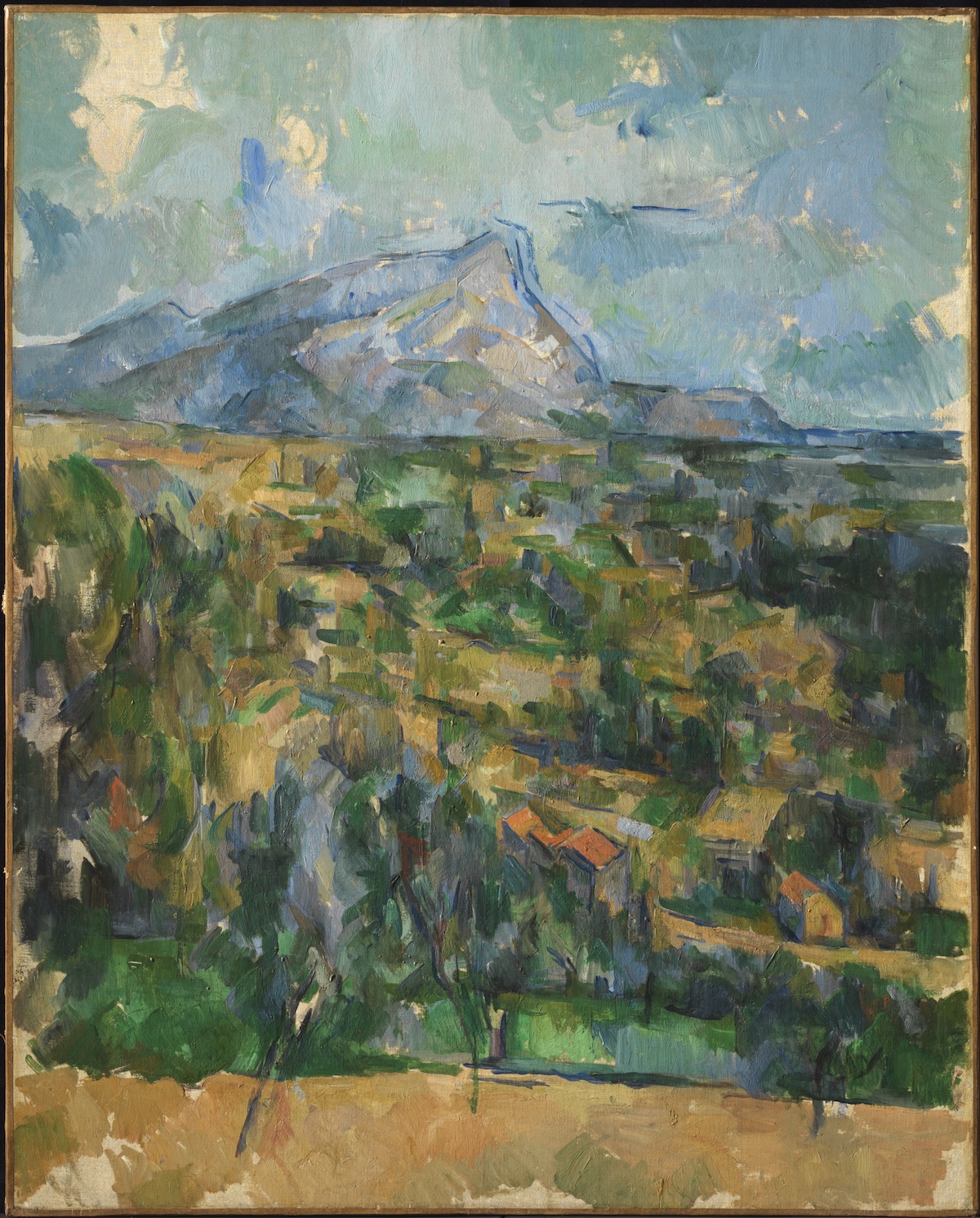
donated to the Museum of Modern Art
Several major American museums will be receiving generous donations from the Henry & Rose Pearlman Foundation.
Henry Pearlman primarily made his money in the refrigeration business, but is mainly known for his incredible art collection, containing countless Impressionist and Post-Impressionist masterworks. It all started with a single painting by Chaim Soutine, and from there he began buying works by Manet, Cézanne, Renoir, Toulouse-Lautrec, and Modigliani. In 1948, he even had his portrait painted by Oskar Kokoschka. Following his death in 1974, his collection has been in the care of the Princeton University Art Museum as a long-term loan. However, with the value of each work steadily rising over the years, insurance and transportation costs have increased as well. This has made it difficult for a single museum to oversee the entire collection. So now, the Pearlman Foundation will be donating all of its sixty-three works of art to three American museums.
The Pearlman Foundation chose these three institutions for very specific reasons. The foundation chose New York’s Brooklyn Museum because of its proximity to Pearlman’s birthplace as well as its history of community engagement. They will be receiving close to thirty works, including several by Modigliani like the portrait of Jean Cocteau and the limestone sculpture Head. Just across the East River in Manhattan, the Museum of Modern Art (MoMA) was chosen mainly for its robust prints and drawings department, which will offer a good home for the Pearlmans’ vast collection of works on paper by Cézanne, among other artworks. And finally, the Los Angeles County Museum of Art (LACMA) will be receiving works from the foundation for its “ability to innovate around bringing art to where people are”. Works such as Young Woman in a Round Hat by Manet and Tarascon Stagecoach by Van Gogh will be off to California soon. Both will become the first works by their respective artists to enter the museum’s collection. Foundation president and Pearlman’s grandson, Daniel Edelman, laid out his respective reasons for each museum, commenting, “With very different collections, communities, and presentations of art, these three great institutions share an understanding that museums, their audiences, and how those audiences engage with art, are constantly changing. All three are committed to leading that challenge and inspiring others to meet it as well.” The foundation also encourages these museums to collaborate in the future, swapping or loaning works to present art to different audiences. The Brooklyn Museum’s directors, Anne Pasternak, Shelby White, and Leon Levy, commented on how accessibility was an important issue for Pearlman, and how this donation keeps with that spirit: “Henry Pearlman collected with the public in mind, believing that modern art should inspire audiences of all backgrounds.”
Starting in 2026, the three museums will take turns exhibiting the entire Pearlman collection in a traveling show called Village Square: Gifts of Modern Art from the Pearlman Collection to the Brooklyn Museum, LACMA, and MoMA. After the exhibition concludes, the museums will receive the works that have been given to them.
London’s National Gallery To Form Citizens’ Panel
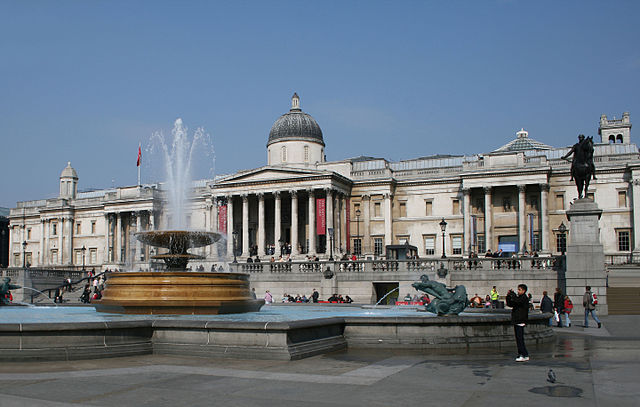
The future of museum administration may lie in a bold move that London’s National Gallery made recently to form a citizens’ panel to allow the public a greater voice in the management of one of Britain’s greatest museums.
With the help of the public participation charity Involve, the National Gallery will select members of the public to serve on a panel it is calling NG Citizens. The National Gallery is not the first museum to adopt this idea, nor the first gallery in the United Kingdom. Other cultural institutions to form citizens’ panels include the Dresden State Art Collections, the Federal Art Gallery in Bonn, the Château de Versailles, the Birmingham Museums Trust, and Nottingham’s New Art Exchange. The National Gallery announced that 15,000 households across Britain will receive an invitation to participate in the museum’s citizens panel. Those who accept will be entered into a lottery to choose fifty people, which will then be narrowed down to twenty. This group will form NG Citizens for the next five years. Its aim is not for ordinary people to have a hand in crafting policy or curating exhibitions, but rather to have a greater influence in shaping the mission and direction of the gallery. “The gallery aims to shape its programmes and priorities around the needs and aspirations of communities across the UK,” an official statement read. These sorts of initiatives are incredibly important, especially in Britain, where both funding and visitorship for most museums have decreased in recent years. The new Labour government under Keir Starmer has made attempts to remedy that, yet many cultural institutions, like small regional museums, still struggle to remain open.
The citizens’ panel assembled by the Birmingham Museum Trust has already submitted its recommendations, which the museum administration has formulated into a five-year plan. In due time, NG Citizens will do the same. Museums need to remain irrelevant to the broader public. The arts can sometimes be seen as a realm for the rich, especially since the elevated cost of living has made the arts more difficult as a profession. But museums are often a key institution in making the art world more accessible. Even though panels like NG Citizens are not permanent bodies, they will doubtless be crucial in ensuring that these museums remain an integral part of their areas’ cultural life. Making these citizens’ panels a more regular aspect of museum governance may hopefully be something we see more of in the future.
Let The Man Out Of Chicago’s Bean
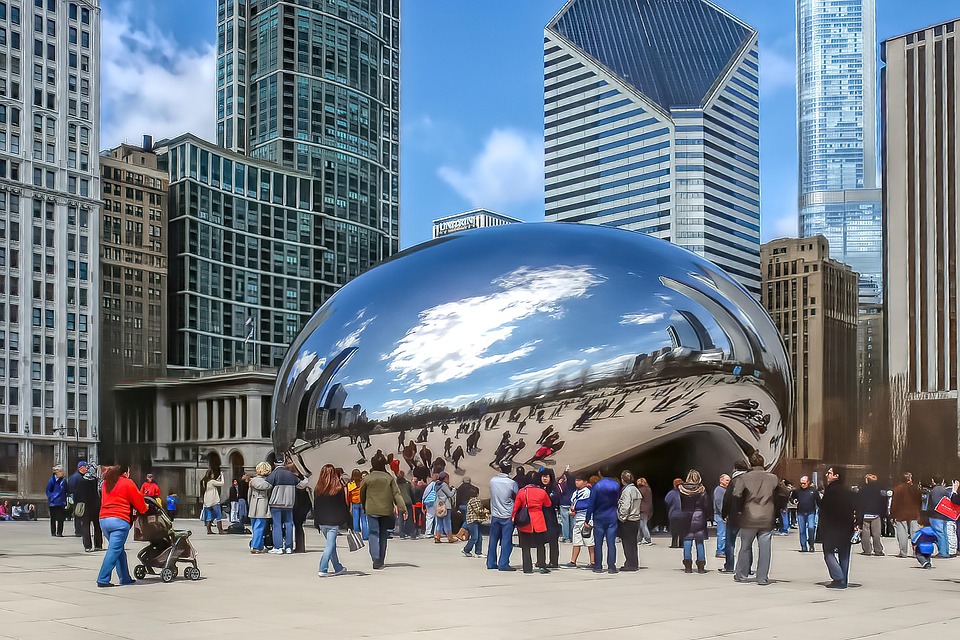
known as The Bean, in Chicago’s Millennium Park
Anish Kapoor’s sculpture Cloud Gate, popularly known as The Bean, has been the subject of many satirical works and conspiracy theories ever since it was erected in Chicago’s Millennium Park in 2006. One theory, however, gained popularity this past week after demonstrators called for the release of a man who has allegedly been trapped inside the sculpture all this time.
The Man in Bean Coalition alleges (in jest) that at the beginning of construction in 2004, Kapoor kidnapped a child and placed it inside the sculpture itself, supplying air and food through a series of vents. The movement further claims that the sculpture itself is not made from plates of polished stainless steel, but it is, in fact, an enormous one-way mirror. What some are calling the Man in Bean protests have mainly been confined to the Internet, but an in-person protest occurred on July 31st. In videos of the protest, demonstrators could be heard chanting, “We’ll scream, we’ll shout, Anish Kapoor, let him out!” The goal of the Man in Bean Coalition is to secure the release of this unknown person by putting pressure on figures such as Brendan Reilly, alderman for Chicago’s 42nd ward, where Millennium Park is located. Understanding the effort to be a humorous one, Reilly played along. “I am happy to confirm that a man has not been trapped inside ‘Cloud Gate’ (aka ‘the Bean’) for the past 21 years. In fact, the man was freed years ago. Further, we can neither confirm nor deny that Soldier Field is actually a flying saucer secretly relocated from Area 51 back in 2003.” Reilly has also urged the public to refrain from calling his office, as it has proved distracting for his staff.
The Man in Bean Coalition’s campaign has received support from several prominent individuals and organizations. The renowned Chicago pizza chain Lou Malnati’s expressed its support for the coalition’s efforts to release the man from The Bean. The restaurant’s social media accounts have claimed, “There is a man in the Bean. Throughout the years, many of our drivers have delivered to him. He is registered in our system as ‘First name: Man in the, Last name: Bean Please free m’. Unfortunately, our system has a character limit and would not allow him to fill out the rest.” Another supporter of the coalition is British artist Stuart Semple, who for years has taken advantage of every opportunity to poke fun at anything related to Anish Kapoor. Semple has, in years past, created his own line of pigments to protest Kapoor buying the rights to Vantablack, an incredibly dark black paint. He has made other pigments to criticize figures and companies that claim to own specific colors, including Tiffany and Mattel. This is also far from the first time that The Bean has become the center of a joke or work of satire. 2017 in particular saw a slew of events created on Facebook where people sought to dress the sculpture as a ghost for Halloween, roast and brew it into coffee, have it cooked by Guy Fieri, and roll it into Lake Michigan to see if it would float.
Despite Reilly’s answer, the campaign has doubled down on its allegations, encouraging followers to disregard reports from what it calls “Big Bean Media”. While the intent of these joke protests may have been difficult to determine before, it is starting to become clearer. To many, they now seem like a sort of parody of the current political and media ecosystems in the United States, namely the lack of trust between the public, news media, and our political leaders. Regardless of the reassurance given by politicians, the answers they provide to our questions will hardly be satisfactory for some people. But regardless of the organizers’ intent, in a time now where more and more people are taking to the streets to defend the rights and freedoms of themselves and their neighbors, some levity and silliness is most welcome.
Activists Install Anish Kapoor Work On Offshore Oil Rig

activists on a North Sea oil rig (photo courtesy of Greenpeace)
Anish Kapoor, one of the most famous and influential living artists in the world today, has once again demonstrated the power of art in activism. While last week people used his sculpture Cloud Gate (also known as The Bean) to stage satirical protests and demonstrations, this week his work has been used for a very different purpose: as a protest against the fossil fuel industry.
On the morning of Wednesday, August 13th, a group of activists associated with Greenpeace traveled forty-five miles by boat from Norfolk, England, to scale an offshore gas rig operated by the petroleum company Shell. They unfurled a 96-square-meter canvas from the rig’s side, attaching a hose at the top and allowing 1,000 liters of crimson liquid to pour down, creating a harrowing image resembling a blood stain. The red dye used in the work is nontoxic and biodegradable, made with a combination of seawater, beetroot powder, and other substances. Kapoor has titled the work Butchered, a name that reflects the brutal impact of the fossil fuel industry on our planet. He commented, “The carbon dioxide released by burning fossil fuels is invisible, but we are witnessing the devastation that its extraction wreaks on our world. What still remains largely hidden is the responsibility oil giants like Shell bear for causing this destruction and profiting from worldwide suffering.” Kapoor touches upon an incredibly relevant issue for many. Governments and industry often shift the responsibility of climate change onto the public by urging reductions in plastic waste and gasoline usage. They are ready to discuss the carbon footprint of an individual, yet the impact of regular people is infinitesimally small when compared to that of large corporations. “I wanted to make something visual, physical, visceral to reflect the butchery they are inflicting on our planet: a visual scream that gives voice to the calamitous cost of the climate crisis, often on the most marginalised communities across the globe.”
This is not the first time Kapoor has weighed in on environmental issues. He was one of the most prominent art world figures who called for British cultural institutions to sever ties with British Petroleum (BP), something that the British Museum has failed to do. He has also worked with Greenpeace in the past, being part of its Polluters Pay Pact initiative, calling on governments to enact harsher restrictions on large, corporate polluters. According to a study published in April 2025 by ecologists Christopher W. Callahan and Justin S. Mankin, climate change caused by corporations has already caused $28 trillion in damage to the planet, with half of that number being attributable to just ten companies, including Chevron, British Petroleum, ExxonMobil, and others. Shell alone is estimated to have caused $1.42 trillion in damage due to the extraction and use of fossil fuels. Despite this, the company plans to create nearly seven hundred new projects, including rigs, pipelines, refineries, and other infrastructure, which would only add to the cost.
Sweet Treats: Desserts & The Arts
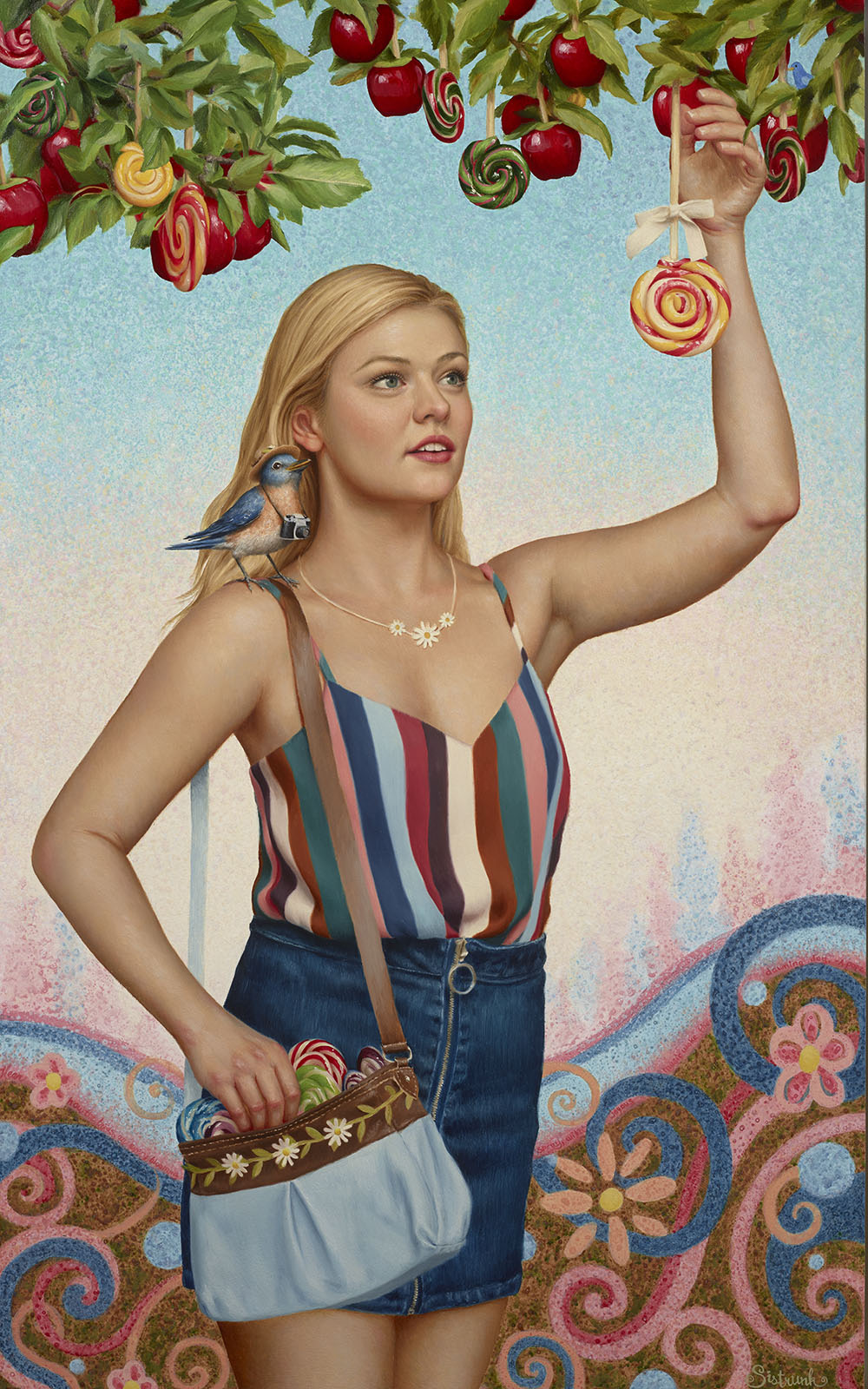
Food is culture. It’s one of the most readily accessible, tangible expressions of identity that most of us experience. Understanding the food of a culture, a country, or a region is a crucial step in grasping the climate, religion, values, and personality that make each culture unique. And because of this ubiquity, artists have used food as a subject for millennia… and sweet things are often prized above all else.
Historically, sweet things were rare and expensive. Many of the ingredients used in desserts were rather costly, either due to their rarity or the considerable distances they would have to travel to reach you. For example, for a person living in seventeenth-century Europe to buy a handful of sweets, cane sugar would often have to travel from the plantations of Brazil and the Caribbean. Nuts like almonds would have to be transported from the Middle East. Both chocolate and vanilla only came from Mexico at the time. And most spices had to come from India or Indonesia on Portuguese or Dutch ships, traveling 6,200 nautical miles each way by going around the entire continent of Africa. Sweets were a luxury, and paintings featuring them as a subject often did so to show off said luxury. Osias Beert, for example, was a still-life master from Antwerp, a predecessor of Dutch Golden Age painters like Pieter Claesz and Willem Heda. In several of his paintings, he features sweets laid upon a table, including pastries and cookies. However, most interesting is a type of confection he featured in multiple paintings, often known as comfits or dragées. In works like Still-Life with Porcelain Vessels containing Sweets, they may appear like seashells or coral. They are nuts or pieces of dried fruit that have been coated with sugar in a labor-intensive process that produces a hard, sweet shell. Jordan almonds are an example of this sweet treat. Both the process of importing the sugar and the method of applying the sugar shell made comfits a valuable luxury for wealthy Europeans. Other painters like Godfried Schalcken show the luxury of sweets in more personal ways. His painting Young Woman Eating Sweets, made in the early 1680s, shows a girl caught in the act of dipping her finger into a silver bowl of sugar to give herself a little taste. Because of sugar’s rarity and value, sweets were a guilty pleasure, something that household staff like the painting’s subject needed to sneak away to enjoy. Continuing into the nineteenth century, paintings like those of American artist John F. Francis emphasized the elegance and luxury of sweets, whether they be baked goods or fresh fruit.


As the arts entered the twentieth century, production of sweet things became more industrialized, making the products cheaper to make and more readily available for a wider consumer base. While this took the exclusivity and luxury out of some sweets, that didn’t mean they disappeared from art. As sweets became more of a commodity, they became a popular subject for pop artists. Ice cream sundaes like those sold from carts and diners became the focus of a series by Andy Warhol. He also focused on commercially-produced candies and their advertising, namely Life Savers. Wayne Thiebaud became well-known for his paintings of ice cream, cake, candies, and all other sorts of sweets that could be found homemade or in the display case of a bakery. The artists featured in Rehs Contemporary’s Sweet Treats exhibition use desserts and candies for all sorts of reasons, though. The work of Stuart Dunkel, for example, turns the art of still life painting on its head by shifting the viewer’s perspective to that of a small mouse named Chuckie. In his work, macarons become seats, gumdrops become valuable treasure to defend with a toothpick, and a cupcake becomes a tower piled high with frosting. Small, consumable items gain a new purpose when we view them from Chuckie’s eyes. Chris Guest has become known for his figure painting inspired by mid-century pinup photographs. In the works exhibited at Rehs Contemporary, he uses the suggestive nature of his work paired with sweet treats such as lollipops and ice cream cones, creating a juxtaposition that recontextualizes these desserts from an innocent part of childhood towards something more titillating. And finally, the work of the late Beth Sistrunk frequently used sweets and candies to create a dazzling fantasy world where lollipops grow on trees and fence posts are made from ladyfingers. She often used bright, vibrant colors and a variety of techniques to bring this Willy Wonka world to life, almost like an adult version of a child’s fantasy land. Her paintings are also incredibly personal, as she often included self-portraits in her work. While the fantasy elements may pull people’s attention, her skill as a figure painter can often be the hidden secret of her work’s appeal. They also emphasize that sweets are made by and for people. A still-life painting of a doughnut or a bowl of ice cream can sometimes divorce its subject from the important context that sweets are for our consumption.
Sweets are an indulgence. They can provide comfort, symbolize happiness and celebration, and unlock memories of childhood. They can be plain and unassuming or brightly colored and decadent, making them a perfect subject for artists; from crumbly shortbreads to shiny chocolate glazes, dull browns and beiges of cookies and cakes to the vibrant packaging of Halloween candies. Desserts and sweets are more than just foods; they are symbols of indulgence, of love, of consumer culture, and so much more, with artists from Dutch Golden Age masters to the present day using their imagery. And this is one of the reasons why Rehs Contemporary chose sweets in art as the focus of its latest gallery exhibition. Paintings using desserts as their subjects are often lighthearted and whimsical, qualities that are often not taken seriously in the art world and sometimes relegated to the category of kitsch, implying something low-quality, tasteless, or tacky. But lightheartedness should not be seen as unworthy of consideration. Lightheartedness is necessary for us to live balanced, fulfilling lives. So why shouldn’t the art we admire reflect that?
Sweet Treats at Rehs Contemporary Galleries will open on Friday, August 22nd, and run until September 26th.
Sotheby’s Breuer Building Headquarters To Open On November 8th
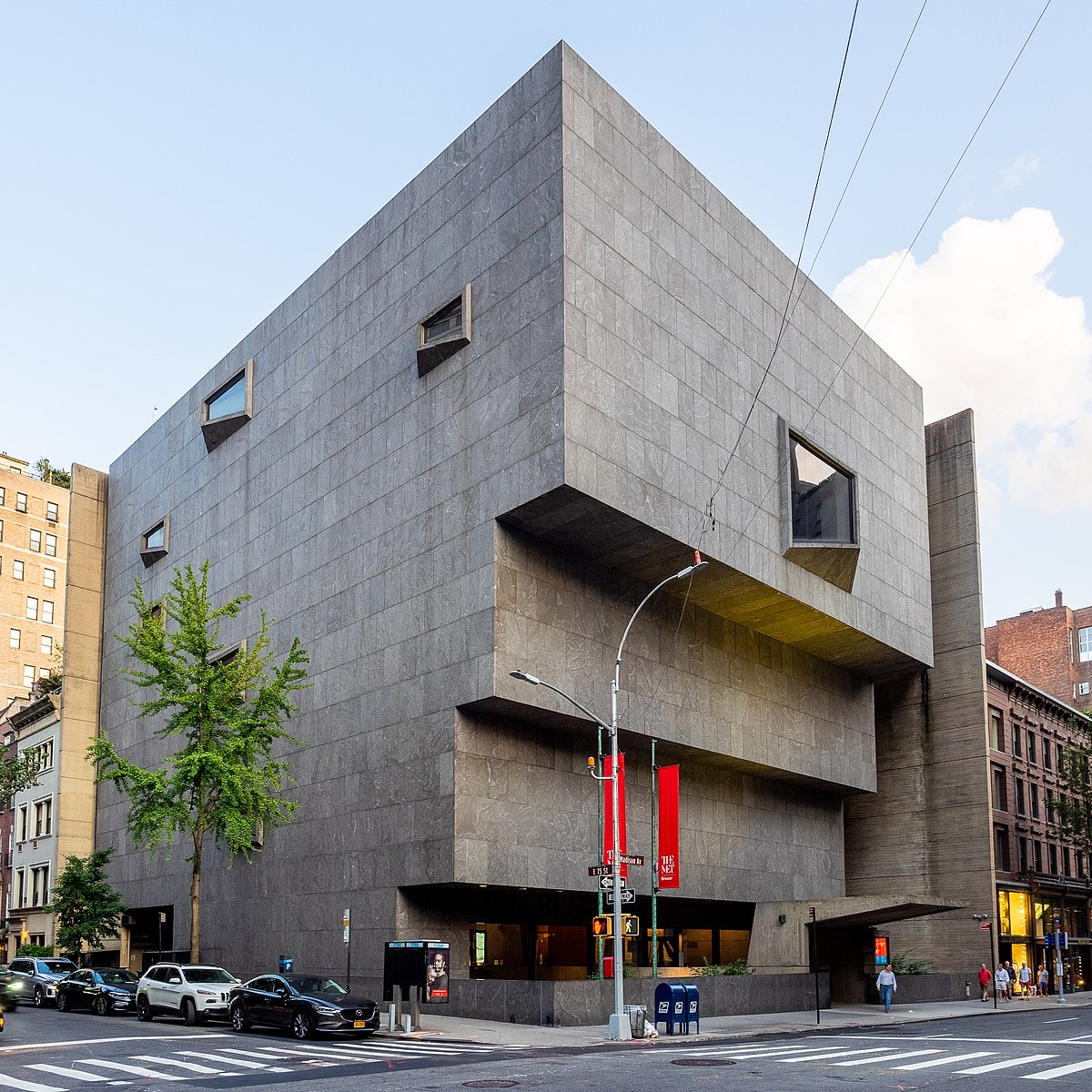
Sotheby’s has announced that its new headquarters in the Breuer Building will open to the public on November 8th of this year.
In June 2023, Sotheby’s announced its intention to purchase the iconic Breuer Building, a historical landmark located at 945 Madison Avenue, to use as its New York headquarters. The building, completed in 1966 according to designs by the brutalist architect Marcel Breuer, was originally intended as the home of the Whitney Museum of American Art. However, in 2014, when the Whitney moved to its current location in Manhattan’s Meatpacking District, the space was leased out to other museums. The building’s tenant became the Metropolitan Museum of Art, using the building to house its contemporary art collection. More recently, the Frick Collection used the building as a temporary exhibition space during the Frick Mansion’s renovations. Over two years ago, Sotheby’s bought the building from the Whitney for $100 million. According to Sotheby’s CEO Charles Stewart, buying the Breuer Building was “a once in a lifetime opportunity that we couldn’t pass up.” The auction house’s current headquarters are located at 1334 York Avenue. However, they had previously been situated at 980 Madison Avenue between 1964 and 1987, barely more than a block from the Breuer Building. The move to the Breuer will return Sotheby’s to a more central location, closer to the other major Manhattan museums and galleries.
Sotheby’s hired the architectural firms PBDW Architects and Herzog & de Meuron to renovate the Breuer, emphasizing the importance of preserving the building’s original architectural features. The original bush-hammered concrete, bluestone floors, lighting fixtures, and trapezoidal windows have all been carefully maintained. Simultaneously, they have improved accessibility and built out spaces for auction rooms, galleries, and a restaurant. Sotheby’s chairwoman of the Americas, Lisa Dennison, called the building “an architectural masterpiece”, further commenting, “Those who knew it in earlier incarnations will be moved by how we’ve reimagined 945 Madison Avenue, preserving the spirit of nearly 60 years of acclaimed programming. The Breuer’s design, with its remarkable ability to embrace many styles and eras of art, is especially meaningful for an auction house.”
The opening of Sotheby’s new headquarters at the Breuer Building is scheduled for November 8, 2025. The auction house will stage an exhibition of modern and contemporary art to inaugurate the building, followed by its autumn marquee sales starting on November 17th.
NYC Museums Donate Art To New JFK Airport Terminal

John F. Kennedy International /
Airport (image courtesy of the Port Authority of New York &
New Jersey and JFK Millennium Partners)
John F. Kennedy International Airport’s new Terminal 6 will include works of art from several prominent New York cultural institutions. The Port Authority of New York & New Jersey and the JFK Millennium Partners consortium have announced that four New York cultural institutions will be commissioning and donating artworks and artifacts to be housed in the new Terminal 6. The terminal will open ten of its gates by 2026, while the structure’s completion is set for 2028. The donors include the Metropolitan Museum of Art, the Museum of Modern Art, the American Museum of Natural History, and Lincoln Center. The current plan is for these artworks to be displayed in the international arrivals corridor of the terminal. The MoMA’s contribution will be a collaboration with Yoko Ono, inspired by her installation work PEACE is POWER, which she created as part of the museum’s expansion in 2019. Lincoln Center will be commissioning a large mural featuring musicians, dancers, actors, and other artists. While the Metropolitan Museum of Art won’t be sending any actual artworks to JFK, they plan on creating seventeen high-quality replicas of works representing each of its curatorial collections. The American Museum of Natural History also plans on sending a collage of images from its collection, including a Tyrannosaurus Rex fossil, a Moai sculpture from Easter Island, and taxidermied specimens from the Hall of North American Mammals.
On top of contributions from museums, the new Terminal 6 will include installations by nineteen New York-based contemporary artists hailing from seven different countries, including Barbara Kruger, Nina Chanel Abney, Felipe Baeza, and Uman. These permanent installations have been commissioned and curated by the Public Art Fund. Meanwhile, the new terminal will also feature space for six other works selected by the Jamaica Center for Arts & Learning to be exhibited temporarily on a rotating basis. These arts projects at JFK are a continuation of installations at other new terminals in the New York area. Contemporary artworks have been included at Newark Liberty’s Terminal A, as well as Terminal B and C at LaGuardia. According to the Port Authority’s executive director, Rick Cotton, the contemporary installations and participation from museums constitute an “increased recognition of the impact and the importance of the art.”
JFK and other New York airports are not the first to feature works of fine art in their terminals. I’ve written several times about similar projects at Leonardo da Vinci Airport in Fiumicino, the point of entry for nearly all airline passengers visiting Rome. Instead of contemporary art, the airport and Italy’s culture ministry have collaborated to exhibit artworks from the Renaissance and Baroque periods, including sculptures by Bernini and stained glass panels designed by Giotto. I previously doubted if this was necessary as a promotion of Italian art and culture, since seeing and experiencing the country’s culture is often most tourists’ primary objective. For New York, however, it’s slightly different. While museums are an important attraction for out-of-towners, it’s often not the first thing people want to do when visiting the city. Times Square, Empire State Building, Central Park, the Statue of Liberty, those are the things you’d see on day one. The city’s museums and other cultural institutions, however, are some of the best in the country. So any tourist would be remiss if they neglected to take advantage.
Painting Threatens German Cathedral’s UNESCO Status
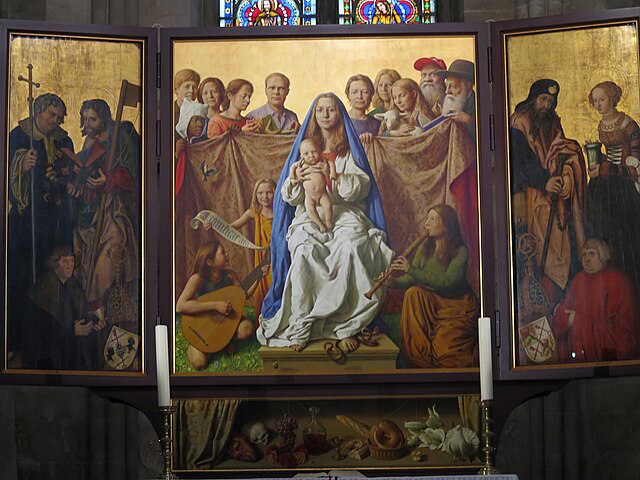
Cathedral (photo courtesy of ErichanderElbe)
Germany’s Naumburg Cathedral is at risk of losing its world heritage site status from UNESCO because of the placement of a somewhat controversial altarpiece.
Naumburg Cathedral is considered one of the most beautiful churches in central Germany. Much of the current structure was built in the thirteenth century, and now serves as a Protestant parish church. UNESCO granted the cathedral World Heritage Site status in 2018. However, that status is now threatened because of the congregation’s choice to display a rather unique work of art. The Cranach-Triegel Altarpiece is a combination of paintings by two separate artists separated by many centuries. The original triptych was created by the painter Lucas Cranach the Elder in the early sixteenth century. However, today, only the two wing panels survive. The center panel showing the Madonna & Child was destroyed during the Protestant Reformation’s iconoclastic efforts to remove and destroy art considered idolatrous. It wasn’t until 2022 that the German artist Michael Triegel created a replacement for the middle panel. There are no surviving images of Cranach’s original, so Triegel had to improvise slightly. His work is consistent with the general style of the two original wing panels, but contains several modern touches. Some of the figures surrounding the Virgin Mary and the infant Christ are dressed in more contemporary clothing. For example, one of the figures bears the likeness of Dietrich Bonhoeffer, a Lutheran theologian and anti-Nazi dissident, depicted as an old man wearing a red baseball cap.
When Triegel’s central panel was completed and combined with the remnants of Cranach’s original, the work was placed in Naumburg Cathedral’s west choir, where the altarpiece was originally displayed between 1519 and 1541. But while the church’s parishioners were very pleased with the painting, some artists and cultural specialists were less enthused. According to their objections, the altarpiece is an obstruction to another work of art kept in the church. The walls of the west choir are decorated with a series of twelve sculptures meant to represent the noblemen who contributed money towards the cathedral’s construction. The most famous of them are the statues of Eckhard II and Uta von Ballenstedt, the margrave and margravine of Meissen. The statue series is widely considered to be one of the greatest works of medieval German sculpture. The sculpture of Uta has been particularly influential, possibly serving as an inspiration for the design of the Evil Queen in the 1937 Disney film Snow White & the Seven Dwarfs. Upon the Cranach-Triegel Altarpiece’s installation in the west choir in 2022, the International Council on Monuments & Sites (ICOMOS) voiced its opposition to the church placing the painting there. The organization even considered recommending that the church’s status as a UNESCO World Heritage Site be stripped. The state government of Saxony-Anhalt intervened and requested that UNESCO determine whether the altarpiece was indeed detrimentally obstructing the sculptures. Experts examined the site in March 2025, determining that the painting could remain in Naumburg Cathedral but must move to a different location. Several cultural organizations suggested that the altarpiece could alternatively be placed in the cathedral’s north transept. This would allow visitors to view the medieval sculptures while placing the painting in a more central location. The state of Saxony-Anhalt’s cultural minister, Rainer Robra, commented on the situation, calling UNESCO’s decision “a positive outcome for our World Heritage sites and the citizens of Saxony-Anhalt through a solution-oriented process.”
However, the drama is not over yet. Despite UNESCO’s decision that the Cranach-Triegel Altarpiece could remain in the cathedral, the church’s parishioners have voiced their opposition to moving the painting out of the west choir. The congregation stated on August 7, 2025, calling UNESCO’s decision “a functional intervention”, as well as “a desecration of the altar and a disregard for its spiritual significance.” They highlight that the west choir was the original location of the altarpiece before its partial destruction during the Reformation. Therefore, if the church did not consider the work an obstruction to the sculptures at the time, it should not be considered one now. They argue that keeping the altarpiece in the west choir enhances the sculptures rather than obstructs them. The statues line the walls leading up to the altar, with the anonymous sculptor designing them to face or gesture towards it. The statues literally turn to face Christ and the Virgin Mary. Removing the painting to another part of the church would, therefore, be detrimental to the experience of both churchgoers and tourists since the space would be somewhat incomplete.
The church’s statement continues, “The current reconstruction of an altar at this location thus represents not only a liturgical decision, but also a conscious sign of reconciliation with history – a spiritual healing that does not suppress what was once destroyed, but rather reinterprets it with dignity.” The parishioners’ statement expresses that they were never consulted on whether the altarpiece should be moved. They therefore demand that the painting be kept in its current location out of “respect for ecclesiastical self-determination in sacred spaces”. Since Naumburg Cathedral is not a museum piece to be preserved but rather a space for “living tradition”, it only makes sense that the voices of those who attend the church, engaging in its historical and spiritual continuity, should perhaps not be drowned out by academics with little to no connection with the space.
Bayeux Tapestry Loan Receives Opposition
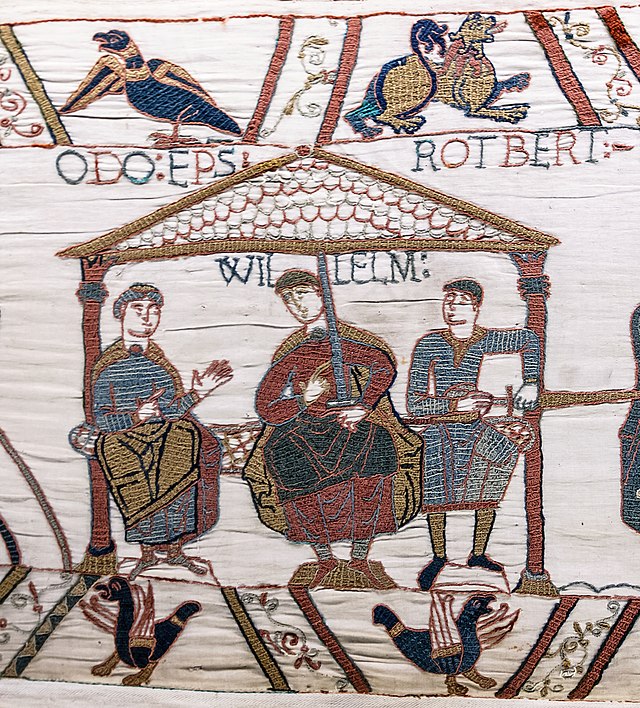
William the Conqueror in the
center alongside his half-brothers Odo and Robert
The plan to loan the Bayeux Tapestry to the British Museum has received pushback in the form of a petition that currently has over 50,000 signatures.
In July, the British and French governments announced a cultural exchange agreement where a collection of Anglo-Saxon treasures would be temporarily loaned to French museums, while the famous Bayeux Tapestry would be loaned to the British Museum between September 2026 and July 2027. However, in the meantime, some in the French cultural sector have expressed their opposition to the arrangement. Most notably, the French art journalist Didier Rykner initiated an online petition, citing concerns that the work may be damaged during transport. In addition to the petition, several French cultural figures have expressed concerns about the arrangement. The Bayeux Tapestry Museum’s former director, Isabelle Attard, has commented that the tapestry should not leave its museum. “Its value is incalculable and if anything happens to it no amount of money and no other similar object can replace it.” She also noted that the Bayeux Tapestry is very fragile because of its age and previous treatment. Its current display has it sewn onto a textile support hung from a rail. It’s also been exposed to light continuously since it was returned to the museum after the Second World War. Rykner says he initially began his petition after conferring with several textile restorers and conservators, all of whom have said that the tapestry should not be moved from its museum. Rykner has refused to disclose the identities of these anonymous specialists, citing a supposed culture of fear that allegedly dissuades cultural workers from expressing their views. He alleges that many in the French cultural sector refused to speak out “because they’re not free. They’re all civil servants.” Rykner further commented, “The last two times it was moved were first by Napoleon and then by the Germans (during the Nazi occupation). I cannot think of why you would want to be the third to move it.”
Here’s the thing about Didier Rykner. His name has appeared in my news feed several times over the past few years. He’s been described in various ways, but I’ve settled on art journalist, since he’s primarily the editor of the online magazine La Tribune de l’Art. He is sometimes referred to as an art historian, although that title is not strictly accurate. He received a diploma from the École du Louvre in 1987, but does not possess an advanced degree in art history or conservation. The bulk of his education was in agronomic engineering. He first came to prominence in 2007 when he started a petition against the Louvre’s announcement to open a satellite location in Abu Dhabi. In a book he later wrote, he said the decision made the museum into “a commercial franchise”. Since then, he has described himself as “a militant for the heritage cause.” He has used his platform to draw attention to the ways French cultural heritage is being damaged, with demonstrable results. For example, in 2014, he wrote about the dangers imposed by the practice of leaving love locks on the Pont des Arts, how they weaken the bridge’s structural integrity. He also extensively criticized entrepreneur Vianney d’Alançon’s plans to transform the historic Château de la Barben into an attraction called Rocher Mistral, a theme park similar to Medieval Times. Rykner’s investigations formed part of an opposition that resulted in a court fining d’Alançon tens of thousands of euros for unauthorized construction. However, it can be easy to see Rykner as something entirely different: a cultural contrarian.
Rykner claims that, in terms of cultural heritage, everything created before the nineteenth century should be protected. While I agree that cultural heritage should be protected as much as possible within the realm of practicality, what results is a rather strict, immovable definition of cultural heritage that could actively harm the arts and our ability to protect and enjoy them. Critics like Rykner believe in a rather monolithic idea of culture, that it can only be one thing, frozen in time, kept under glass, completely removed from human experience. However, culture is created by people, and it changes over time, sometimes drastically so. Just the other week, I wrote about how churchgoers in Germany are trying to make this very point. Cultural authorities have informed the congregation that they cannot display a painting in a particular part of their church, as it allegedly obstructs visitors’ appreciation of a series of sculptures. However, the members of the congregation have emphasized that many spaces like their church are not museum pieces. They are spaces that still serve a practical purpose in their community. Rykner initiates petitions to completely halt all changes to heritage sites, without regard for the people who still frequently use them. The French government’s plans on installing contemporary stained glass windows in some of Notre Dame’s chapels are an example of this. Rykner has managed to gather over 200,000 signatures on that petition, suggesting that contemporary stained glass would be destroying something eternal and indispensable to French identity, which only dates back to the 1860s when the cathedral was last renovated.
Some reports from several years ago concluded that the Bayeux Tapestry should not be transported due to its age and fragility. However, other reports say that the work could be moved under strict safety protocols. Philippe Bélaval, director of France’s National Monuments Center and President Macron’s designated representative regarding the new cultural exchange agreement, cited a study from early 2025 that outlined extensive recommendations on how the work could be handled and transported. Another study from March 2022 determined the feasibility of transporting the Bayeux Tapestry from Normandy to London; however, the conclusions have been kept confidential by cultural authorities in Normandy. The art historical community is not united on this matter, but that does not mean that those urging caution should be disregarded. At the end of the day, the Bayeux Tapestry is property of the French state. So, an online petition may not be the best way to stop the work’s trip to London next year.
____________________
Featured Artworks
Léon Richet’s Marguerite
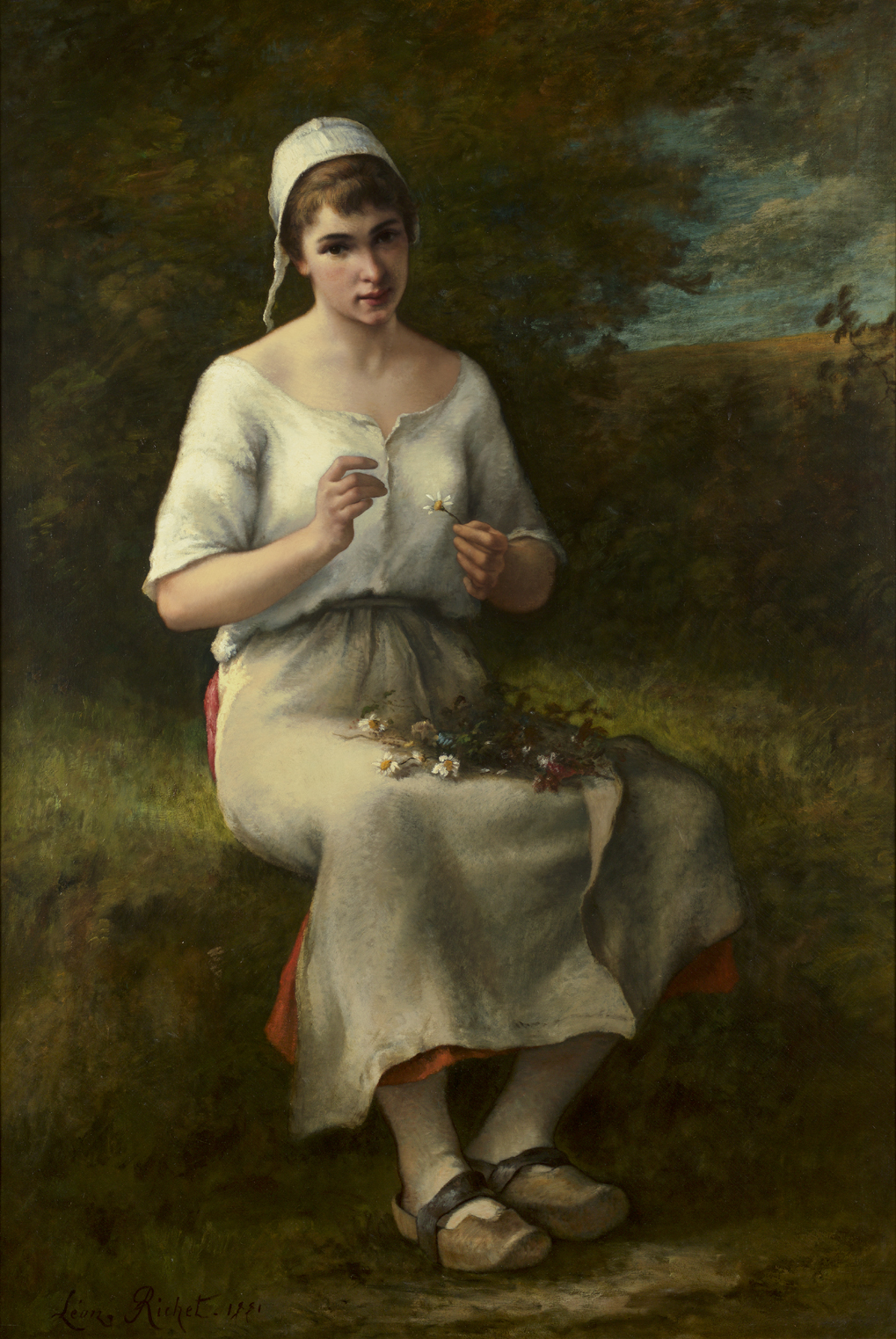
While nineteenth-century paintings of French peasants often show them amid their work against a pastoral background, that cannot exactly be said about Léon Richet’s Marguerite.
This is a rather rare work for the artist, as he was considered more of a landscape painter. Yet influence from the Barbizon landscape painters can be seen throughout. Here, the artist gives us a large, full-length portrait of the titular peasant girl. Richet created this painting in 1881 and had it exhibited at that year’s Salon. He would not gain recognition from the Salon’s juries for another few years, receiving his first honorable mention in 1885 and his first medal in 1888. Although he had not received his accolades at the time of creating Marguerite, the audience can see how Richet builds on the revolutionary new styles that flourished during his lifetime. In the painting, the girl looks up, staring directly at the viewer, while in the middle of inspecting some flowers she’s just collected. It’s a private moment in which the audience has become somewhat of an intruder. The background shows influence from the Barbizon painters of the mid-nineteenth century, emphasizing landscape painting and the use of looser brushstrokes. However, the focus on the peasant girl indicates Richet looking to the Realist school of painting as pioneered by Gustave Courbet. Her simple outfit and wooden shoes fastened with leather straps, similar to those worn by the subjects of Courbet’s 1849 painting The Stone Breakers, are evidence of her incredibly humble status.
The influence of Realist art can also be seen in the work’s size. Richet’s Marguerite measures over five feet by three-and-a-half feet, a canvas size typically only reserved for portraiture of aristocrats and other wealthy patrons. The paintings of Joshua Reynolds and George Romney come to mind, as does the portraiture of Jean-Auguste-Dominique Ingres. This, however, is taking the lowly and ordinary and representing it on the same size and scale as the lofty and extraordinary. It’s the same idea behind why Courbet often used incredibly large canvases relative to the subjects of his work. Though created more than forty years after Courbet and the Barbizon painters created their first masterworks, their legacy is evident in the works of later painters like Léon Richet.
Oisème, Route de village by Eugène Boudin
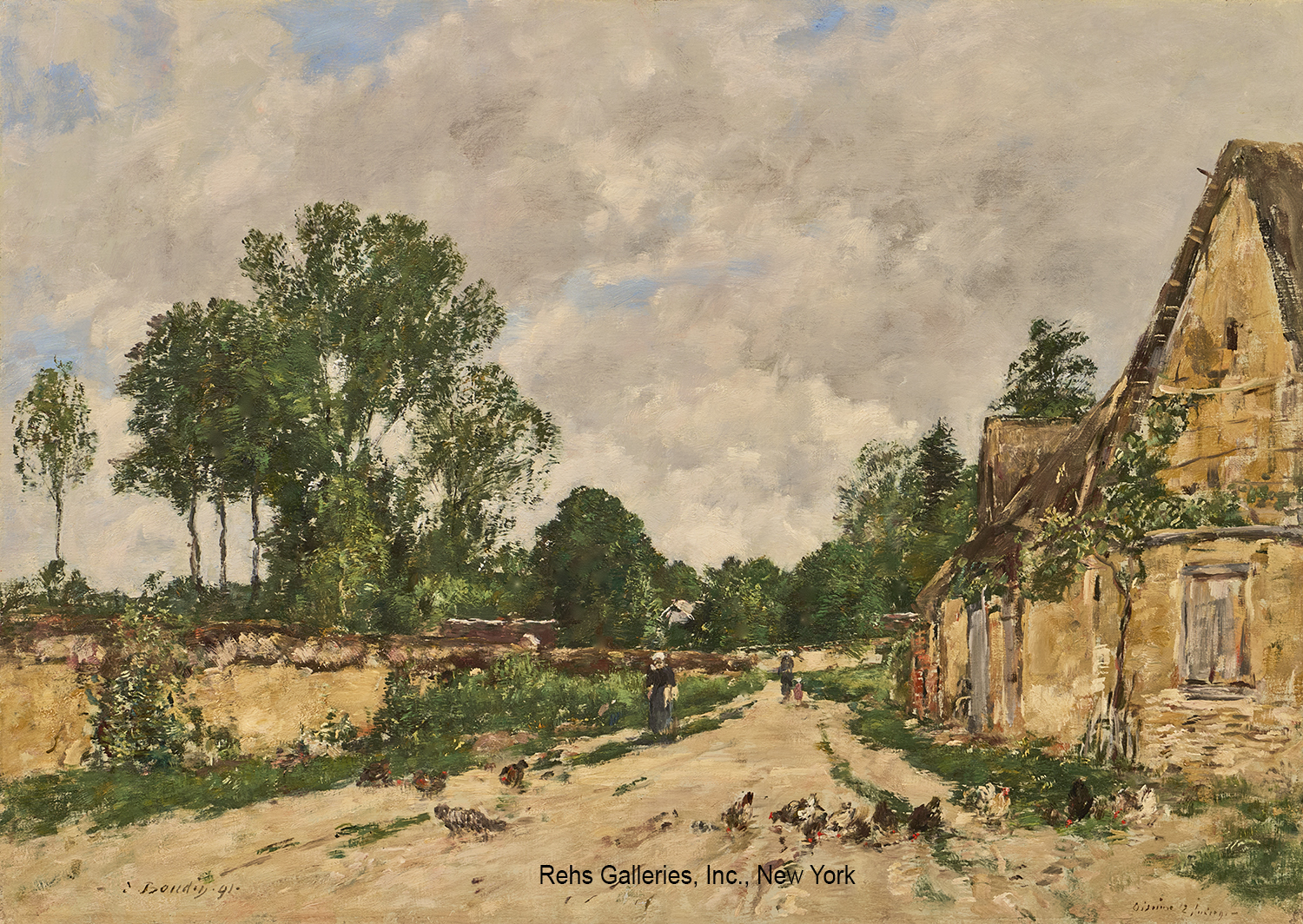
Eugène Boudin, primarily known as a maritime painter, immortalized the growth of the seaside spots in Normandy from fishing villages to resort towns. His fascination with the coast, whether it’s the bustling port of Le Havre, ships navigating the waters near Trouville, or beachgoers basking in the sun near Deauville, is well-documented. However, his paintings that deviate from oceanic themes are a rare find. Rehs Galleries has recently acquired one such unique piece, offering a privileged glimpse into Boudin’s lesser-known rural landscapes.
Boudin’s 1891 painting Oisème, Route de village shows a country road running through the village of Oisème, a small town located just northeast of the city of Chartres. It is one of three landscapes Boudin created in the area. At the time, no more than eight hundred people lived in the village, with Boudin’s painting conveying the slow pace of late nineteenth-century rural life. The canvas is dominated by the natural greens and browns of trees, grass, the exposed earth of the road, and the clay and stone houses and walls. One or two villagers walk along the road in the distance while flocks of chickens populate the foreground. Despite the difference in subject matter from his more popular work, Boudin employs the same loose brushstrokes that became an inspiration for the Impressionists. Meanwhile, his focus on the daily life of working people echoes the influence of Realist masters like Gustave Courbet. It’s a cloudy day in the country, and yet the scene is bright and warm, rather different from the much cooler grays and blues the artist would employ in his seascapes.
Métro George V, Champs-Élysées by Edouard Cortés
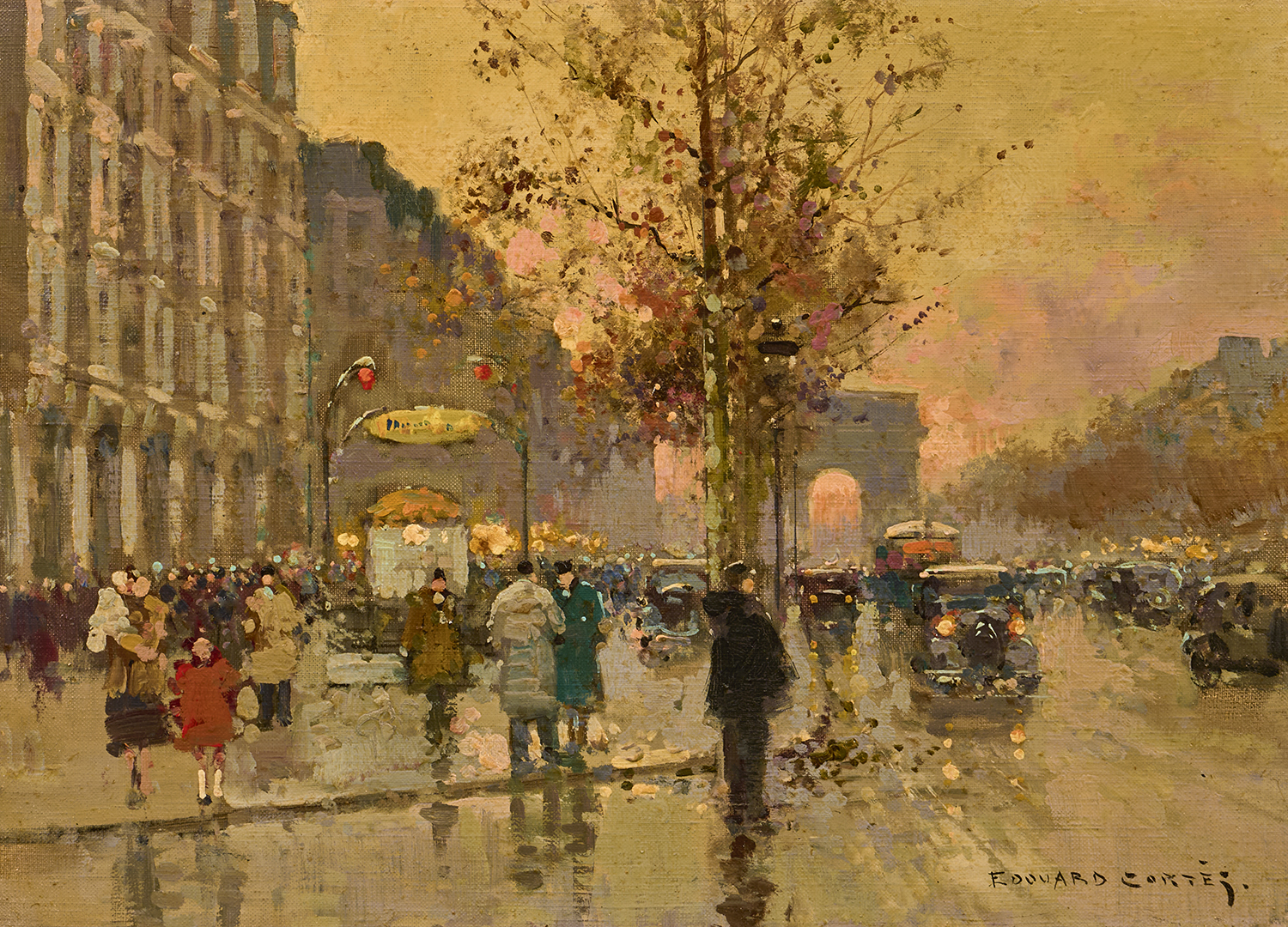
The Arc de Triomphe was a particularly common subject for Edouard Cortés. The square where the arch sits, the Place de l’Étoile (now the Place Charles de Gaulle), is the convergence of twelve different avenues, including the Avenue de Friedland, the Avenue Foch, and the Champs-Élysées. So, of course, there was no shortage of viewpoints for Cortés to use in his work featuring the Arc de Triomphe. While a street scene of the Champs-Élysées was a common subject in Cortés’s works, the inclusion of a Paris Métro entrance was a rare and intriguing addition.
The Paris Métro system first opened in 1900, with each station marked by distinctive Art Nouveau entrances, many of which still stand. The Métro station in the Cortés is the George V stop, located on the Champs-Élysées right in front of Louis Vuitton’s flagship location between Avenue George V and Rue de Bassano. The stop was previously called the Alma station, named after the Avenue d’Alma, which was renamed Avenue George V in 1918 in honor of the British monarch, the current king’s great-grandfather. This was a way to honor the alliance between Britain and France during the First World War. Nowadays, the stop is marked by a simpler, classical-style entrance, yet the Cortés painting shows the older, cast-iron gates flanked by a pair of red lamps. The painting, created around 1949, shows us Paris only five years following the liberation from the German occupation. Despite the war’s devastation, the city seems vibrant, with the sun’s light starting to fade in the west as the sky flashes pink through the Arc de Triomphe. While some of the artist’s work includes some of the city’s last horse-drawn streetcars, the Champs-Élysées is entirely populated by new automobiles now. Food rationing had only ended the year before, and France was ready to enter a new age of prosperity.
Le Réveil de Vénus by Louis Courtat
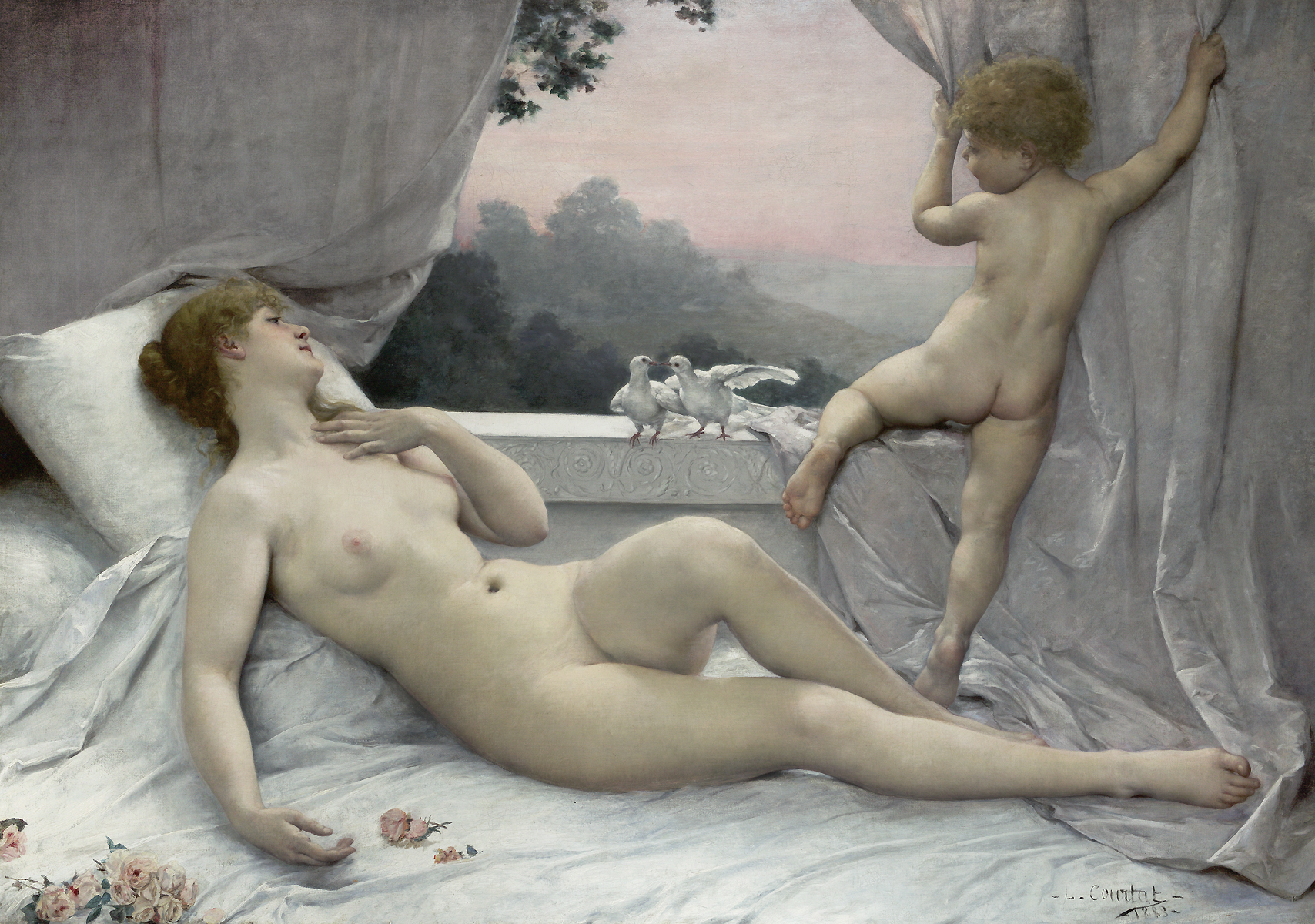
Louis Courtat’s painting Le Réveil de Vénus (The Awakening of Venus) is a nineteenth-century rendition of a classical subject, incorporating stylistic motifs from eighteenth-century Rococo and Neoclassical painting. Much of Courtat’s work is a continuation of the artistic lineage established by his academic predecessors, such as Alexandre Cabanel. He was also a great admirer of Jean-Auguste-Dominique Ingres, the leading neoclassical master of the early nineteenth century. Courtat became known for his mythological subjects and female nudes, often combining the two genres, as seen in Le Réveil de Vénus. His first recognition at the Salon, a decade before creating Le Réveil de Vénus, was a painting of the popular mythological subject Leda and the Swan. The subject of the sleeping Venus had been used in Western painting prior to Courtat’s rendition, with other artists, such as Charles-Joseph Natoire, Jean-Honoré Fragonard, Simon Vouet, and François Boucher, known for their own respective versions.
Here, Courtat depicts the goddess Venus, representing love itself, reclining on a bed as she awakens from a peaceful slumber. The scene is tranquil, with a nude cherub gently drawing back a curtain to reveal a serene landscape in the background. It is misty outside, but the outlines of trees and hills are detectable. A thin band of rosy light appears, indicating the coming of morning. Meanwhile, a pair of doves is perched on the window’s ledge, indicating not only peace and renewal but love and partnership. The presence of the doves, symbolizing fidelity, counters any potential erotic overtones, ensuring that the nude Venus is purely an allegorical or symbolic figure. The doves, therefore, serve a similar purpose as the small dog in Titian’s Venus of Urbino, symbolizing fidelity rather than any carnal desires. Courtat seamlessly combines the imagery of nascent love and new beginnings with his mastery of figure painting in the academic style. While some of his contemporaries experimented with more realistic nudes using modern subjects, Courtat’s work continued a tradition of elegance and precision that still captivates viewers today.
The Rehs Family
© Rehs Galleries, Inc., New York – September 2025