
COMMENTS ON THE ART MARKET
WELCOME TO THE NOVEMBER 2025 EDITION OF COMMENTS ON THE ART MARKET
October proved to be a dynamic month in the art world — filled with rediscovered masterpieces, daring museum heists, and intriguing intersections between pop culture and painting. In this issue, we take a look back at the stories that captured our attention, highlight new additions to the gallery, and share a few updates you won’t want to miss.
____________________
A NOTE OF THANKS
As the holidays approach and Thanksgiving draws near, we want to take a moment to express our heartfelt gratitude to all of you—our readers, clients, artists, and friends—for your continued support and for being part of our gallery community.
This past year has been an especially difficult one for our family as Howard’s ALS has progressed, yet it has also reminded us of what truly matters: family, connection, and the ability of art to bring light and comfort even in challenging times.
From all of us at Rehs, thank you for being part of our extended family. Your messages, visits, and shared passion for art continue to uplift and inspire us. We are truly grateful for each and every one of you.
____________________
THE ECONOMIC CANVAS
STOCK MARKET
As October came to a close, global financial markets showed broad strength across major indices. U.S. equities ended the month higher, while cryptocurrency prices declined following recent gains earlier in the year.
Financial Market Overview
- The S&P 500 rose approximately 2.4 percent in October 2025, supported by steady corporate earnings reports and easing inflation data.
- The Nasdaq Composite gained about 4.8 percent, led by continued strength among large-capitalization technology companies.
- Bitcoin recorded its first negative October since 2018, falling roughly 5 percent for the month and trading between $104,000 and $126,000.
In the art market, global public auction data indicated moderate activity and selective buying patterns. Total transaction volume increased by an estimated 3% year-over-year, while average sale prices declined slightly compared to last year.
During London’s Frieze Week 20th/21st Century Sales, total sales reached £141.8 million (~$190 million) with a 90% sell-through rate by value (92% by lot).

A notable result was Peter Doig’s Ski Jacket (1994), which sold for £14.27 million (~$19.1 million) — more than double its low estimate.
Based on October results, both financial and art markets displayed steady activity characterized by selectivity and stable performance. Global equities advanced, while collectors continued to focus on artworks with established provenance, strong exhibition histories, and consistent market demand. For example, we are offering an exceptional work by Eugène Louis Boudin “Le quai de Camaret, Pêcheur attendant la marée” which ticks all the boxes. This painting was previously part of the Armand Hammer Foundation Collection and has been exhibited at several U.S. institutions, including the Smithsonian Institution, the Los Angeles County Museum of Art (LACMA), and the Denver Art Museum. The work remains in excellent condition and represents a significant example of Boudin’s mature coastal compositions.
As of October 2025, both the financial and art markets exhibited steady overall performance, with moderate trading volumes and selective buying. Data across major indices and auction houses indicate that participants are focusing on assets—whether financial or cultural—that demonstrate quality, documentation, and stability.
____________________
TALES FROM THE DARK SIDE
On Sunday, October 19th, a group of men executed a heist at the Louvre Museum in Paris, stealing a collection of jewelry estimated to be worth €88 million (or $102 million).
While the popular imagination makes it seem like heists require absolute geniuses to pull off, the robbery at the Louvre on Sunday was relatively straightforward. At about 9:30 in the morning, roughly half an hour after the museum opened to visitors, a team of four men wearing reflective vests drove a truck up to the balcony of the Louvre’s Galerie d’Apollon, extending a ladder from the truck’s bed. This sort of ladder device is known as a monte-meuble in French, and is commonly used in Paris to move furniture and other large objects in and out of the windows of the upper stories of buildings. The team broke in and stole several items from display cases. Security alarms had been sounded, but the thieves used the saws and other tools they had brought to fend off the guards who arrived at the scene. The team descended the ladder, ditching the truck to escape on scooters. The entire heist lasted about 4 minutes. In the midst of their escape, the robbers dropped one of the items they stole, the Crown of Empress Eugénie. The museum was immediately evacuated and closed, finally reopening on Wednesday. Several other museum robberies have occurred in France recently. Last month, someone stole €600,000 worth of gold nuggets from the Natural History Museum, while €9.5 million worth of antique Chinese porcelain was taken from the Adrien Dubouché Institute in Limoges. Shortly after the Louvre heist, many believed that these incidents were related, possibly committed by the same people. However, a Chinese woman was arrested in Barcelona on Tuesday after being caught trying to dispose of some of the stolen gold.
France’s Ministry of Culture listed the items taken from the Louvre: a tiara, necklace, and one of two earrings from a set owned by Queen Maria Amalia, wife of King Louis Philippe I. These jewels, mainly diamonds and sapphires, were previously owned by Hortense de Beauharnais, Napoleon’s stepdaughter and sister-in-law. There was also a necklace and a pair of earrings made from diamonds and emeralds worn by Empress Marie Louise, Napoleon’s second wife. And finally, there was a bow brooch, a reliquary brooch, and a tiara owned by Empress Eugénie, wife of the Emperor Napoleon III. The most valuable item in the collection, however, was left untouched. The Regent Diamond is a 140-carat diamond that was part of the crowns of five different French monarchs. Napoleon had it fitted on the guard of his sword, as seen in several portraits, including those by Ingres and Gros. Today, it is estimated to be worth about $60 million.
Many specialists have commented that the thieves will not try to sell these jewels in their current state. The necklaces, brooches, and other items are very recognizable, and the heist has been widely publicized, making them impossible to sell as they are. Most likely, the robbers will break the pieces down and sell them for parts. To do that, they will need to remove every gemstone from the stolen pieces. However, it would still be difficult to sell the gems individually since they can still be recognized. This means that the diamonds, emeralds, and sapphires will need to be re-cut. They will be less valuable than before, since they will likely be sold based on their value by weight. However, this will still amount to a significant sum of money. The metals will also be melted down and sold off. The only elements from the stolen pieces that cannot be altered are the pearls from the tiara, of which there are 212. Since they cannot be re-cut like the gemstones, they can be tracked down. However, there is a slim chance that some of the items will be recovered unharmed. Some publications have cited the 2019 Dresden Green Vault heist as proof that the stolen pieces may be found. Many of the items stolen in that incident were recovered in 2022. Some optimists think that this team may have been hired by a private collector who does not want the items broken down, but rather kept in their original condition.
The heist on Sunday was the first successful robbery from the Louvre since 1998, when the Jean-Baptiste-Camille Corot painting Le chemin de Sèvres was stolen in May of that year. But given the state of the museum’s security, it’s surprising that it took this long. The museum’s overall condition is cause for concern, as the world’s most visited museum has faced extensive problems for years. The former palace can only accommodate around 4 million visitors per year, yet it often welcomes more than double that. In 2023, the Louvre put a cap on daily visitors to control the stress placed on the building. Leaks of rainwater have come close to works on display in the galleries. Louvre staff have gone on strike more than once to call attention to the poor state of the museum. And finally, earlier this year, French President Emmanuel Macron announced that the Louvre would undergo extensive renovations, which some say might cost as much as €800 million.
This latest incident underscores the urgent need for enhanced security measures at the Louvre. On the Wednesday following the heist, Laurence des Cars, the Louvre’s director, appeared before the French Parliament to answer questions from legislators, hopefully paving the way for a more secure future for the museum. Two individuals have already been arrested in relation to the theft, which may lead to more of the culprits being apprehended and the possible recovery of the stolen items.
____________________
THE ART MARKET
At Auction
On Friday, October 24th, Sotheby’s Paris hosted its Modernités sale, featuring mostly twentieth-century works by European and North American artists, including Jean Dubuffet, Roy Lichtenstein, and Jean Fautrier. The main draw, however, was a pair of portraits by the Italian modernist Amedeo Modigliani.
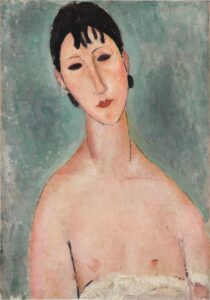
Elvire en buste and Raymond were both initially valued between €5.5 million and €7.5 million. Sotheby’s selected the former for its promotional materials and advertisements for the sale. The painting is a bust-length semi-nude portrait of a subject who appears in several of Modigliani’s works. Though the young woman’s identity remains unknown, she was most likely a local model living near Cagnes-sur-Mer, the town close to Nice where Modigliani and several other artists relocated in 1918 to escape the German siege of Paris.
During his time in the south of France, art historians note that Modigliani’s work reflected a synthesis of influences—from sixteenth-century Mannerism to the “structural rigor” of Cubism and the stylized forms of African art admired by modernists in early twentieth-century France. Despite being considered one of the highlights of Modigliani’s southern period, Elvire en buste had not been exhibited publicly for nearly sixty years, remaining instead in a series of private collections.
The work proved extremely popular with the bidders at Sotheby’s, blowing right past the already impressive high estimate and landing at the astronomical hammer price of €23 million / $26.7 million (or €26.98 million / $31.4 million w/p), or over three times the pre-sale high estimate. It is the most expensive painting by Modigliani sold at auction since 2023, when Portrait of Paulette Jourdain sold at Sotheby’s Hong Kong for $34.8 million w/p.
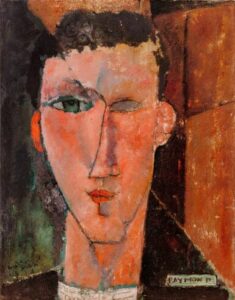
The other Modigliani portrait offered on Friday, Raymond, is believed to have been created in 1915, when the artist was still in Paris. According to several of the artist’s associates, including Jean Cocteau and André Salmon, the subject is the young writer Raymond Radiguet when he was only 12 years old. Even as an adolescent, Radiguet would regularly travel from his home in the suburbs of Paris to the city center. He would go on behalf of his father, who worked as a caricaturist and often sent his young son to deliver his work to newspapers and magazines. Though it would be several years before Raymond himself would have his poetry and novels published, he felt drawn to the French capital’s café culture, meeting many of the modern art pioneers who frequented such establishments. He would later be photographed by Man Ray and have his likeness carved as a bust by Jacques Lipchitz.
Modigliani created portraits of children during his career, but here we see something different. The portrait does not explicitly portray Radiguet as childlike. Rather, the work is more similar to Modigliani’s paintings of his artistic contemporaries, such as Pablo Picasso. According to Sotheby’s specialists, Modigliani’s strength as a portraitist was his ability to “seize an essence rather than an appearance.” Radiguet is sculptural and mature here, with a diagonal line bisecting his face, separating his eyes: one with a green pupil looking back at the viewer, the other dull and gray. Some have commented that this may reflect Modigliani’s well-known quote about the ability of artists to observe as well as express: “With one eye you look at the world, with the other, you look within yourself.” The artist’s division of the face may also refer to the subject’s fractured being, existing as an adolescent while also subverting the expectations of someone his age through independence and creativity.
Having remained in private hands since its creation, Raymond made its auction debut at Sotheby’s on Friday. Like Elvire en buste, Raymond also surpassed the high estimate, hammering at €8.8 million / $10.2 million (or €10.6 million / $12.4 million w/p).
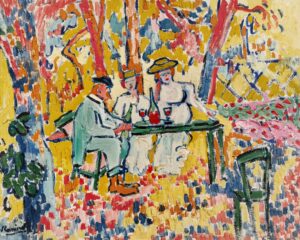
And finally, a little bit of Fauvism to round out the top lots, a colorful work by Maurice de Vlaminck. While many may know him for his landscapes and views of village streets, it’s important to remember that Vlaminck was originally associated with the Fauves, being good friends with André Derain. Le déjeuner champêtre, also called Apéritif à la Grenouillère, shows three figures seated at a table enjoying a drink surrounded by a dazzling array of reds, pinks, and yellows in a distinctly post-Impressionist wonder. It serves as Vlaminck’s own foray in exploring the subject of leisure, which was popular among modern painters since the mid-nineteenth century.
La Grenouillère was a restaurant and cabaret on a pontoon boat moored on an island in the middle of the River Seine, less than ten miles west of Paris. Claude Monet and Pierre-Auguste Renoir had also painted scenes at La Grenouillère. Vlaminck then shows a trio of bourgeois Parisians fleeing the city for an afternoon to enjoy a drink by the water. The painting dates to 1906, only a year after the Fauves first exhibited at the Salon d’Automne in Paris. There, Vlaminck had his work shown alongside that of Derain, Henri Matisse, and Kees van Dongen.
Le déjeuner champêtre has been in very few hands since it left Vlaminck’s studio, first going to Vlaminck’s dealer Ambroise Vollard, who then left it to the collector Madeleine de Galéa. Her heirs were the ones who consigned the painting to Sotheby’s, where it made its auction debut. Le déjeuner champêtre was most recently featured in an exhibition focusing on the artist at the Museum Barberini in Potsdam just earlier this year. Estimated to sell between €2 million and €3 million, the Vlaminck hammered just beyond the low estimate at €2.15 million / $2.5 million (or €2.66 million / $3.1 million w/p).
Overall, Sotheby’s Modernités sale on Friday was a resounding success. Of the forty-one available lots, sixteen sold within their estimates (a 39% accuracy rate). Ten lots (24%) sold below estimate, while nine (22%) sold above estimate. With only six lots unsold, the sale achieved an 85% sell-through rate. Among the works that went unsold were an untitled painting by Joan Mitchell, estimated at €4 million or more, and one of Andy Warhol’s 1973 Mao Zedong portraits, estimated between €700,000 and €1 million.
While those results might have weakened an ordinary sale, the record-setting performance of the Modigliani portraits carried the day. The Modernités sale had been expected to bring in between €35.9 million and €50.7 million—but thanks to the exceptional Modigliani results, the final total surpassed even the high estimate, reaching €52 million / $60.5 million.
Bob Ross Paintings Go to Auction

Thirty paintings by beloved television art instructor Bob Ross will soon head to auction, with proceeds supporting public television.
American Public Television (APT) has consigned the collection to Bonhams, which will feature several of the works in its California & Western Art sale on November 11th in Los Angeles. The remaining paintings will be offered gradually across several auctions in 2026. According to APT, proceeds from these sales will help sustain both APT and PBS, ensuring the continued operation of public broadcasting in the United States.
Bob Ross hosted The Joy of Painting on PBS from 1983 to 1994, producing more than 400 episodes and inspiring countless viewers to pick up a brush. Though Ross passed away in 1995, his presence remains a comforting constant in American culture. His gentle demeanor and signature encouragement to embrace “happy accidents” made art approachable and joyful for millions. Even three decades after his death, Ross continues to represent calm, creativity, and kindness in an often hectic world.
However, that legacy now faces new challenges. Recent federal budget cuts—over $1 billion slashed from the Corporation for Public Broadcasting (CPB) at the urging of President Donald Trump—have placed PBS and NPR under serious financial strain. The CPB oversees both networks, which provide public television and radio programming nationwide. As a result, PBS has reportedly reduced its workforce by 15%, and several local stations have been forced to close.
Most of Ross’s paintings created for The Joy of Painting have rarely been seen beyond their televised moments. More than 1,100 works remain in storage with Bob Ross, Inc., though some have entered private collections or museums—most notably, the Smithsonian Institution, which acquired several in 2021. During his lifetime, Ross frequently donated paintings to PBS stations for fundraising purposes, a practice now echoed by APT’s decision. As Joan Kowalski, president of Bob Ross, Inc., explains, this move “ensures his legacy continues to support the very medium that brought his joy and creativity into American homes for decades.”
Bonhams is no stranger to Ross’s market. At its American Art sale in New York in August 2025, two Ross landscapes sold for $114,800 and $95,750 (with premium), respectively. The upcoming group of thirty paintings is expected to bring in at least $825,000, though with Ross’s enduring popularity—and growing public support for PBS in the face of funding cuts—these works may well exceed expectations.
____________________
BEYOND THE FRAME
Exhibitions, discoveries and cultural commentary
Rembrandt Restoration at the Städel Museum
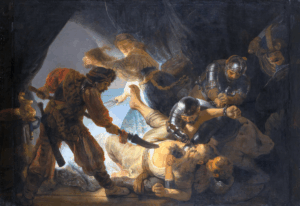
Rembrandt’s Blinding of Samson, one of the artist’s most prominent religious works, is set to receive an extensive makeover.
The Blinding of Samson dates to 1636, in the early stages of Rembrandt’s peak. He mainly produced portraits at the time, but occasionally received commissions for historical or biblical subjects. The Blinding of Samson was not actually a commission, but rather a gift to the House of Orange, the most powerful family and de facto rulers of the Dutch Republic at the time. The Prince of Orange, Frederick Henry, had commissioned Rembrandt to create a series of paintings depicting Christ’s Passion, with The Blinding of Samson being given as an apology for running behind schedule. Only thirty years old at the time of the painting’s completion, Rembrandt relished the opportunity to create these sorts of works, as they allowed him to display his talents better. Before the mid-nineteenth century, large monumental canvases were reserved for paintings with historical or biblical subjects.
Appropriately, The Binding of Samson measures just over two by three meters, or seven by ten feet. Though only a third the size of his famous group portrait, The Night Watch, The Blinding of Samson is nonetheless one of the largest canvases Rembrandt ever produced, and is one of the main highlights at the Städel Museum in Frankfurt. The painting depicts a scene from the Old Testament, where the Israelite hero Samson has been deceived by his lover, Delilah. In the Book of Judges, Samson tells Delilah that the covenant with God that gives him his strength is formed after swearing an oath never to drink wine and never cut his hair. As Samson slept in Delilah’s lap, she cut off his hair, robbing him of his strength and facilitating his capture by the Philistines, who subsequently gouged out his eyes. Typical of seventeenth-century historical or biblical paintings, the Philistines are not wearing historically accurate attire, but rather contemporary plate armor typical of Rembrandt’s time. Delilah is shown in the background, with a pair of scissors in one hand and Samson’s hair in the other.
The idea for the restoration project first came about in 2021, when the Städel Museum presented the exhibition “Rembrandt in Amsterdam: Creativity & Competition.” The show allowed researchers to examine The Blinding of Samson, revealing underdrawings and underpaintings that show the alterations Rembrandt made during the work’s creation. Museum specialists plan to view these hidden layers through X-ray imaging, infrared reflectography, looking at the canvas under ultraviolet light, microscopy, and micro-X-ray fluorescence analysis. After this data is collected, conservators will remove any paint applied to the canvas as part of previous restoration efforts. Finally, the museum will construct a new frame for the painting in the style of frames available to a Dutch artist in the 1630s. The complete restoration of the painting is estimated to take approximately three to four years, with a significant portion of the cost to be covered by Bank of America through its Art Conservation Project. Stephan Knobloch, the museum’s director of art technology and restoration, stated that they intend to restore the blinding of Samson “to its original intensity while ensuring the long-term preservation of the painting’s substance.” Similar to the ongoing restoration efforts of The Night Watch at the Rijksmuseum in Amsterdam, this new project will provide an opportunity for conservators and scientists to uncover new information about Rembrandt’s techniques in a transparent way.
Vienna Exhibition Shines Light on Forgotten Female Artist

Michaelina Wautier, a previously overlooked female painter from the Flemish Baroque period, is now getting a moment in the spotlight with her own exhibition at the Kunsthistorisches Museum in Vienna.
Very little is known about Wautier’s life. She was born in 1604 in the city of Mons, now in Belgium. She had an older brother named Charles, who also worked as an artist. Some suspect that, since women were not allowed to study art at the prominent European academies, she likely received some artistic training from Charles. There are approximately 35 paintings attributed to her, yet only about half of them are signed or dated. A woman working professionally as an artist was rare but not entirely unheard of in the 17th century. In the Low Countries, Judith Leyster and Clara Peeters were notable, while Mary Beale became a prominent portraitist in England. And of course, arguably the most famous was Artemisia Gentileschi in Italy. At the time, most women painters were confined to specific types, primarily still-life and genre paintings. Artemisia is somewhat of an exception to this convention, painting biblical and history scenes on very large canvases. However, as art historians learn more about Wautier, the more they learn about her importance to Flemish Baroque art. Her largest and most important work is The Triumph of Bacchus, painted in the early 1650s. It had previously been in the collection of Archduke Leopold Wilhelm, governor of the Habsburg Netherlands and brother of the Holy Roman Emperor, Ferdinand III.
Despite the lack of documentary evidence on the details of Wautier’s life, some of her paintings tell us a great deal. For example, The Triumph of Bacchus tells us many things about Wautier’s work and her degree of fame. Because most female painters worked primarily in still-life and genre works, their paintings tended to be relatively small, allowing them to work without a studio. However, The Triumph of Bacchus measures just over 9 by 11 ½ feet. Furthermore, art historians can infer that, given the amount of exposed skin on display in the painting, she was also able to work from live nude models, something that was not often done without a dedicated studio. The best guess is that Wautier shared one with her brother Charles. This also would have made Wautier the first female painter to have depicted the nude male body on a life-size scale. Analysis of her other paintings reveals that she was successful and wealthy enough to afford and use ultramarine pigment, an incredibly rare and expensive form of blue made from lapis lazuli. Some of her work also shows that she had no shortage of commissions. This is clearly evident in the portraits she painted. Also, one of the highlights of the Vienna exhibition is a series called The Five Senses. Each painting depicts a young boy in a situation that allegorically represents sight, smell, taste, hearing, and touch. According to the Museum of Fine Arts Boston, all five paintings were likely made to hang together. This implies “a significant amount of space to display together. Therefore, it is probable that the series was a commission, rather than painted for the market.”
As an indicator of her popularity and success as a painter, Wautier must have been sufficiently established for her to subvert or defy some artistic conventions in her work. For example, in The Five Senses, another artist would have likely shown young female subjects, since they were more popular for allegory. Furthermore, some of the actions being performed are actually rather unpleasant. For smell, a boy grimaces and pinches his nose at the smell of a rotten egg. And for touch, the boy has cut his finger while whittling a piece of wood. Even when the boys’ actions are not explicitly unpleasant, the predominant color scheme of brown and gray starkly contrasts with other Baroque allegorical paintings, like the collaborations between Peter Paul Rubens and Jan Brueghel the Elder. Back to The Triumph of Bacchus, Wautier did something here that is rather rare for female artists in most periods of art history: self-insertion. It is believed that the female figure on the right side of the canvas facing the viewer, possibly representing Ariadne, is in fact a self-portrait of the artist. Not only was this rare for female artists, but even more rare and somewhat shocking is her robe coming down across her torso to expose her left breast. University of Antwerp art historian Kirsten Derks commented, “I don’t know of any other artist who would dare to do that.”
The push for greater recognition of Wautier can be traced back to 1993, when the Belgian art historian Katlijne Van der Stighelen found The Triumph of Bacchus in storage at the Kunsthistorisches Museum. At the time, many of Wautier’s paintings were misattributed to other artists, including her brother. So when she saw this monumental work of a mythological subject, she became incredibly puzzled because she could not recognize the artist by their style. “For female baroque artists to work on this scale and with this variety of subjects is completely unseen”. Van der Stighelen began researching the artist and, eventually, searched for a suitable venue for an exhibition. In 2018, she curated Michaelina Wautier: Baroque’s Leading Lady at Antwerp’s Museum aan de Stroom. Since then, Wautier has only gained more and more recognition. Christie’s Old Masters specialist Maja Markovic called Wautier’s rise in prominence “nothing short of meteoric”. Her paintings also command impressive prices on the secondary market. However, this is mainly because there are so few of her works in private hands. Only three verified Wautier paintings have appeared at auction in the last five years.
In Vienna, twenty-nine of her thirty-five known existing paintings, 82% of her surviving oeuvre, are now assembled in one place. The exhibition at the Kunsthistorisches Museum now seems like a crowning achievement for art historians and other advocates of increased attention and scholarship on Wautier’s life and work. The Vienna exhibition will travel to the Royal Academy in London in March 2026.
New Taylor Swift Video Merges Pop Music with 19th-Century Painting
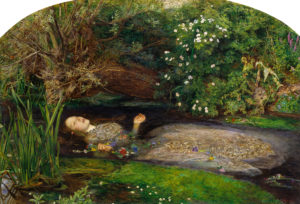
Taylor Swift recently released the music video for “The Fate of Ophelia”, her new single from the album The Life of a Showgirl. Many eagle-eyed viewers have also picked up on the art historical references in the video.
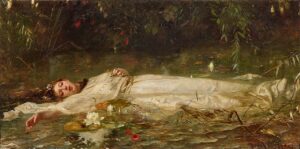
The lyrics of the song “The Fate of Ophelia” are addressed to an unnamed man, likely Swift’s fiancé, Kansas City Chiefs tight end Travis Kelce. The song’s chorus relates how this man “dug me out of my grave and saved my heart from the fate of Ophelia.” This line is a reference to the Shakespeare character of the same name, who is the main love interest of Hamlet. In the play, Ophelia is manipulated by the men in her life, like her father, Polonius, and, of course, Prince Hamlet, to serve their own ends. She begins to speak only in riddles, indicating an unstable mental state brought on by grief. She dies after falling off a willow branch into a stream, where she drowns, but it is also implied that she intentionally drowned herself. Even today, Ophelia is a symbol of innocence being destroyed by heartbreak. In writing that she has been saved from the fate of Ophelia, Swift is saying that she thankfully has people in her life who will not mistreat her, thus preventing her from falling into despair. While many have grabbed onto John Everett Millais’s 1852 painting Ophelia as a source of inspiration for the song and the video, Swift recreated a different painting in the opening shot. The music video opens with Swift lying in a sort of diorama modeled after the Friedrich Heyser painting Ophelia, created in 1900. Similar to the Millais painting, Heyser depicts the character of Ophelia in the brook, acquiescing and embracing death, surrounded by greenery and flowers. Swift does not overtly reference the Millais painting until the very end, when she lies in a half-full bathtub. This image also serves as the cover art for the album. However, it also references how Millais created the work by having his model, the artist Elizabeth Siddal, lie in a bathtub in his studio for hours.
Millais was a member of the Pre-Raphaelite Brotherhood, which, starting in the late 1840s, highlighted medieval and early Renaissance aesthetics in their work. They pulled from poetry and literature, using vivid colors and an intense realism in rendering their subjects. Swift does not wear the dress that Ophelia wears in either the Heyser or Millais paintings, but it is, regardless, a reference to Pre-Raphaelite art and its influence. She wears a white dress with long, loose sleeves, invoking a medieval aesthetic common among the Pre-Raphaelites. This can be seen in other prominent paintings, such as John William Waterhouse’s Lady of Shalott, or the depictions of women in the work of Dante Gabriel Rossetti. One source of inspiration for the Pre-Raphaelite painters was the Arthurian romances, which is not surprising since they are a quintessential example of British medieval literature and folklore. The Arthurian legends are invoked at another point in the music video, immediately following the first chorus. The scene cuts to Swift at the bow of a ship (or rather, a representation of a ship on a stage). Her hair is now red and worn long, blowing in the artificial wind as stage props imitate a stormy sea. While not confirmed, this may be a reference to the story of Tristan and Isolde. In the legend, Tristan is a knight who is sent to Ireland to retrieve the princess Isolde for his uncle, the king, to marry. Tristan and Isolde fall in love, with their affair discovered by the king. In the end, the king kills Tristan, and Isolde succumbs to grief and dies of heartbreak, not dissimilar to the fate of Ophelia. Some, like Lauren Puckett-Pope and Alyssa Bailey writing for Elle, have commented that this segment may actually contain references to other paintings like William Etty’s The Sirens and Ulysses and Arthur Hughes’s Ophelia (“And He Will Not Come Back Again”). However, this connection is rather weak, as the scene bears little resemblance to either of the paintings. The Ophelia-Isolde connection is not just more evident to me, but far more interesting in its meaning.
Of course, this is not the first time that fine art from centuries past has been incorporated into music videos and other forms of popular culture. By drawing on other art forms, Swift and the video’s designers reinforce the themes the song conveys, creating a more cohesive work of art overall for fans to enjoy.
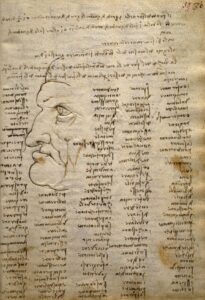 Through several art installations, a new project in Milan will focus on Leonardo da Vinci, his interest in words, and his impact on the Italian language.
Sabrina D’Alessandro is not a typical artist. Most of her work involves language, specifically studying words that are now rarely used in modern Italian. In 2009, she founded the Ufficio Resurrezione Parole Smarrite, or Lost Words Resurrection Office (URPS), an organization dedicated to preserving parts of the Italian vocabulary that have fallen out of common usage. They educate the public and raise awareness about these words by creating artworks and installations that are displayed in museums and public spaces. D’Alessandro and the URPS have showcased these works worldwide, including in museums and exhibition spaces in Milan, Siena, Vilnius, New York, Seoul, Singapore, and New Delhi. And now, installations and public artworks will not just be housed in a museum, but will be scattered throughout the city of Milan, using words found in Leonardo’s writings.
Leonardo da Vinci left behind many written works. Among them is a notebook called the Trivulziano Codex. This is a document, of which fifty-five of the original sixty-two pages survive, which shows Leonardo’s attempts at self-education. To expand his vocabulary, Leonardo wrote down eight thousand words he found in a variety of different books, the lists accompanied by annotations on their meanings. The codex is now housed in a library within Sforza Castle, the seat of the Dukes of Milan during the fifteenth and sixteenth centuries. In their project, Leonardo Parlante, D’Alessandro and the URPS have created sculptures and installations to be exhibited in the castle courtyards starting on November 1st. For the castle’s Courtyard of Arms, they created the word salvatica in large block letters made from terracotta, with related words carved into it. The word itself has more than one meaning, according to Leonardo. It is related to the modern Italian word selvatico, meaning wild or related to nature. However, Leonardo also wrote that the word refers to something that is saved, linking it to the concept of salvation. The castle’s Ducal Courtyard will feature two additional installations: the word “purità” made from terracotta, similar to salvatica. Meanwhile, vanagroria will be made out of polished steel. The former is an uncommon variant of purezza, meaning purity, while the latter is an archaic spelling of vanagloria, or vainglory. Both of these words will be placed at opposite ends of the courtyard’s central reflecting pool. It may be confusing how these words can be appropriately represented as sculptures using materials associated with their antonyms. However, purità being made of a form of clay and its placement by the reflecting pool is a reference to Leonardo’s writings on elephants. He once remarked that elephants are noble, honest animals. They “go down to the rivers, and there, solemnly cleansing themselves, they bathe, and so, having saluted the planet, return to the woods.” The terracotta sculpture, therefore, resembles the backs of elephants, caked with dust, ready to be washed away, purifying the animal like a ritual ablution. Meanwhile, the material and placement of Vanagroria is a commentary on vanity and the potential for self-reflection.
Along with the installations at Sforza Castle, D’Alessandro and the URPS plan to create posters and other works that will be displayed throughout Milan. These posters will feature words from the Trivulziano Codex accompanied by a brief quote from Leonardo, turning Milan into “a great philosophical and visual text that invites us to rediscover the riches of our language and reflect on themes such as knowledge, experiences, life, and freedom.” D’Alessandro’s work demonstrates how Leonardo’s writings have preserved vocabulary and other language forms that would have otherwise been lost to scholars and artists alike. The research behind Leonardo Parlante earned D’Alessandro a residency at the Casa degli Artisti in Milan, with some of her other work featured in the National Museum of Contemporary Photography’s Scrittura obliqua exhibition. The installations at Sforza Castle and the posters put up around Milan will be on view between November 1st and January 31st. On November 13th, Leonardo Parlante will be the subject of a discussion as part of the BookCity literary festival.
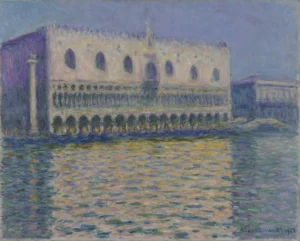 On Saturday, October 11th, the Brooklyn Museum opened its Monet & Venice exhibition to the public, marking the largest museum show to focus on the artist in nearly twenty-five years.
In 1908, Claude Monet was living and working in the small town of Giverny, about 40 miles northwest of Paris. There, he owned a house surrounded by the lush gardens that inspired his famous water lily paintings. By this time, Monet had been exploring garden scenes for over a decade but found himself in a creative slump. That changed when British collector Mary Syth Hunter invited him to Venice. During his two-month stay, Monet created thirty-seven paintings, twenty-nine of which were later exhibited at Galerie Bernheim in 1912.
The majority of the current exhibition centers on the Brooklyn Museum curators’ efforts to contextualize Monet’s Venetian paintings. Visitors begin their experience in a darkened room, where projected videos of Venice envelop the walls, accompanied by the sounds of seabirds and the gentle lapping of lagoon water against the jetties.
From there, guests move into a smaller gallery that transports them from present-day Venice to the city as it was in 1908. Display cases feature letters, postcards, and photographs that Claude and Alice Monet sent back to France—reminders that, though time passes, the essence of being a tourist remains unchanged. The exhibition also includes period travel guides the Monets likely consulted, as well as several paintings, such as An Interior in Venice by American artist John Singer Sargent, offering further glimpses into Venetian life a century ago.
Both then and now, Venice has captivated travelers as a beautiful, slightly decaying city that seems lifted from a fairytale. In these opening galleries, visitors witness the depth of that fascination. Alongside two of Monet’s views of the Palazzo Ducale hang a pair of monumental Venetian cityscapes by the eighteenth-century master Canaletto, one depicting the very same building. Nearby, etchings and engravings by Michele Marieschi showcase other iconic Venetian landmarks.
These works by Canaletto and Marieschi are more than picturesque views, they reflect the flourishing art market driven by young aristocrats undertaking the Grand Tour, a cultural rite of passage through Europe that often culminated in Italy. Later in the exhibition, the curators extend this historical arc with nineteenth-century interpretations of Venice by Thomas Moran, James McNeill Whistler, and Pierre-Auguste Renoir.
This thoughtful contextualization underscores Venice’s enduring allure, both as a destination and as an artistic muse, across the centuries leading up to Monet’s transformative 1908 visit. The curators then turn their attention to Monet’s own artistic evolution, offering deeper context through two key lenses. First, they explore the artist’s lifelong relationship with water. Raised in the port city of Le Havre, Monet was naturally drawn to waterways—a motif that would define much of his career. The English Channel, the River Seine, and his beloved pond in Giverny all served as enduring sources of inspiration. This fascination was hardly unique among the Impressionists and their predecessors; artists such as Eugène Boudin, one of Monet’s earliest mentors, also made water a central subject in their work. Yet Monet pushed this exploration further than anyone before him. His obsession with capturing the shifting interplay between light and reflection led him to abandon traditional landscape conventions, creating compositions like his Water Lilies that omit the horizon line entirely, immersing viewers in pure atmosphere and surface.
The second focus of the exhibition examines Monet’s pioneering use of series. By this point in his career, he had completed several ambitious cycles, painting the same subject repeatedly under different weather and lighting conditions. While his Water Lilies remain the most celebrated, other notable series include his Haystacks, Rouen Cathedral, and Houses of Parliament. One of the London paintings from this last group is featured in the Monet and Venice exhibition, on loan from the Brooklyn Museum’s own collection.
Though this serial approach was groundbreaking, it eventually left Monet restless after decades of painting familiar motifs. His 1908 trip to Venice, however, reignited his creative spark. In many ways, it recalled his younger days, when he would outfit a small boat as a floating studio and paint scenes along the Seine in places like Argenteuil and Vétheuil. In Venice, surrounded by canals, gondolas, and centuries-old architecture, Monet rediscovered the joy of painting. As he later wrote to his dealer, the experience made him “see my canvases with a better eye.”
The curators at the Brooklyn Museum have done a remarkable job of providing such thorough context precisely because it reframes Monet—not as an isolated genius, but as an artist shaped by multiple artistic lineages and influences. This approach underscores how his Venetian paintings emerged not in a vacuum, but as the culmination of decades of experimentation and dialogue with the art of his predecessors and contemporaries.
After all this rich contextualization, the exhibition reaches its crescendo. The centerpiece is a grand oval room draped in deep blue velvet, where ten of Monet’s Venetian paintings are displayed together. While individual Monet works appear throughout the earlier galleries alongside those of other artists, this room is devoted entirely to the Impressionist master himself.
The paintings are grouped in trios, each depicting the same view—whether the Church of Santa Maria della Salute, the island of San Giorgio Maggiore, or the Palazzo Ducale, captured under varying conditions of light and atmosphere. Seen together, the subtle shifts in tone and color reveal Monet’s obsessive sensitivity to change and his ability to render the intangible passage of time. His loose, fluid brushstrokes lend the works an almost dreamlike quality—what the curators aptly describe as “ethereal.”
By omitting human figures, Monet directs attention entirely to the architecture and to Venice itself. The result is a vision of tranquility that echoes the city’s centuries-old nickname, La Serenissima—“the most serene.” His time in Venice not only revitalized his artistic spirit but also sustained his creativity for the final eighteen years of his life.
Monet & Venice is on view at the Brooklyn Museum through February 1, 2026.
Vermeer’s Pearl Earring Subject Identified?
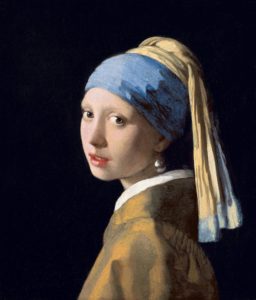 Has the mystery finally been solved? One British art historian believes he has identified the subject of Johannes Vermeer’s Girl with a Pearl Earring—a revelation that could completely reshape our understanding of the Dutch master’s work.
Vermeer’s Girl with a Pearl Earring is among the most iconic paintings in the world, yet its subject has remained unknown for centuries. Scholars have long debated whether the work is a portrait or something more symbolic. One prevailing theory is that the painting is a tronie, a Dutch Golden Age genre portraying an idealized character rather than a specific individual. Artists like Rembrandt popularized the tronie format in works such as Man with a Feathered Beret and Old Woman Praying. Others have proposed that, given the sitter’s exotic headdress, she might represent a sibyl of Ancient Greece.
In his forthcoming book, Vermeer: A Life Lost & Found, British art historian Andrew Graham-Dixon challenges these ideas. He argues that Girl with a Pearl Earring depicts a real person—not a character or allegory. While theories have previously suggested that the sitter could be Vermeer’s eldest daughter, Maria, or a household servant (the latter popularized by Tracy Chevalier’s novel and its 2003 film adaptation starring Scarlett Johansson and Colin Firth), Graham-Dixon puts forward an entirely new identification: the sitter, he claims, was Magdalena van Ruijven, daughter of Vermeer’s principal patrons.
Vermeer’s relationship with his patrons, Pieter van Ruijven and Maria de Knuijt, was unusually close. The couple, among Delft’s wealthiest citizens, amassed their fortune through inheritance and investments. For years, scholars assumed Pieter was Vermeer’s chief supporter, but research for the Rijksmuseum’s landmark 2023 Vermeer exhibition revealed that Maria de Knuijt was the true benefactor. She left Vermeer 500 guilders in her will, making him the only non-family member to receive a bequest. It is estimated that the couple owned as many as twenty-one Vermeer paintings, including The Milkmaid, View of Delft, and Girl with a Pearl Earring.
Graham-Dixon also highlights a deeper bond between the painter and his patrons: shared faith. Both families were Remonstrants, members of a Protestant sect that broke away from the Dutch Reformed Church. The Remonstrants rejected rigid Calvinist doctrine, emphasizing individual interpretation of Scripture, equality among people, pacifism, and tolerance. Because their movement was outlawed in the Dutch Republic, their churches operated in secret, including one near the van Ruijven–de Knuijt home. This shared faith, Graham-Dixon suggests, likely brought the Vermeer and van Ruijven families together, and may explain why Vermeer painted their daughter.
According to Graham-Dixon, Magdalena van Ruijven would have been about twelve years old when Girl with a Pearl Earring was painted, coinciding with her baptism, a key rite of passage in Remonstrant life. He proposes that her parents may have commissioned the portrait to commemorate this spiritual milestone. The girl’s exotic turban and calm, luminous expression might therefore symbolize spiritual awakening rather than simple exoticism, aligning her with her biblical namesake, Mary Magdalene.
As Graham-Dixon writes, “To have been christened Magdalena was to have been charged with preserving that meeting in the memory. Vermeer’s picture was there to summon and sustain that moment daily, directing Magdalena’s prayers and placing her always in the presence of Christ.” He notes that the girl’s parted lips and turned gaze, perhaps even a faint tear in her eye, may allude to the Gospel of John’s account of Mary Magdalene recognizing the resurrected Christ and exclaiming “Rabboni!” (meaning “Teacher”).
If this interpretation is correct, it casts Vermeer’s work in an entirely new light. Many of his paintings, long considered quiet genre scenes, could now be understood as deeply spiritual meditations rooted in Remonstrant values. This framework also explains why so many of his works appear in thematic pairs. For example, The Milkmaid and Woman Holding a Balance both explore moral and spiritual equilibrium, measuring one’s actions and conscience. In Woman Holding a Balance, a depiction of the Last Judgment appears in the background, while in The Milkmaid, stale bread and simple gruel symbolize humility and charity, virtues central to Remonstrant belief.
As Graham-Dixon concludes in The Times, “The realization that all of Vermeer’s paintings are spiritually motivated flies in the face of most modern preconceptions about his work. But it is my conviction that all this may seem somehow less shocking than expected.”
If his theory gains acceptance, it would mark one of the most profound recontextualizations in the history of art scholarship, transforming Vermeer’s paintings from serene scenes of everyday life into quietly powerful expressions of faith, morality, and spiritual reflection.
Thank you for following along with our Comments on the Art Market. Stay tuned for more art news, discoveries, and gallery highlights in next month’s newsletter.
The Rehs Family
© Rehs Galleries, Inc., New York – November 2025