
COMMENTS ON THE ART MARKET
Upcoming Exhibition
ANTIQUES+MODERNISM SHOW 2025
620 Lincoln Ave.
Winnetka, IL. 60093
Gala Preview Party, Thursday October 30th - 6:30pm–9:30pm
October 31 - November 2, 2025
Hours:
Friday, 10:00 AM to 6:00 PM
Saturday, 10:00 to 5:00 PM
Sunday, 11:00 to 4:00 PM
____________________
Stocks & Crypto
Summer is over, but the stock market is still hot… albeit in the face of a Federal Government shutdown. To be fair, historically speaking, government shutdowns don’t always impact stocks, and in some instances, we’ve seen advances during shutdowns. Despite elevated volatility, we saw some solid gains in the market – in fact, the S&P and Nasdaq had their best September performance in 15 years! The Dow was up more than 1.8%, while the S&P turned in a 3.5% gain and the Nasdaq jumped more than 5.5%... it’s worth noting that the Dow closed the month out at a fresh record high. To pile on the positives, this month marked the fifth straight monthly gain for the S&P – it’s hard to argue with continued momentum like that. But, in my non-professional opinion, stocks are getting further detached from their financial fundamentals… based on some things I’ve read lately, it appears the markets broadly have become more speculative than they were historically. Many believe this makes it more difficult to project market movements, but more importantly, we may not see corrections like we’re used to… I mean, after months and months of gains alongside disappointing economic data, it’s hard not to wonder what’s going on. Although inflation seems to have stabilized in some sense, the unemployment rate has ticked upwards, and job creation plans are at their lowest in more than a decade, indicating employers continue to be cautious. Confoundingly, consumer confidence is trending downward at the same time retail sales have gone up. Fortunately, the Fed has cut rates, and they’re expected to cut them again before the end of the year… moves that make buying stocks more attractive, which buoys the market overall. With opposing forces being applied, it’s hard to know what to expect in the near future.
Another indicator of all this uncertainty continues to manifest in the commodities sector with gold prices… I’ll circle back to that in a moment. Taking a quick look at currencies, both the Pound and the Euro benefited from a weakening dollar – some analysts expect the trend to continue into 2026. However, as mentioned, gold has elevated to the point it almost feels concerning – by early September, gold was pushing new records in the $3,500 range… but by the end of the month, it had advanced to nearly $3,900, or more than 11%! Historically, we have seen gold prices spike during times of stress and uncertainty because it is viewed as a “safe-haven asset”… this kind of movement usually goes hand-in-hand with inflation concerns, US Dollar weakness, geopolitical risks, and asset bubble concerns – all things that are on the table at the moment. Crude prices have dropped moderately, but have traded in the low 60s all month… prices currently sit at the lower end of that range as oversupply concerns have bubbled up recently.
As for Crypocurrencies, we saw some significant volatility, but ultimately, prices mostly recovered after a steep selloff… by the end of the month, both Bitcoin and Ethereum notched a 5+% gain, though Litecoin was still slightly negative with a 1.8% loss. I think the crypto markets will always see more significant price fluctuations compared to the stock market, but it is becoming clear that these are stable assets with staying power in the financial world… year-to-date, Bitcoin and Ethereum have yielded 20% and 36% returns, respectively.
As I alluded to earlier, I think it is becoming more and more difficult to predict market movements based on the information at hand, but I continue to hold the belief that stock prices are overinflated and not supported by the underlying financial data. With that said, I’d be hesitant to pour more money into the stock market, but as I always stress – you shouldn’t be listening to me for financial advice.
____________________
Tales From The Dark Side
Pennsylvania Art Fraudster Sentenced

The Circuit Court for the Eastern District of Pennsylvania at the Byrne Courthouse, Philadelphia
Last Friday, the US Attorney’s office for the Eastern District of Pennsylvania announced that Carter Reese, an art and antiques dealer in Reading, Pennsylvania, was sentenced for knowingly selling forged artworks allegedly by twentieth-century masters.
Reese was well known in his community as an art dealer and historian. He previously taught history and art at the Hill School, a private preparatory school in Pottstown, Pennsylvania. He later served as director of admissions for the school before founding his own consulting company to help students with college admissions. His art and antiques collection is incredibly extensive as well. Court documents indicate that he owns approximately 17,000 items estimated to be worth $6 million. The forgery scheme was not a long-term aspect of his life, though. It mainly took place between 2019 and 2021.
During this time, Reese admittedly sold or tried to sell forgeries in the style of well-known artists such as Pablo Picasso, Joan Miró, Andy Warhol, Keith Haring, Fernand Léger, and many others. He worked with a Chicago-based forger who, several years ago, was convicted of selling $1 million worth of forged artworks. He would do this by buying prints or copies from websites like eBay and altering them to make them appear genuine. Reese created false provenance documentation to support the forgeries’ authenticity. When confronted with skepticism or questions, he vehemently denied any accusations that the works were fakes. However, when federal prosecutors charged him with mail fraud and wire fraud in May 2025, the 77-year-old dealer relented and pleaded guilty. Prosecutors say that Reese weaponized his reputation and good standing in his community to prey on potential buyers. The charges against him could have brought on a 40-year sentence. However, Judge Jeffrey Schmehl gave him sixty days in prison, four months of home detention, twenty months of supervised release, a fine of $50,000, and restitution of $186,125. Reese did not provide a reason why he undertook the scheme, but said to Judge Schmehl that he was “deeply and desperately sorry”.
At the sentencing hearing on Friday, individuals connected to the case were allowed to give victim impact statements on the full extent of Reese’s crimes. One such person was Christine Oaklander, former director of collections at the Allentown Art Museum. Oaklander was actually integral to Reese’s scheme falling apart. He convinced her to act as an intermediary in the sale of several works, which turned out to be forgeries. After the buyers confronted her, she contacted the FBI. After recording some of her phone calls, the FBI gathered evidence against Reese, which ultimately led to the charges. In her statement, Oaklander said that her reputation and mental health have been greatly impacted as a result of Reese’s scheme. She also said she spent about $130,000 of her own money to help Reese contact and negotiate with buyers. “Your behavior is incomprehensible,” she said to the court. Reese’s defense lawyer, Jason Hernandez, asserted that his client should not be sentenced to any prison time, given his advanced age. He also noted that Reese did not lie to or mislead investigators when confronted with the evidence of his crimes. Reese is also planning to auction off most of his personal collection to help raise the money for the fines and restitution payments he must now pay. While Judge Schmehl recognized Reese’s remorse and willingness to make amends as genuine, he nonetheless noted that jail time is necessary. “A meaningful sentence is, indeed, warranted in this case.” Carter Reese must report to prison on October 24th
____________________
The Art Market
Bonhams British & European Art
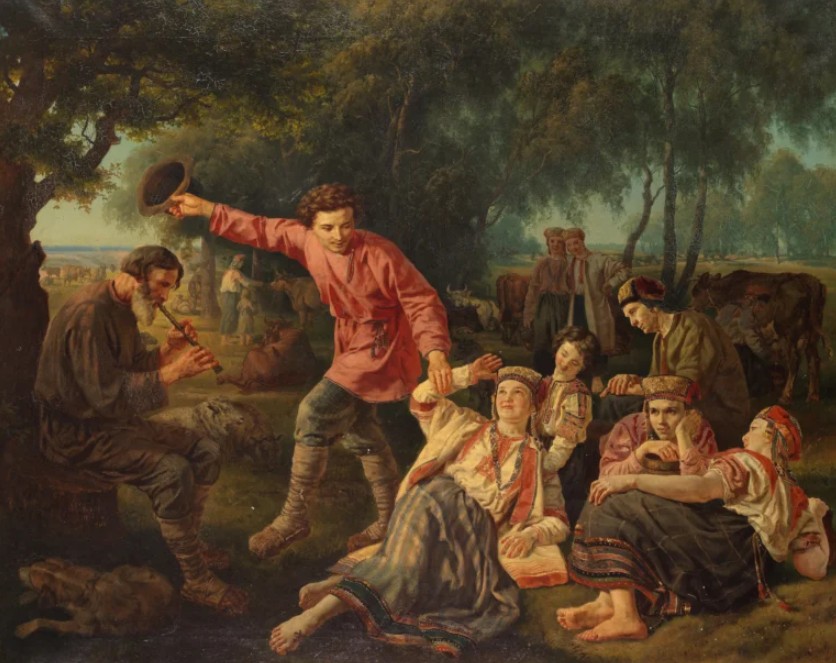
A Summer Pastoral, attributed to Vladimir Sherwood
The fine art market took a bit of a break in August, with many of the main auction houses using that time to focus on sales of luxury goods such as cars, sports memorabilia, watches, jewelry, and other items. However, the market for paintings has started back up again with Bonhams British & European Art sale at their Knightsbridge location in London. One hundred twenty-three lots were available on Wednesday, September 17th, and did rather well. The works ranged from watercolors of birds by Archibald Thorburn, scenes of Venetian canals by Antoine Bouvard, and British landscapes by Percy and Leader. However, there were several surprises on Wednesday that ended up becoming the sale’s top lots. First was an oil painting attributed to the nineteenth-century Russian master Vladimir Sherwood (sometimes spelt Shervud).
Though primarily known as a Russian revival architect who designed the State Historical Museum on Red Square in Moscow, Sherwood was also an accomplished painter. The painting offered at Bonhams, A Summer Pastoral, cannot be positively attributed to the artist with complete assurance. Still, his name can be seen
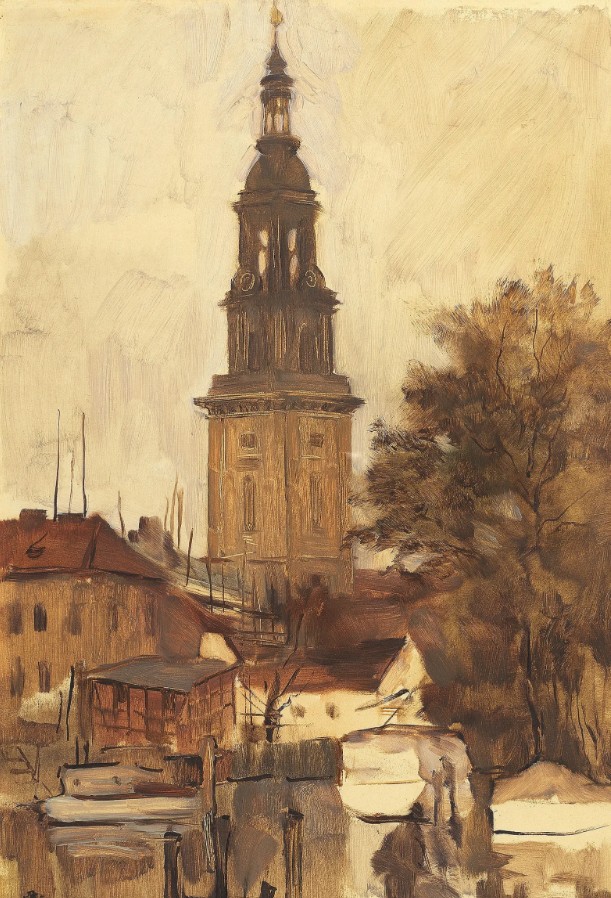
Garrison Church, Potsdam by Lotte Laserstein
as if it is carved into the stump of a tree on the left-hand side, accompanied by the date 1868 as well as the name of Moscow, all in Latin letters rather than Cyrillic. As the grandson of English immigrants to the Russian Empire, he likely would have been educated in both English and Russian. The painting shows a group of young people in traditional Eastern European peasant dress. An older man on the left-hand side sits on the aforementioned stump playing a vertical flute, with a young man inviting one of the girls to dance to the music being played. There are other figures in the background, both human and bovine. Many cows populate the painting, indicating that the group of figures is part of a Russian cattle farming community. With the rise of modern nationalism in the nineteenth century, local peasant customs became a source in forming broader national traditions like clothing, food, dance, and other forms of cultural expression. The Sherwood was only estimated to sell for no more than £2K, and it isn’t difficult to see why. Even without zooming in on the images Bonhams provided, you can see extensive craquelure and pigment separation throughout. The painting requires extensive restoration before any buyer can resell it. However, A Summer Pastoral attracted far more attention than anyone would have anticipated. Bids came pouring in, elevating the hammer price past the high estimate, past £10K, past £20K, finally landing at £42K / $57.3K (or £53.7K / $73.3K w/p). This put the hammer price at twenty-one times over the high estimate, making it the most expensive work by the artist ever sold at auction on record, beating out an oil painting attributed to the artist that sold at Dorotheum in 2019 for €37.8K w/p against an €8K high estimate.
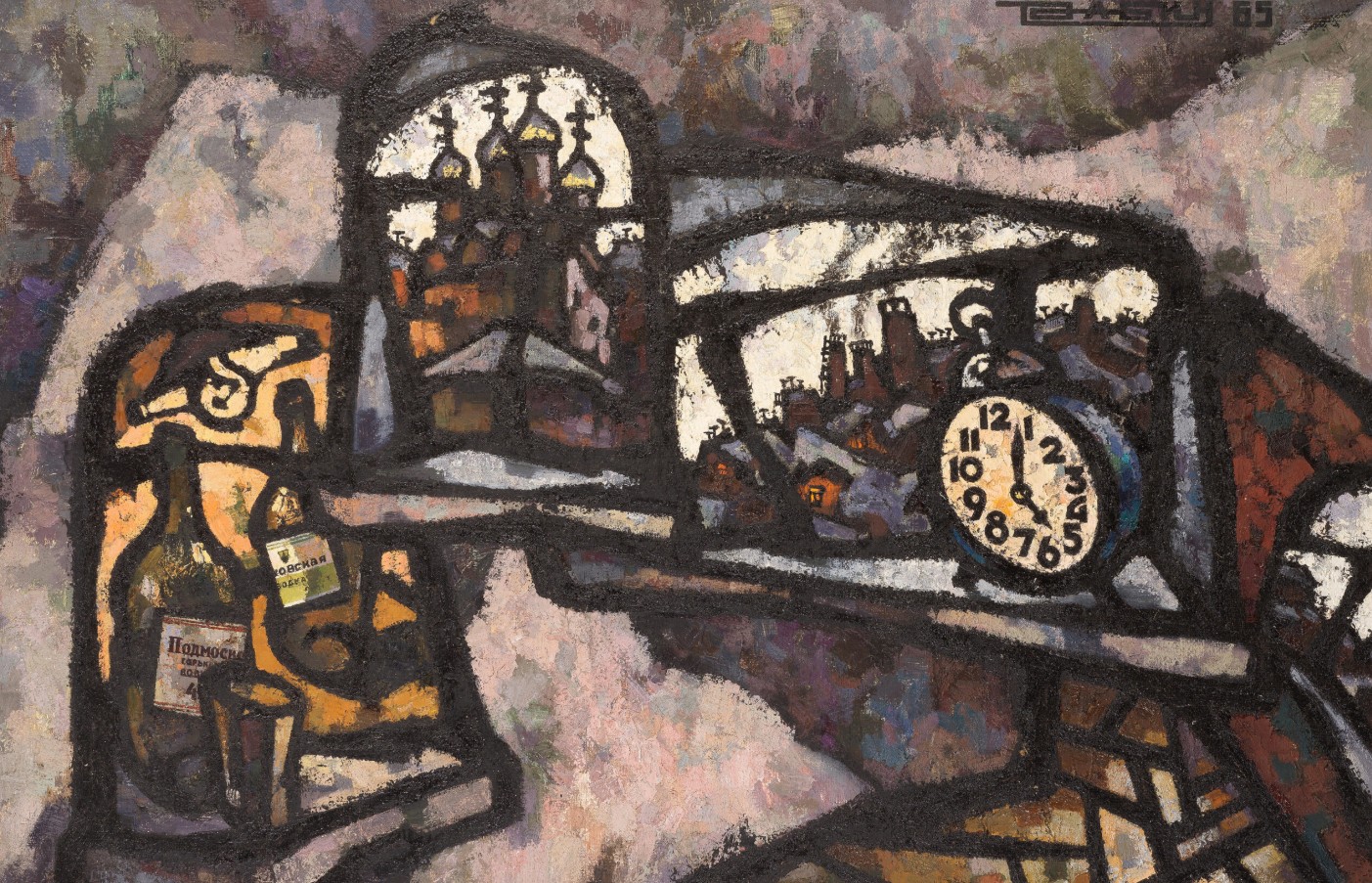
Four Windows and an Alarm Clock by Oscar Rabin
Next up were two works that each sold for the same amount. Garrison Church, Potsdam is an ink drawing by the German artist Lotte Laserstein, who mainly gained prominence during the inter-war period in Germany. While the drawing is undated, it likely dates to Laserstein’s time in Germany before she escaped to Sweden in 1937 due to increasing Nazi oppression. Furthermore, the church itself was demolished by East German authorities in 1968. It would not be until 2017 that work would begin to rebuild the church. Construction is scheduled to be completed by 2027. Like the Sherwood, the Laserstein drawing was not expected to make much, with Bonham’s specialist assigning it an £800 to £1.2K estimate range. In terms of exceeding expectations, the Laserstein actually outperformed the Sherwood, eventually selling for £28K / $38.2K (or £35.8K / $48.9K w/p), or 23.3 times the high estimate. A different lot, a painting by Oscar Rabin, achieved the same hammer price. However, this was less surprising than the Laserstein since it fell within its pre-sale estimate range. Four Windows and an Alarm Clock has been in the same private collection since leaving the artist’s studio in 1965. Rabin, being one of the preeminent artists of the Soviet nonconformist movement, focused mainly on Soviet material life. Bonhams specialists predicted it would sell for between £28K and £30K. The Rabin ended up squarely on the low estimate.
The Sherwood and the Laserstein were by far the biggest surprises of the sale, but they were not the only ones. Nine lots sold for more than double their estimates, including A Caravan in the Desert by Robert George Talbot Kelly (est. £700 to £1K; £3.4K hammer) and Westminster Abbey by George Hyde-Pownall (est. £2K to £3K; £9.5K hammer). Overall, the sale didn’t do too badly, with thirty-six of the one hundred twenty-three lots selling within their estimates, giving Bonhams a 29% accuracy rate. Fourteen lots (11%) sold below, while thirty-four lots (28%) sold above. This leaves thirty-nine lots unsold, giving Bonhams a 68% sell-through rate. Adding everything up, the lots that sold brought in £412.7K / $563K against a total low estimate of £330K. Even if the Sherwood and the Laserstein only reached their high estimates, the sale would have still reached that number.
Sotheby’s Karpidas Collection Evening Sale
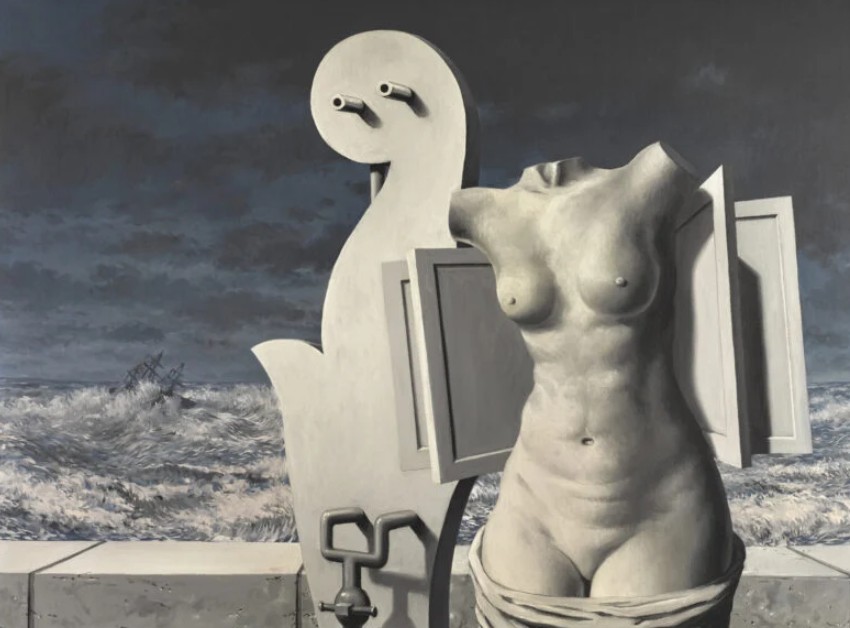
La Statue Volante by René Magritte
Last week, the first significant sale of the autumn auction season took place at Sotheby’s London with the collection of Pauline Karpidas. Since the 1970s, Karpidas has been a collector of modern and contemporary art. She is a prominent donor to the Tate Museums and the University of Manchester, donating dozens of works of art to the latter’s Whitworth Museum. While the Karpidas Collection contained a large number of works from different artists across genres, there seems to have been a strong emphasis on Surrealist art, with works by Salvador Dalí, Leonora Carrington, and Giorgio de Chirico featured in the sale.
As with any sale focusing on Surrealism, a painting by the Belgian artist René Magritte emerged as the top seller. The artist’s 1958 painting La Statue Volante shows the inclusion of several motifs Magritte had begun to use in the 1920s. A headless, armless, marble torso of a nude woman stands in front of a stormy seascape of blue and white. Behind the sculpture is a series of panels, as well as a curved shape that is almost reminiscent of the scrolls of a violin. These objects are also white, like the color of the stone, as if they are also sculpted from marble. Art historians, such as Francis Naumann, theorize that the abstract shape behind the sculpture represents another representation of the human form, in contrast to the more classical nude. The backdrop of a stormy sea is also an image that Magritte had used continuously throughout his work. His main visual reference point was a 1905 painting by the Armenian artist Vartan Makhokian, of which Magritte kept a postcard reproduction in his studio. For Magritte, a stormy ocean represented the vastness of the unknown, and therefore the world of dreams and the unconscious, which the Surrealist movement dedicated itself to exploring. As the first major Magritte painting to be brought to auction since May, La Statue Volante attracted some attention. Sotheby’s specialists assigned the painting an estimate range of £9 million to £12 million. Auctioneer Oliver Barker opened the bidding at £7.9 million, with the bid quickly rising to £8.4 million after just under forty seconds. Barker waited about two minutes for any additional bids before bringing the hammer down at that price, equivalent to $11.48 million (or £10.12 million / $13.8 million w/p). Although it sold for slightly under its minimum estimate, La Statue Volante is the most expensive work by the artist sold at auction since the Leonard & Louise Riggio sale at Christie’s New York this year, where one of Magritte’s L’empire des lumières paintings sold for $34.9 million w/p.
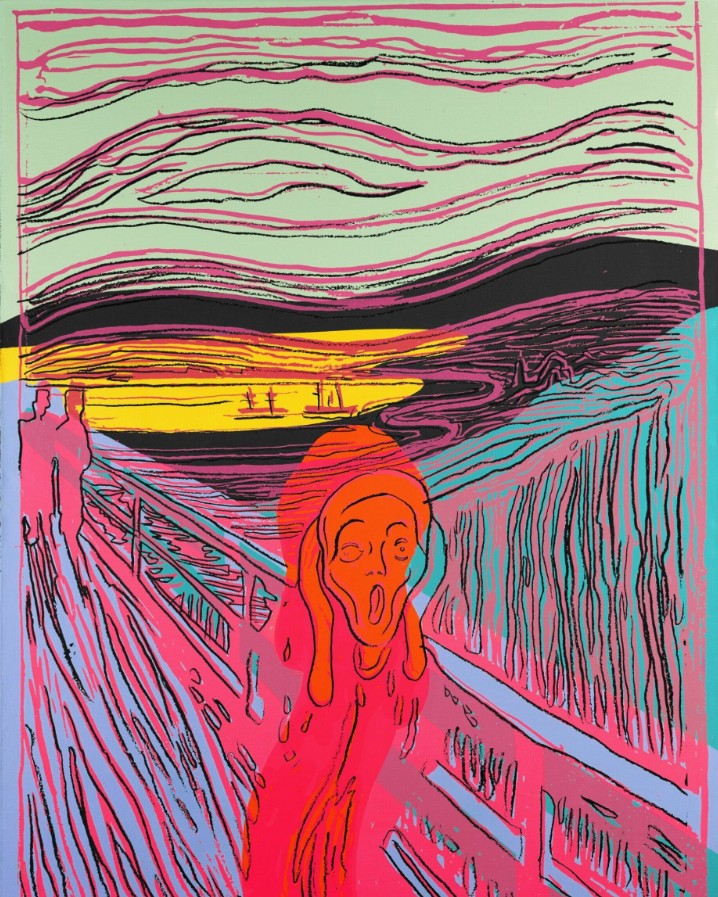
The Scream (After Munch) by Andy Warhol
While Surrealist art was the main focus of the Karpidas Collection, other genres also featured prominently, including Pop Art. Coming in behind the Magritte was one such example, The Scream (After Munch) by Andy Warhol. As one of the de facto leaders of pop art in the mid- to late twentieth century, Andy Warhol recognized that while examples of consumer culture like Campbell’s soup cans and boxes of Brillo pads were an important part of popular culture, he also recognized that fine art could also form a part of pop culture as well. When the image is famous enough, it can be reproduced and sold through posters and print reproductions. Throughout his career, Warhol gave us his own colorful spins on Botticelli’s Birth of Venus, Da Vinci’s Mona Lisa, and Paulo Uccello’s St. George and the Dragon. His reinterpretations of older paintings not only highlighted the role of art as a commodity, but they also recontextualized his own work and methods. His take on The Birth of Venus turns the painting from a mythological scene into just another one of his celebrity portraits, similar to his famous paintings and prints featuring Marilyn Monroe and Debbie Harry. Warhol also reimagined several paintings by Edvard Munch during his career. He previously cited both Munch and Matisse as his favorite artists. He was invited by the Norwegian gallerist Tor Uppstrom to create a series of fifteen reinterpretations of works by Munch, including The Scream. Sotheby’s specialists call these works “a convergence of two artistic minds grappling with the same enduring human condition — anxiety in the face of modern life.” Pauline Karpidas acquired this work at a sale at Sotheby’s in 1996. However, these Warhol/Munch works have become somewhat of a rarity, with none of them having come to auction since 2010. Therefore, it was not particularly surprising when the bidding exceeded the £3 million high estimate assigned by Sotheby’s, eventually reaching £5.4 million / $7.38 million (or £6.6 million / $9 million w/p).
Finally, coming in third was an oil painting dated around 1941 by Francis Picabia. The artist is often associated with several different styles and genres, dabbling in Dada, Surrealism, and Cubism at various points in his career. The painting Deux Amies comes from a very specific point in his life. In the summer of 1940, not long after the invading Nazis took over the French capital, Picabia moved from Paris to the south of France. From then on, he decided to focus on a rather unusual subject. He began creating female nude paintings. While this genre of figure painting was nothing new, he still sought to challenge many of the older, academic norms surrounding figure painting by drawing inspiration from pinup photography and cheap erotic magazines. For Deux Amies, art historians have been able to narrow down the specific issue the artist drew from to create this image. The painting is somewhat of a collage, combining photographs of the same model in two different poses featured in the April 1937 issue of Paris Sex-Appeal. Picabia’s use of not only mass media but mass media of a titillating or lascivious nature was, according to Sotheby’s, “bridging the low with the lofty, the kitsch with the divine”, becoming a precursor to the pop art of Andy Warhol and Jeff Koons. Although not as abstract as some of his other work, the paintings from this period are, nonetheless, incredibly important in the trajectory of both Picabia’s style and Western art in general. The painting eventually sold on the higher end of its £2.2 million to £2.8 million estimate range, landing at £2.7 million / $3.7 million (or £3.3 million / $4.55 million w/p).
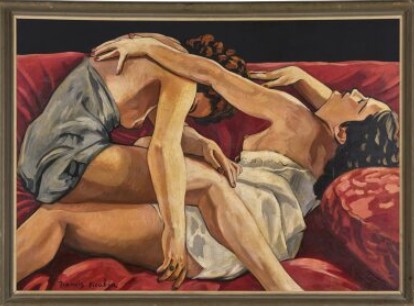
Deux Amies by Francis Picabia
Typically, with prominent single-collector sales, there aren’t that many surprises since the estimates are already in the millions, so it would take a far greater amount of money to push the hammer price of a given lot into selling for an exponentially higher amount than expected. However, there were indeed a small handful of surprises on Wednesday. Nine of the fifty-five lots sold for more than double their high estimates, accounting for approximately 16% of the entire auction. Six of those lots are by the same artist, the French sculptor Claude Lalanne. Along with her husband, François-Xavier Lalanne, Claude Lalanne became one of the most prominent French sculptors between the 1950s and 2000s, creating works of both fine and decorative art. While François-Xavier preferred animal subjects, Claude greatly employed the imagery of plants, flowers, and other vegetation. At Sotheby’s on Wednesday, the biggest surprise of the evening came in the form of Claude’s Unique Structure Végétale Mirror and Wall Light. Lalanne created this mirror in 1995, primarily from bronze patinated with gold, and decorated with leaves crafted from galvanized copper. Pauline Karpidas owned several mirrors by the artist, with Sotheby’s singling this one out as the best. Estimated to sell for no more than £450K, the Lalanne mirror reached this figure after thirty seconds of bidding. Barker allowed the bidding to continue for another 11 minutes, the hammer Price skyrocketing to over six times the high estimate at £2.9 million / $3.96 million (or £3.6 million / $4.9 million w/p). The mirror became the second most-expensive work by the artist sold at auction, surpassing a different mirror also owned by Pauline Karpidas, which sold at Sotheby’s Paris in 2023 for €4.4 million (or $4.6 million).
Sotheby ended up doing exceptionally well on Wednesday. Of the fifty-five available lots, sixteen sold within their estimates, giving Sotheby’s a 29% accuracy rate. While twelve lots (22%) sold below their estimates, an incredible twenty-seven lots (49%) sold over. With no lots going unsold, the Karpidas Collection evening sale achieved a 100% sell-through rate. Against a total high estimate of £55 million, the evening sale collection generated a total of £64.7 million, equivalent to approximately
____________________
Deeper Thoughts
Picasso Museum Announces Expansion
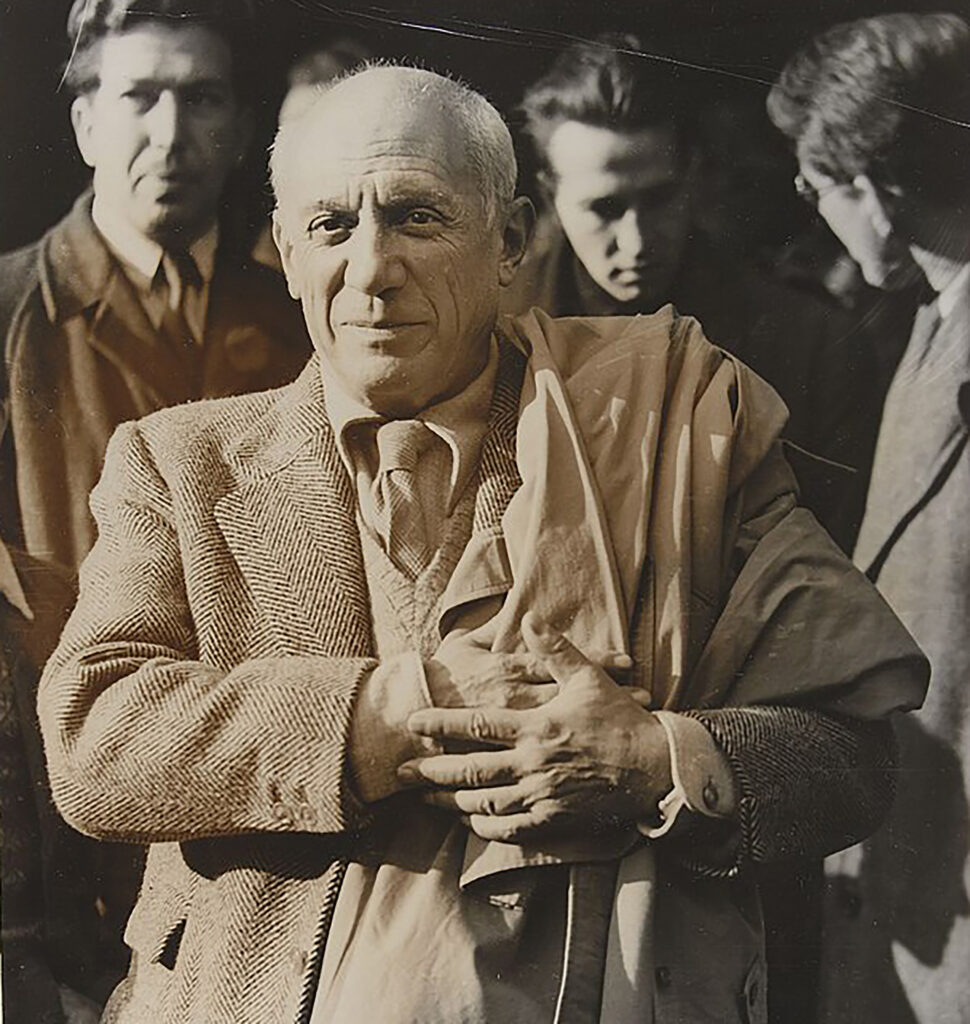
The Picasso Museum in Paris has recently announced a $50 million expansion project, which will include an outdoor space for a public sculpture garden.
It has been eleven years since the last renovations at the Picasso Museum. The museum is housed in the Hôtel Salé, a seventeenth-century mansion in the Marais District of Paris. Though the museum first opened in 1985, the Hôtel Salé desperately needed updates to make the museum more operational and manageable. The project ran over schedule and over budget, resulting in the dismissal of the museum’s director by the French cultural minister. And now, a little over a decade later, the Picasso Museum recently unveiled an expansion project it is calling Picasso 2030. The centerpiece of this expansion project will be the acquisition of the small park adjacent to the museum, Jardin de l’Hôtel Salé Leonor Fini. This park will be transformed into a public sculpture garden that will be able to hold some of Picasso‘s sculptures and other three-dimensional works curators might find difficult to display in the galleries. The museum owns 368 such works, including bronze sculptures like L’Homme au mouton (1943), La Chèvre (1950), and Métamorphose I (1928). The Picasso Museum’s director, Cécile Debray, stated in her announcement that she hopes the addition of a public sculpture garden will make the museum more accessible and encourage people to visit more frequently. She further commented, “The building is magnificent and very well-maintained. But as time went on, I saw its limitations”.
One of the other main focuses of Picasso 2030 is to build a new wing dedicated to temporary exhibitions, nearly doubling the amount of space available to such shows to around 8,600 square feet. This would free up wall space for works from the permanent collection, of which the Picasso Museum only has space for about 10% on the gallery walls at any given time. The museum will also gain a new restaurant, a bookstore, classrooms, and cultural mediation spaces. Unlike the last round of renovations, the museum plans on remaining open while the project is underway between 2028 and 2030. In total, the museum estimates the expansion will cost around €50 million. Normally, the French government would be willing to foot the bill. However, President Emmanuel Macron‘s government has already involved itself in several expensive cultural projects, including renovations to the Louvre and other cultural institutions. However, the museum may still do well with partial funding, as it is one of the most popular small museums in the French capital. The museum also has an extensive network of donors it can draw from, while the Picasso family itself may also be asked to contribute.
Trump NEA Policy Ruled Unlawful
A federal court has prohibited the National Endowment for the Arts (NEA) from implementing President Donald Trump’s executive order barring grants to organizations promoting “gender ideology”.
Since Donald Trump reassumed the presidency in January 2025, his administration has been exerting greater control over the cultural institutions of the United States. Earlier in the year, President Trump placed considerable pressure on the National Endowment for the Humanities to the point that its chairwoman, Shelly Lowe, resigned. He also attempted to fire the director of the National Portrait Gallery, Pat Sajet. Many pointed out that the president cannot hire or fire the heads of any of the Smithsonian Institution’s museums. Sensing the growing hostility from the new administration, however, Sajet decided to leave on her own volition several months later to become director of the Milwaukee Art Museum. And of course, the administration has been trying its best to cut funding from the National Endowment for the Arts (NEA). Earlier in the year, a group of private organizations made headlines after announcing they would make significant donations to help the NEA fund some of their Challenge America grants. The Andy Warhol Foundation and the Helen Frankenthaler Foundation have collectively pledged $800,000, while the Mellon Foundation announced it would donate $15 million to the Federation of State Humanities Councils. Mellon Foundation president Phoebe Stein described these funds as “a lifeline for communities across the country who rely on their humanities councils’ programs and grants to fill critical needs and enrich their lives.” However, a federal judge has recently ruled that some of the restrictions placed on NEA grants by the Trump administration are unlawful.
As part of his administration’s cultural policy, Trump has demanded that the NEA add an additional layer of review for grant applicants to ensure that no federal funds are given to support artists or cultural organizations that promote “gender ideology”. This specific restriction was implemented as part of Executive Order No. 14168. Of course, what that rather vague term means is that to receive money from the NEA, an artist is forbidden from shining a light on the lived experiences and difficulties of people whose gender and sexual identities do not comply with the simplistic, reductive concepts of heteronormativity and an unchanging gender binary. The American Civil Liberties Union filed a lawsuit on behalf of several arts organizations that would have much of their funding denied because some of their work pertains to queer and trans people. By denying funds on political or ideological grounds instead of on artistic merit, the ACLU argued that the new NEA policy, as outlined in Executive Order No. 14168, is both unlawful and unconstitutional. And now, a federal judge has agreed with them.
Judge William Smith, an appointee of George W. Bush, ruled that the NEA policy, and therefore the executive order, is a violation of the Administrative Procedure Act (APA). The APA states that the courts must determine when a federal agency has acted “in excess of statutory jurisdiction, authority, or limitations”. In this case, the NEA policy, implemented in accordance with the executive order, violates the act of Congress that established the NEA in 1965. The law explicitly states that grants and other funding are to be dispersed to support “projects and productions which have substantial national or international artistic and cultural significance, giving emphasis to American creativity and cultural diversity”. The law also explicitly states that funding should be given to provide a greater voice to underrepresented or disenfranchised groups; or, to quote the law itself, “a minority, inner city, rural, or tribal community”. The ACLU legal team also referenced the minutes of the congressional debates during the NEA’s creation, noting that the legislators who crafted the law intended for there to be safeguards against government-run cultural institutions from being used for expressly political purposes. By instructing a federal agency to act beyond its purview, Trump’s executive order and, therefore, the NEA policy violate the APA.
Judge Smith also found that the NEA’s policy created by Trump’s executive order violates the First Amendment. Specifically, the new restrictions that the order and the policy implement are “a restriction on artists’ speech, and one that is viewpoint based, because it assigns negative weight to the expression of certain ideas on the issue of gender identity.” Smith went into detail on whether art created with the help of NEA grants or funding is considered government speech or private speech. If it is government speech, then there would be no First Amendment violation. However, he decided that since the NEA has no editorial control, the government has no role in shaping the content or message of these works of art, making NEA-funded works private speech. He therefore declared that the NEA is now “permanently enjoined” from applying “a viewpoint-based standard of review”, and that the arts organizations that the ACLU represented in the case cannot be made to comply with Trump’s executive order when using NEA grants.
Met Museum Commission Highlights Indigenous Art
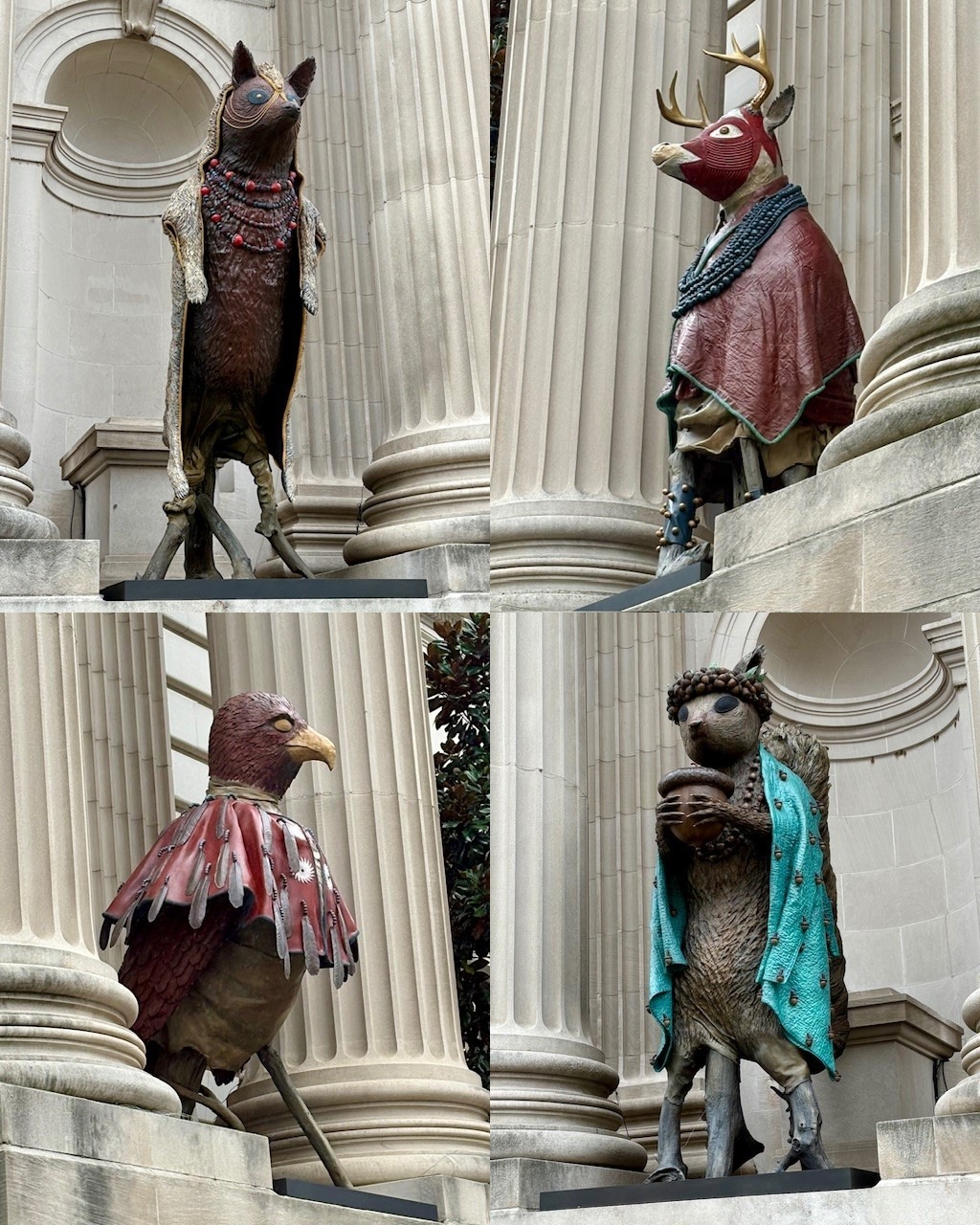
The Animal That Therefore I Am by Jeffrey Gibson
Last Friday, the Metropolitan Museum of Art in New York revealed a new addition to its façade: a series of bronze sculptures by Jeffrey Gibson.
Since 2019, the Metropolitan Museum has commissioned sculptures occupying the niches on the front of the museum facing Fifth Avenue. Since 2024, the luxury motor company Genesis, a subsidiary of Hyundai, has been the sponsor of these commissions. Between September 2024 and June 2025, those spaces were occupied by a sculpture series called Long Tail Halo by the Korean sculptor Lee Bul. However, those works have been replaced by a new series, The Animal That Therefore I Am by the indigenous American artist Jeffrey Gibson. While Gibson has made use of many artistic media, including painting and performance, indigeneity features prominently in his work. The artist is of Cherokee descent and is a member of the Mississippi Band of Choctaw Indians. Specifically, according to a museum press release, Gibson’s work “critiques the reductive ways Indigenous culture has been historically flattened and misappropriated.”
Each of the four sculptures is around ten feet tall, each in the form of a different animal. There’s a hawk, a squirrel, a coyote, and a deer. The animals are all shown standing on two legs, dressed in cloth and beads, using patterns and colors that evoke the artistic traditions of indigenous cultures. These elements are executed with great skill, despite it being Gibson’s first time working with bronze. Gibson initially created the works by carving pieces of driftwood, which he then scanned and used to make casts for the bronze. The name of the series, The Animal That Therefore I Am, is derived from Jacques Derrida’s book of the same title, which discusses the philosophy surrounding what distinguishes humans from other animals, as well as the ethics of humanity’s domination and killing of animals. Derrida was considered radical in Western philosophy for considering animals. However, as Gibson reminds us, indigenous cultures in North America and beyond have commonly given animality a greater degree of respect through various forms of animism and spiritualism.
In giving the animals elements of human material culture, what the artist calls “regalia”, Gibson’s sculptures comment on how animals have been forced to adapt their lives to comply with human encroachment on the environment. He distinguishes between regalia and mere clothing in that the former “is imbued with the ability to transform oneself — while you’re wearing it, you are a different being.” Animals’ need to adapt to humanity’s domination is further reinforced by the fact that all four animals are native to the New York area, including the Hudson Valley, where the artist now lives and works. Furthermore, the Metropolitan Museum’s location is incredibly appropriate for these works’ exhibition. The museum is located on Fifth Avenue, but is mainly situated in Central Park, the bulk of the museum building jutting into the green space. The museum is therefore located at the threshold between a world made of concrete and asphalt and one that, though man-made, is more akin to nature.
Gibson initially conceived of the project’s central theme over a decade ago while painting on elk hides. During a discussion on the sculptures, Gibson said that using the skins made him come face-to-face with the realities of using animals for our benefit. When painting on hides, “you come across scars. You come across hair follicles. You’re reminded that it’s an animal.” Unlike other forms of anthropomorphization, Gibson does not necessarily give his animals names and genders. Rather, he references the qualities of each animal, the lessons humanity has learned from them, and the many names that they go by in different indigenous languages. The hawk has the title they carry messages between light and dark spaces bia̱kak/dawodv/hawk, while the deer is called they teach us to be sensitive and to trust our instincts issi/awi/deer. The coyote has the name they are witty and transform themselves in order to guide us nashoba holba/wayaha/coyote, and lastly the squirrel is titled they plan and prepare for the future fvni/sa lo li/squirrel.
The Metropolitan Museum will exhibit Jeffrey Gibson’s The Animal That Therefore I Am on the museum façade through June 9, 2026.
Rubens Rediscovered in Paris
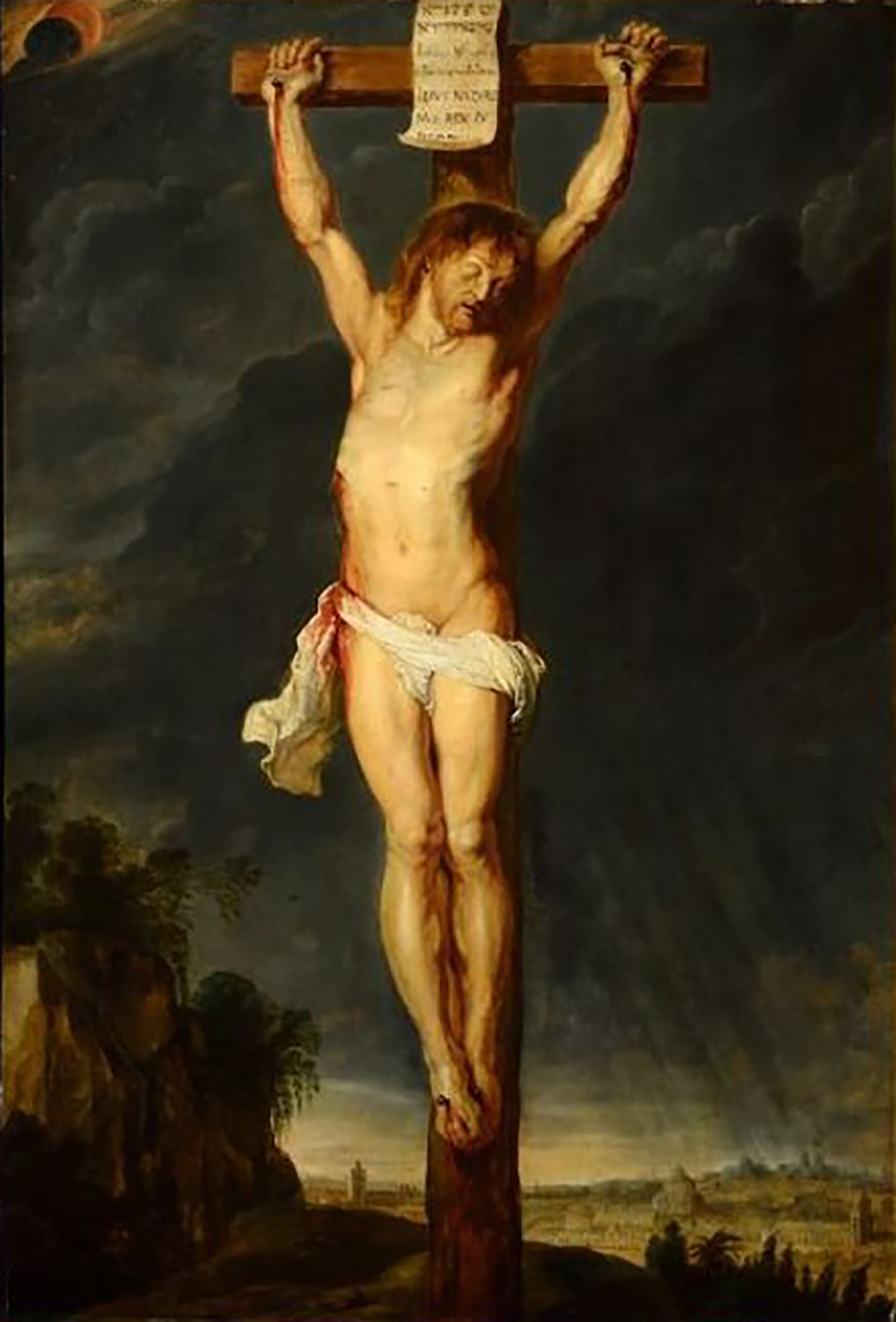
Christ on the Cross by Peter Paul Rubens
A French auctioneer has rediscovered a lost masterpiece by the Baroque Flemish painter Peter Paul Rubens.
Christ on the Cross has allegedly been missing since shortly after its creation in the second decade of the seventeenth century. And now, Jean-Pierre Osenat, who runs the auction house Osenat, claims to have found the painting in a Paris mansion. He says he came across the 41.5-by-28.5-inch work while cataloguing the inventory of a home in the city’s 6th arrondissement, traditionally a hub of artistic and intellectual life in the French capital. Since then, the painting has been authenticated by Dr. Nils Büttner, a professor at the Stuttgart State Academy of Fine Arts who specializes in fifteenth- and sixteenth-century German, Dutch, and Flemish art. Dr. Büttner is also the chairman of the Centrum Rubenianum in Antwerp. This organization publishes the Corpus Rubenianum Ludwig Burchard, the main Rubens catalogue raisonné since 1963. In his announcement, Osenat remarked, “This is an extremely rare and incredible discovery that will define my career as an auctioneer.” According to new research, the first time the painting appears in any provenance documents was in the possession of the renowned nineteenth-century academic master William-Adolphe Bouguereau. Büttner and Osenat guess that the painting went from Bouguereau to the family that owned the inventoried house. The painting’s owners beyond the nineteenth century are unknown.
Osenat claims that this Rubens is one of the starting points of Baroque era painting in Europe. To a certain extent, he is correct. Religious art showing the crucified Christ was not new by the time of Rubens. But the Flemish master’s particular rendition of the subject was incredibly influential. According to art historians like Michael Jaffé, Baroque era depictions of Christ on the cross became modeled after two different artists’ styles. The style pioneered by the Italian painter Guido Reni shows Jesus in a very statuesque manner, seeming almost peaceful and stoic. However, the depiction favored by Rubens shows the opposite. Christ’s muscles are tensed up, his fingers are bent into claws, and a look of torment crosses his face. His arms stretch almost straight up instead of out to his sides, contorting his body with a protruding chest. Rubens created several versions of this painting, nearly all from the same ten-year period. Some of these paintings now belong to various museum collections, including the Royal Museum of Fine Arts in Antwerp and the Museum of Fine Arts Boston. The painting recently uncovered by Osenat, however, is almost the same as these other works, yet shows slight differences. Instead of a look of anguish, the face of the recently rediscovered crucified Christ has its eyes closed, head lolling off to the side. The upper body is slightly relaxed, but his hands are still clenched. It’s almost as if this rendition depicts Jesus a moment later, losing consciousness from the pain. It’s not just a copy of a subject the artist had done time and again. With the added context of the Rubens-Reni dichotomy, the differences, however small, make the rediscovered painting more interesting.
In his announcement, Osenat stated that the painting would be featured in the Tableaux Anciens sale scheduled for November 30th. It is not known how much specialists estimate the painting would sell for.
Christie’s Closes Digital Department
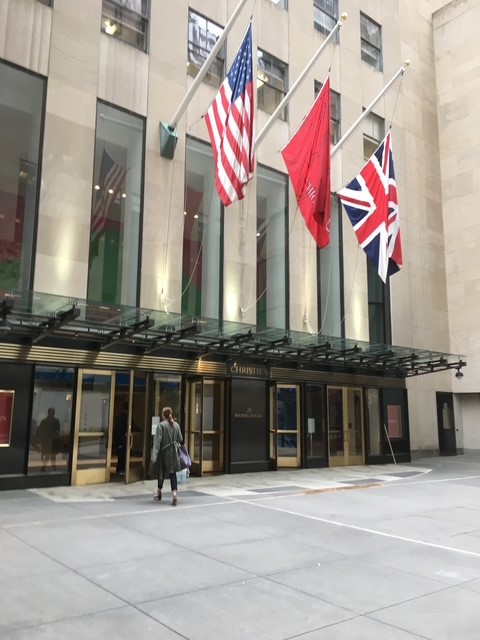
Christie’s has closed its digital art department, potentially marking the beginning of the mainstream art world’s breakup with the medium.
Nicole Sales Giles worked at Christie’s as the vice president of digital art. However, she recently told Now Media that she and the auction house have parted ways, and that they have closed their digital art department. When asked for a comment, a spokesperson for Christie’s said that this was “a strategic decision to reformat digital art sales.” Instead of having their own department, digital works of art will instead be dealt with through the twentieth and twenty-first century divisions. Now that the digital department is shuttered, there is the issue of Christie’s 3.0, the auction house’s platform for buying and selling NFTs and other works backed by blockchain technology. Christie’s plans to keep the service up and running are currently unknown.
The art world establishment has had an interesting love affair with new forms of digital art ever since 2021, with the rise of the NFT as an artistic medium. It was at Christie’s that the first major NFT sale took place, when the Everydays series by Beeple sold for $69.3 million. Over the course of 2021 and into 2022, NFTs and other forms of digital art made prominent appearances at major auction houses and galleries. This sparked widespread speculation, both enthusiastic and fearful, that this foray into the mainstream art world would legitimize a very new art form that many were hesitant to approach. However, the market has changed. By the end of 2022, NFT sales at Christie’s had dropped 96%. The full scale of how NFTs are used for nefarious purposes became common knowledge. Digital art platforms like Async Art, KnownOrigin, and LG Art Lab have all since closed. Eventually, some blamed major auction houses like Sotheby’s for inflating the bubble, using their reputations to hype up the technology and drive up prices. Perhaps auction houses like Christie’s were somewhat hasty in establishing separate departments for digital art, given the considerable uncertainty in the market for these works.
It’s understandable why there hasn’t been much fanfare over the decision to close down the digital department. Christie’s would rather quietly sweep under the rug the fact that they and many others fell for a bubble. It’s embarrassing, yes, but like the tulips of centuries ago or the Internet companies of living memory, there’s always something everyone thinks is going to be the next big thing. And it doesn’t always pan out the way we think. But now, there’s a different item on the market we’re going to have to deal with. Art generated by artificial intelligence has replaced NFTs as the art of the future in some people’s minds. However, with the NFT bubble still so fresh in people‘s minds, as well as a series of legal battles over the ethics and legality of AI art, I doubt there will be any multimillion-dollar sales anytime soon.
Symbol Of Venice. Made In China?
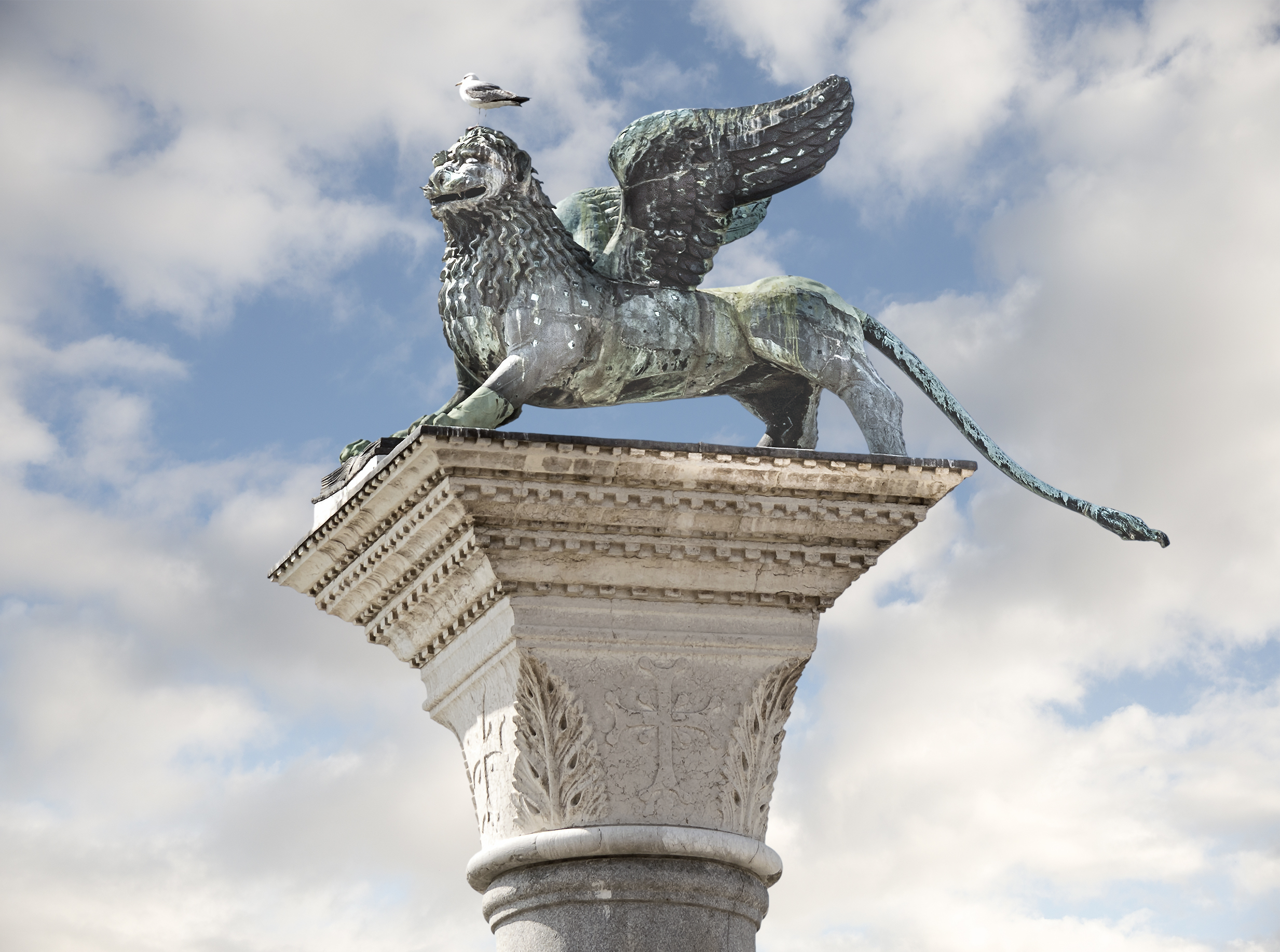
The Lion of Venice (photo courtesy of Didier Descouens)
The famous Lion of Venice, a bronze sculpture used for centuries as a symbol of the Italian city, most likely came from China, according to recent scientific studies.
The Lion of Venice is a bronze sculpture that sits atop a column in the Piazzetta di San Marco. It is one of the most famous representations of the Lion of Saint Mark, one of the most enduring symbols of the city. The symbol consists of a winged lion next to an open book representing the Gospel of Saint Mark. Saint Mark is the patron saint of Venice, and the winged lion has been used to symbolize him by many church leaders and ecclesiastical scholars. Saint Mark’s association with Venice dates back to the ninth century, when his remains were taken from Alexandria to Venice, where he was reburied in the Basilica of Saint Mark. Starting in the late thirteenth century, the Republic of Venice used the winged lion as an official symbol, appearing on its flag. The lion sculpture potentially arrived in Venice sometime in the twelfth or thirteenth century, with the first written reference dating to 1293 describing the lion as somewhat neglected and in need of restoration. The sculpture remained on top of its column until the fall of the Republic of Venice during the French Revolutionary Wars in 1797, when General Napoleon Bonaparte brought the lion to Paris as a trophy of his victorious campaigns in northern Italy.
There is no scholarly consensus as to the sculpture’s origins. While nineteenth-century historians say that the lion was made in Venice, later studies posit that the sculpture, in whole or in part, came from Greece, the Levant, or Persia. The most recent comprehensive study of the sculpture was published in 1990 by Bianca Maria Scarfi, who theorizes that the lion sculpture is “a Hellenistic interpretation of the Mesopotamian/Persian lion‑headed griffin, made in the fourth or third centuries B.C.” However, recent scientific studies indicate that the bronze used in the sculpture comes from a more distant locale. Scarfi’s study took chemical readings of different parts of the sculpture to determine their makeup. However, this data could not be used to determine the bronze’s origin since, at the time, there were no comprehensive reference databases. Specialists used mass spectroscopy to analyze multiple samples taken from the lion sculpture. They identified specific lead isotopes present in the metal as originating in the area around the lower Yangtze River in eastern China. This has led art historians to hypothesize that the original sculpture may have had its origins as a zhènmùshòu, a Chinese funerary sculpture meant to serve as guardians of temples and tombs. Given the age of the bronze, the Lion of Venice would have been made during the Tang dynasty between the seventh and tenth centuries CE.
The most thorough study of the lion’s possible Chinese origins was written by Gilberto Artiolli, Ivana Angelini, and Massimo Vidale, all of the University of Padua. Their article “A Lion on the Silk Road” was featured in the 2024 book Reimagining the Silk Roads: Interactions and Perceptions Across Eurasia, published by Routledge. They note that, stylistically, the lion’s face is not consistent with medieval Italian representational conventions. However, they do match with these Chinese tomb guardians, specifically sharing “the low forehead, bulb-like nose, lateral position of the ears, flocks under the chin, the grinning mouth and setting of the fangs, and the pronounced, convoluted wrinkling of the forehead at the root of the nose, were [sic] a round depression is visible”. The original Chinese sculptures, however, were often composites, featuring the heads and manes of lions as well as wings, the hooves of oxen, and the horns of deer or cattle. The Lion of Venice shows several markings, almost like scars, where some of these other features may have been removed. There is, however, a lack of large bronze sculptures from the time period resembling the Lion of Venice. But this lack of similar sculptures may be explained as a result of a period in Chinese history known as the Four Buddhist Persecutions, where the imperial government cracked down on the power and influence of Buddhist temples in favor of Taoism. In many cases, bronze sculptures were confiscated, broken apart, and melted down to mint currency. Surviving sculptures from the period that would have been placed on temples or tombs are therefore nearly always wood or earthenware.
This hypothesis, if proven, could significantly alter our understanding of the Lion of Venice’s historical significance and its role in the cultural exchange between East and West. As to when and how the lion came to Venice from China, Artiolli, Angelini, and Vidale hypothesize that it came along the Silk Road, possibly brought to the city in 1269 by Niccolò and Matteo Polo, the father and uncle of Marco Polo. The Italian team refers to the Chinese provenance hypothesis as “quite plausible, but admittedly not demonstrated by detailed historical sources nor, for the reasons explained above, by conclusive iconographic comparisons. […] Maybe science is helping to unravel some of these secrets.”
Which Is The Real Vermeer?
.jpg)
The Guitar Player by Johannes Vermeer (Kenwood Version)
A new exhibition in London seeks to reopen the debate regarding two nearly identical paintings, one by Johannes Vermeer and the other allegedly a copy. But some claim that the alleged copy is, in fact, an original Vermeer.
London’s Kenwood House is a museum and former stately home that now serves as an exhibition space. Previously, they hosted a show centering on the paintings of John Singer Sargent and his portraits of American Dollar Princesses. And now, from September 1st to January 11th, it will host Double Vision, a new exhibition focusing on Vermeer’s 1672 painting The Guitar Player and its mysterious twin. It is the first time that the two paintings are being displayed side-by-side. The supposed original is part of Kenwood House’s collection, while the Philadelphia Museum of Art owns the copy. The debate surrounding the Philadelphia version’s authorship was reignited in 2023 when Rijksmuseum specialist Arie Wallert claimed that the Philadelphia painting is likely an original work by the artist. His evidence includes a specific pigment used in the painting, lead-tin yellow, which would have fallen out of use among Western European artists at the beginning of the eighteenth century. The main reason many consider the Kenwood painting to be the original is its relatively good condition upon its rediscovery in 1927.
There are two primary differences between the paintings: first, the Kenwood version is signed, while the Philadelphia version is not. Second is the subject’s hair, with the Kenwood painting having it styled into ringlets, while the Philadelphia version has her hair worn up in a sort of crown braid. Specialists from the Philadelphia Museum of Art, Washington DC’s National Gallery of Art, and Kenwood House have not released a final report yet, but they have some preliminary findings. The Kenwood version, for example, was prepared using a light greyish brown made from a combination of white lead, chalk, and earth-tone pigments. The Philadelphia version, meanwhile, uses a darker brown, mainly made from burnt umber. The Philadelphia painting also uses indigo, which was much cheaper than Vermeer’s preferred blue pigment, ultramarine. Former Rijksmuseum fine arts director Gregor Weber has also weighed in, examining the hairstyle of the paintings’ respective subjects. While some speculate that both paintings are by Vermeer, Weber insists that the hairstyle of the Philadelphia version indicates that it is a copy, albeit a very early copy. The hair has been changed to modernize the painting’s appearance, since the Philadelphia version shows the woman “a style starting around 1680 as can be seen in several portraits of fashionable women by Jan Verkolje in Delft, Nicolaes Maes in Amsterdam and others.”
Wendy Monkhouse, the senior curator at Kenwood House, describes the new exhibition as “a rather beautiful confusion” for visitors. The show not only presents the expert analysis of the two paintings but also encourages each visitor to draw their own conclusions. The public’s involvement in not just art’s appreciation but its study and scholarship is the central idea behind the exhibition’s layout. The final report on the expert analysis is due to be released in the next few months, adding to the anticipation and excitement.
Van Gogh Museum Threatens To Close
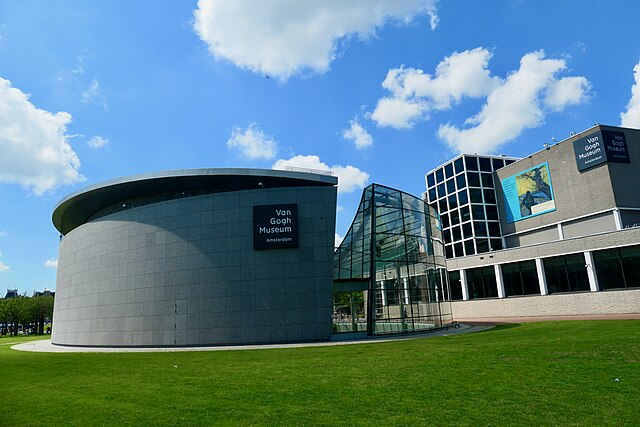
The Van Gogh Museum (photo courtesy of Bruno Rijsman)
The Vincent van Gogh Museum in Amsterdam states that it may be forced to close if it does not receive additional funding from the Dutch government.
The Van Gogh Museum receives approximately 1.8 million visitors per year, and is said to undergo an extensive renovation process between 2028 and 2031. The main building is over fifty years old and was designed to welcome only 500,000 visitors annually. While the other buildings are newer, much of the museum, regardless, needs updates to its climate control system and elevators. The museum also seeks to improve its security and fire safety systems, as well as make the building more sustainable. The museum has been in negotiations with the Dutch government over funding these renovations for the past two years, which the museum estimates will cost around €104 million. However, the museum plans to remain open during the upgrades, keeping one of the two main buildings open at a time to accommodate visitors. Due to the constraints on available space, the Van Gogh plans to focus on selections from their permanent collection instead of curating temporary exhibitions. In addition to the cost of the renovations, the museum estimates that the inability to welcome the number of visitors they’re accustomed to will cause the museum to lose approximately €50 million.
The Van Gogh Museum is one of the most financially sustainable cultural institutions in the Netherlands. The museum itself is responsible for generating approximately 85% of its annual revenue. The remainder comes from government subsidies, totaling approximately €8.5 million per year. The museum estimates that the Dutch state will need to increase that amount to €11 million to remain operational during the three-year renovations. The museum states that it is simply asking the Dutch government to “fulfil its legally established obligations” in accordance with an agreement made in 1962 with the Van Gogh family and the Vincent van Gogh Foundation, where the government agreed to fund the construction and maintenance of a museum dedicated to Vincent van Gogh. Since negotiations between the museum and the state have broken down after two years, the museum has filed a complaint alleging that the Dutch government is now in violation of the 1962 agreement. In response, the Dutch Ministry of Education, Culture, and Science has stated that its current subsidy is sufficient to maintain museum operations during its renovations. The Van Gogh Museum, however, disagrees, saying that without the slight increase in its government subsidy, the museum “will not be able to guarantee the safety of the collection, visitors and staff” while the renovations are underway.
Should the government and the Van Gogh Museum fail to reach a compromise, the legal complaint brought by the museum is scheduled to be heard in court in February 2026. However, Government action may be delayed due to the ongoing situation in the Dutch parliament. In June 2025, the governing coalition fell apart after one of its parties withdrew. New elections are scheduled for late October, meaning it may be two months before any progress is made in negotiations.
John F. Kennedy International Airport’s new Terminal 6 will include works of art from several prominent New York cultural institutions.
____________________
Featured Artworks
John Stobart’s Independence, Wayne City Landing, 1842
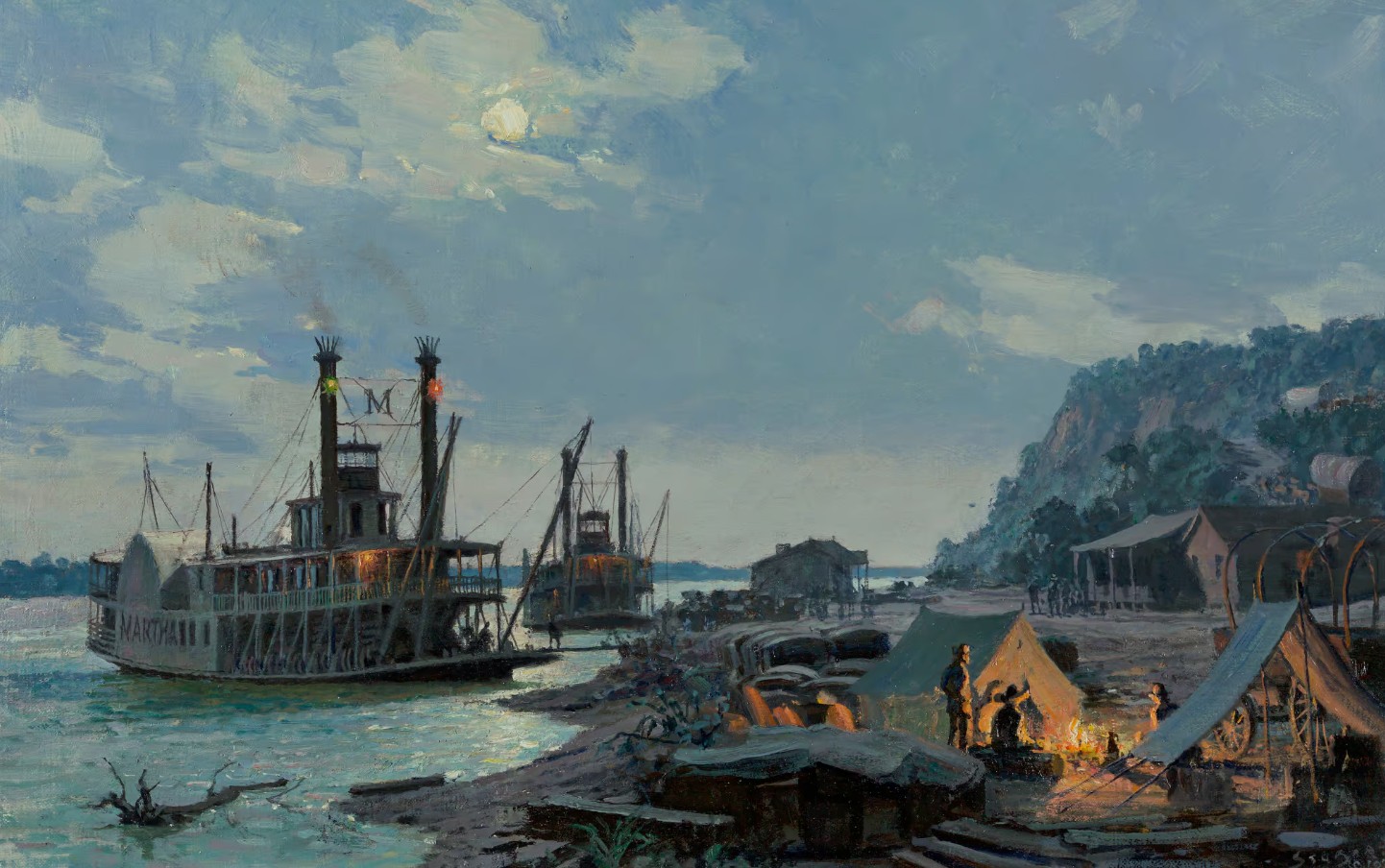
Independence, Wayne City Landing, 1842 by John Stobart
John Stobart was one of the greatest maritime painters of the twentieth century, specializing in painting historical sailing ships and harbor scenes as they would have appeared decades or centuries ago. But while clipper ships on the Atlantic or views of the Thames may be iconic in their own right, Stobart also had an interest in American paddle steamers, featuring them in many of his paintings. The present work, Independence, Wayne City Landing, 1842, depicts a duo of steamboats on the Missouri River making a nighttime stop in the small town of Wayne City Landing. The settlement, now known as Sugar Creek, sits between the river and the city of Independence, Missouri, just downstream from Kansas City. Wayne City Landing and Independence served as the starting point of many people’s journey into the west in the 1830s and 1840s (as anyone who played the Oregon Trail computer game at school would know). Stobart showed this on the far right of the painting, where covered wagons make their way up the bluffs, carrying goods and passengers that had previously traveled on the steam ships. Some of the supplies these ships carried were not just for the settlers’ journeys, but merchants along the Santa Fe trail would take a significant portion for them to exchange for goods that had come up through Mexico.
Independence, Wayne City Landing, 1842 is divided in half, with a serene, moonlit river scene on the left, but with the right showing signs of constant movement. Tents are pitched, a campfire illuminates the figures surrounding it, and the riverboat crews step across gangplanks to load supplies on and off. Stobart created several versions of this scene, with the present work exhibiting a more painterly technique. However, the looser brushstrokes are perhaps more appropriate for this subject. The area around Independence, Missouri, would have always been bustling regardless of the time of day. The movement of the ships being unloaded and the wagon trains on their way west meant that stillness and peace were rare along this part of the Missouri River. Furthermore, with just the moonlight, you wouldn’t be able to see every tree poking out of the hilltop or the outline of each barrel of supplies. In a strange way, Stobart’s abstraction makes it more real.
The Rehs Family
© Rehs Galleries, Inc., New York – October 2025